Purchase Order vs Invoice: Key Differences Every Business Must Know
Understand the key differences between purchase orders and invoices. Learn workflows, legal distinctions, and how three-way matching prevents fraud.
BT
Bizcalc Team
·May 5, 2026
Quick Answer & Key Summary
Quick Answer: A purchase order (PO) is created by the buyer to authorize an order and commit budget; an invoice is created by the seller to request payment for the fulfilled order. Both are verified via 3-way matching.
• Key Formula / Standard:Procurement Workflow: Buyer Issues PO → Seller Fulfills Order → Seller Issues Invoice Matching PO • Rule of Thumb / Benchmark: Enforce PO matching for all purchases over $500 to catch vendor overbilling and prevent duplicate invoice payments.
Whether you are launching a startup or scaling an established company, managing your supply chain and cash flow requires an ironclad document trail. At the core of that trail are two critical financial documents: the purchase order and the invoice.
While they often contain similar information—product names, quantities, and prices—they serve entirely different functions and are created by opposite sides of the transaction. Confusing the two can lead to accounting errors, delayed shipments, and damaged supplier relationships.
In this guide, we break down the purchase order vs invoice relationship: what each document does, the legal weight they carry, and exactly how they fit into a standard professional procurement workflow.
📋
Free Purchase Order Generator
Formalize your buying requests instantly — create a professional, numbered PO with line items, payment terms, and vendor details. No account required.
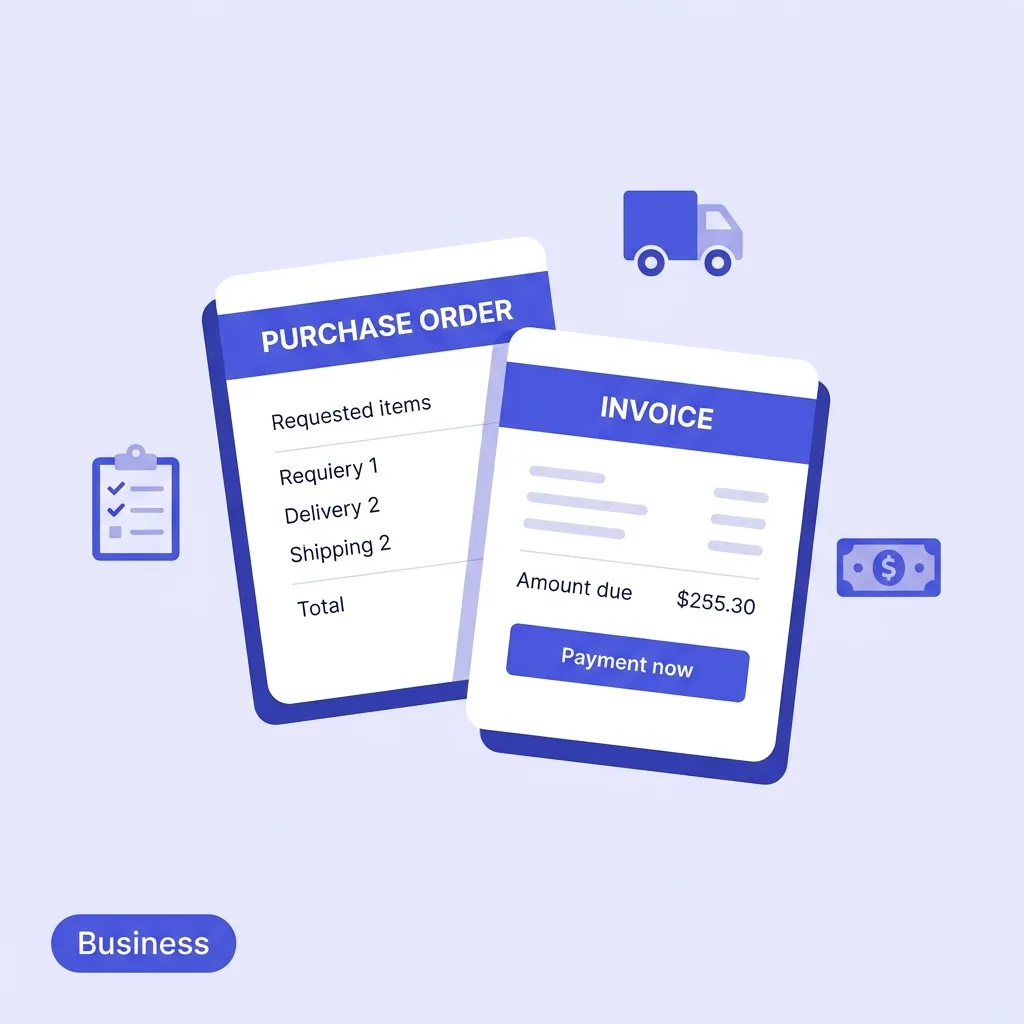
A Purchase Order (commonly referred to as a PO) is a formal, legally binding document issued by a buyer to a seller (or vendor) indicating the types, quantities, and agreed prices for products or services.
When a buyer sends a PO, they are officially committing to a purchase. It acts as an offer. Once the seller accepts the PO, it forms a legally binding contract between the two parties.
For the buyer, the PO provides a paper trail to track expenses before the money actually leaves their bank account. For the seller, the PO provides the security needed to safely begin manufacturing, picking, or shipping the requested goods.
Key Elements of a Purchase Order
A professional purchase order should always include:
The document title: "Purchase Order"
A unique PO Number (e.g., PO-2026-0042)
The Date of Issue
The Buyer's details (Billing and Shipping addresses)
The Vendor's details
A line-item list of requested goods/services with SKUs, quantities, and unit prices
The Expected Delivery Date
Agreed-upon payment terms (e.g., Net 30, Due on Receipt)
If your business needs to order supplies or inventory, you can create a compliant document instantly using our Free Purchase Order Generator.
What is an Invoice?
An invoice is a commercial document issued by a seller to a buyerafter the goods have been delivered or the services have been rendered. It serves as a formal request for payment.
While the purchase order says "I want to buy these items from you," the invoice says "I have provided these items to you; please pay me."
When an invoice is issued, it creates an "Account Receivable" for the seller and an "Account Payable" for the buyer. It is the document that actually triggers the movement of money.
Key Elements of an Invoice
An invoice must include:
The document title: "Invoice"
A unique Invoice Number
The Date of Issue and the Due Date
The Seller's and Buyer's details
A line-item list of the goods/services provided (which should exactly match the original PO)
The Total Amount Due, including applicable taxes and discounts
The Referenced PO Number (This is crucial for the buyer's accounting team)
Payment instructions and accepted methods (e.g., Bank details, Payment portal link)
If you have completed work and need to request payment, you can generate a professional bill using our Free Invoice Generator.
Purchase Order vs Invoice: The Key Differences
The easiest way to understand the purchase order vs invoice distinction is to look at them side-by-side.
Feature
Purchase Order (PO)
Invoice
Who creates it?
The Buyer
The Seller (Vendor)
Who receives it?
The Seller (Vendor)
The Buyer
When is it issued?
Before the transaction (to initiate the order).
After the transaction (to request payment).
Primary Purpose
To confirm an order and outline expectations.
To demand payment for goods/services delivered.
Accounting Impact
Creates a committed expense (Encumbrance).
Creates Accounts Payable / Accounts Receivable.
Tracking Number
PO Number
Invoice Number (plus the referenced PO Number)
How They Work Together: The Procurement Workflow
In a mature business-to-business (B2B) environment, these documents do not exist in isolation. They are part of a continuous cycle known as the "Procure-to-Pay" process.
Here is how a standard transaction flows using both documents:
1. The Buyer Issues a Purchase Order
A retail store (the buyer) needs more inventory. They draft a Purchase Order for 500 units of a specific product and send it to their manufacturer (the seller).
Tool: Purchase Order Generator
2. The Seller Accepts the PO and Fulfills the Order
The manufacturer reviews the PO, ensures they have the stock and agree to the price, and accepts the order. They pick the 500 units, pack them, and ship them to the retail store.
3. The Seller Issues an Invoice
Upon shipping the goods, the manufacturer drafts an Invoice. Crucially, they include the buyer's original PO Number on this invoice. They send the invoice to the retail store's accounts payable department.
Tool: Invoice Generator
4. The Buyer Performs "Three-Way Matching"
Before paying the invoice, the retail store's accounting team performs a standard audit called "Three-Way Matching." They compare:
The Purchase Order (What did we agree to buy and at what price?)
The Receiving Report / Packing Slip (What actually arrived at our warehouse?)
The Invoice (What is the vendor billing us for?)
If all three documents match (e.g., they ordered 500 units, 500 units arrived, and they are being billed for 500 units at the agreed price), the invoice is approved for payment.
📄
Free Invoice Generator
Create a professional, mathematically accurate invoice with your PO reference number, line items, and payment terms — ready to send in minutes.
The retail store pays the invoice according to the agreed terms. The manufacturer may then issue a final Receipt to acknowledge that the transaction is closed.
Why Small Businesses Need to Use Both
Many freelancers and very small businesses skip the purchase order phase entirely, relying instead on emails, phone calls, or verbal agreements, and jumping straight to the invoice.
While this works for minor transactions, skipping the PO introduces significant risk as your business scales:
Price Disputes: Without a PO, a vendor might invoice you at a higher rate than you verbally agreed upon. A PO locks in the price.
Quantity Errors: If you order 100 items but the vendor ships (and invoices you for) 150, a PO proves what your actual commitment was.
Budget Control: For growing companies, requiring employees to generate a PO before buying supplies ensures that management can approve expenses before the company is legally obligated to pay an invoice.
Streamline Your Financial Documents
Navigating the purchase order vs invoice workflow doesn't require expensive enterprise software. Whether you are ordering supplies or billing clients, having clean, accurate documentation protects your cash flow and your professional reputation.
What is the main difference between a PO and an invoice?
A Purchase Order (PO) is sent by the buyer to request goods. An invoice is sent by the seller to request payment for those goods.
Which comes first: the purchase order or the invoice?
The purchase order comes first. Once the seller receives the PO and delivers the goods, they then issue the invoice.
Do all invoices need a purchase order number?
While not legally required for all transactions, B2B companies almost always require the supplier to include the PO number on the invoice so the accounting department can verify the order.
Is a purchase order a legally binding contract?
Yes, once a seller formally accepts a purchase order, it becomes a legally binding contract protecting both parties.
Can an invoice amount differ from the purchase order?
Ideally, no. However, small differences can occur due to changes in shipping costs or taxes. Significant discrepancies require the buyer to approve a revised PO.
#purchase order vs invoice#purchase order vs invoice difference#what is a purchase order#what is an invoice#procurement process