Invoice vs Receipt: What's the Difference and When to Use Each
Confused about the invoice vs receipt difference? Learn exactly what each document does, when to issue them, and how to create them for your business.
BT
Bizcalc Team
·May 5, 2026
Quick Answer & Key Summary
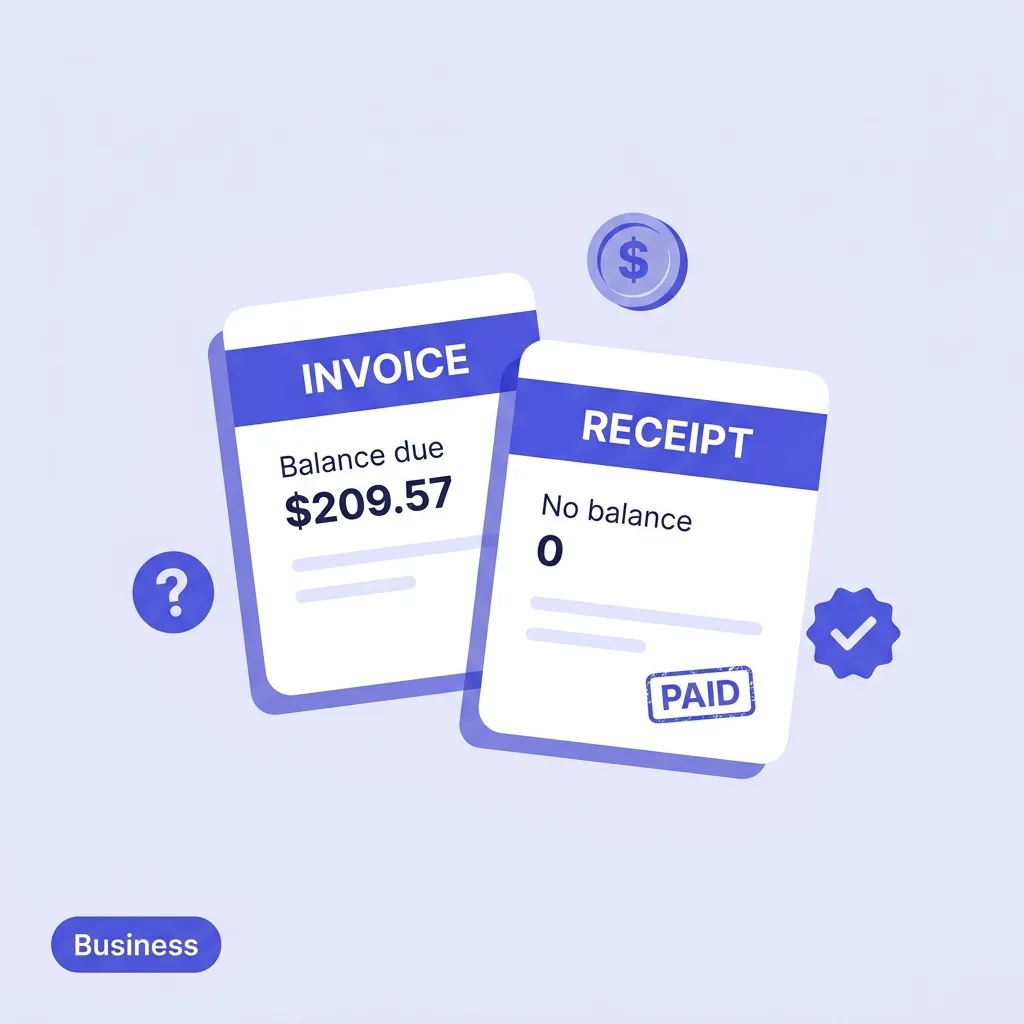
Quick Answer: An invoice is a payment demand issued before payment occurs, requesting settlement for delivered goods or services; a receipt is an acknowledgment issued after payment is completed, confirming funds were received.
• Key Formula / Standard:Invoice = Payment Request (Pending / Accounts Receivable) | Receipt = Proof of Settlement (Paid in Full) • Rule of Thumb / Benchmark: Issue an invoice immediately upon delivery of services; issue a formal receipt within 24 hours of funds clearance.
Every business transaction requires documentation, but knowing exactly which document to send—and when to send it—can be a source of confusion for new business owners and freelancers.
The most common point of confusion revolves around the invoice vs receipt difference. While both documents record details about a sale, they serve entirely different purposes, are issued at different stages of the buyer journey, and have distinct legal and accounting implications.
In this guide, we will break down exactly what an invoice is, what a receipt is, and how they fit into a standard professional workflow.
📄
Free Invoice Generator
Create a professional, itemized invoice with tax, payment terms, and due date — formatted as a PDF in minutes. No account required.
An invoice is a commercial document issued by a seller to a buyer before payment is made. It serves as a formal, itemized request for payment for goods delivered or services rendered.
When you issue an invoice, you are creating a record of a sale and simultaneously notifying the customer that they owe you money. Because the money has not yet changed hands, the invoice creates an "Account Receivable" for your business and an "Account Payable" for your client.
Key Elements of an Invoice
For an invoice to be legally compliant and effective, it generally must include:
The word "Invoice" clearly stated at the top
A unique, sequential Invoice Number
The date the invoice was issued
Your business details and the client's details
A line-item breakdown of the products or services provided
The total amount due, including any applicable taxes
Payment terms (e.g., Net 30, Due on Receipt) and instructions on how to pay
If you need to request payment from a client, you can create one in seconds using our Free Invoice Generator.
What is a Receipt?
A receipt is a formal acknowledgment issued by a seller to a buyer after payment has been successfully received. It serves as proof of purchase and confirms that the financial obligation has been settled.
Unlike an invoice, a receipt indicates that the transaction is complete. It proves ownership of the goods for the buyer, serves as documentation for expense claims or tax deductions, and provides a record of recognized revenue for the seller's bookkeeping.
Key Elements of a Receipt
A professional receipt should include:
The word "Receipt" clearly stated
A unique Receipt Number
The exact date the payment was received
Your business details
A summary of the items or services paid for
The total amount paid, including taxes
The payment method used (e.g., Credit Card ending in 1234, Bank Transfer, Cash)
A clear indication of a "Zero Balance" or "Amount Due: 0"
You can generate professional payment acknowledgments instantly using our Free Receipt Generator.
The Invoice vs Receipt Difference at a Glance
To fully understand the invoice vs receipt difference, it helps to view them side-by-side.
Feature
Invoice
Receipt
Primary Purpose
To request payment from a customer.
To prove payment has been received.
When is it issued?
Before payment (after or during fulfillment).
After payment is finalized.
Who uses it mostly?
Service providers, B2B companies, wholesalers, freelancers.
Retailers, eCommerce stores, and businesses finalizing B2B transactions.
Accounting Impact
Creates Accounts Receivable (money owed to you).
Records Actual Revenue (money in the bank).
Key Distinction
Specifies how and when the customer should pay.
Specifies how and when the customer actually paid.
Standard Workflows: When to Use Each Document
The way you use these documents depends heavily on your business model.
Scenario A: The Service Business or B2B Company
If you are a freelance designer, a consulting firm, or a wholesale distributor, your workflow involves asynchronous payments.
You provide the service or deliver the goods.
You issue an Invoice: You send a document outlining the work done and requesting payment within 30 days.
The client pays: The client wires the money or pays via credit card.
You issue a Receipt: Once the funds clear, you send a final document acknowledging the payment, providing the client with proof for their tax records.
In this model, both documents are used to create a complete, professional paper trail.
Scenario B: The Retail or Direct-to-Consumer Business
If you run a coffee shop, a hardware store, or an eCommerce website, the transaction and the payment usually happen simultaneously.
The customer purchases an item.
The customer pays immediately at the point of sale.
You issue a Receipt: You hand over a thermal printout or email a digital receipt.
In this model, an invoice is completely unnecessary because there is no delay between the purchase and the payment. Only the receipt is used.
🧾
Free Receipt Generator
Issue a professional proof of payment to your customers in seconds — downloadable as a PDF, no sign-up needed.
For complex international transactions, or orders requiring a deposit, the workflow expands.
You issue a Pro Forma Invoice: This acts as a preliminary bill of sale or quote, allowing the buyer to arrange customs clearance or financing.
The buyer pays a deposit.
You issue a Receipt for the deposit.
The goods ship.
You issue a standard Commercial Invoice for the remaining balance.
The buyer pays the balance.
You issue a final Receipt.
Does a Paid Invoice Count as a Receipt?
A common question among small business owners is whether writing "PAID" across an invoice converts it into a receipt.
Technically and legally, a document marked "Paid in Full" with the date and method of payment can function as a receipt for tax purposes. Many accounting software platforms automatically stamp invoices as "Paid" once the digital payment clears.
However, if you are managing your documents manually, issuing a distinct, separate receipt looks far more professional and reduces confusion for your client's accounts payable department.
Streamline Your Document Generation
Understanding the invoice vs receipt difference is the first step toward professionalizing your business operations. The next step is ensuring the documents you send are mathematically accurate, beautifully formatted, and legally compliant.
Stop wrestling with clunky Word documents or messy spreadsheets.
🧾
Free Receipt Generator
Formally acknowledge every payment with a professional, print-ready PDF receipt. No signup, no watermark, completely free.
What is the main difference between an invoice and a receipt?
An invoice is a request for payment sent before the customer pays. A receipt is a proof of payment provided after the customer has paid.
Can an invoice also serve as a receipt?
Yes, if an invoice is stamped or marked 'Paid in Full' with the payment date, it can legally serve as both the original bill and the proof of payment.
Who issues a receipt, the buyer or the seller?
The seller always issues the receipt to acknowledge that they have received the funds from the buyer.
Are receipts required for business expenses?
Yes, most tax authorities (like the IRS) require businesses to keep receipts for expenses over a certain amount (e.g., $75) to prove the purchase was a legitimate business expense.
When should I send an invoice instead of a receipt?
Send an invoice when you have delivered goods or services but have not yet been paid. Send a receipt immediately after the client's payment clears.
#invoice vs receipt difference#invoice vs receipt#what is an invoice#what is a receipt#business documents