Pro Forma Invoice vs Commercial Invoice: A Complete Guide
Navigate international trade with confidence. Understand the critical differences between a pro forma invoice vs commercial invoice and when to use each.
BT
Bizcalc Team
·May 5, 2026
Quick Answer & Key Summary
Quick Answer: A pro forma invoice is an advance, non-binding quote used by buyers for customs valuation and import licenses; a commercial invoice is the final legally binding demand for payment issued once goods are dispatched.
• Key Formula / Standard:Pro Forma = Pre-Shipment Estimate (Not an Accounting AR Entry) | Commercial = Final Binding Tax Invoice • Rule of Thumb / Benchmark: Never record a pro forma invoice as revenue in your general ledger; only commercial invoices trigger revenue accounting.
If you are expanding your business into international markets, sourcing products from overseas, or dealing with high-value custom manufacturing, you will inevitably encounter a unique set of financial documents.
Among the most important—and the most frequently confused—are the pro forma invoice and the commercial invoice.
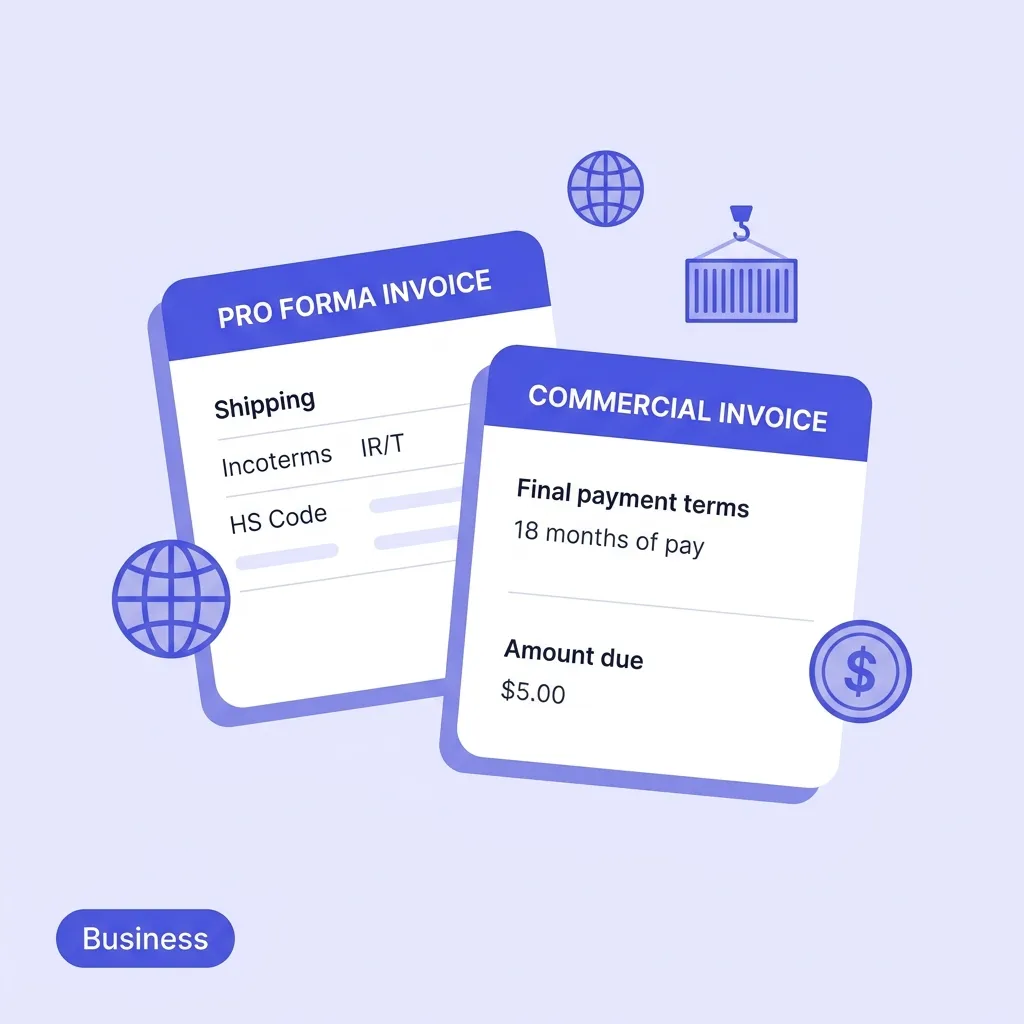
While they look nearly identical and contain much of the same information, substituting one for the other can cause massive logistical headaches. A misunderstanding of the pro forma invoice vs commercial invoice distinction can result in delayed shipments, goods seized at customs, and accounting errors.
In this guide, we break down exactly what each document is, their legal weight, and how they function together to facilitate global trade.
🌐
Free Pro Forma Invoice Generator
Generate a professional pro forma invoice for deposits, customs clearance, or advance financing — formatted as a PDF, ready in minutes, no sign-up required.
A "pro forma" invoice (Latin for "as a matter of form") is a preliminary bill of sale sent to buyers in advance of a shipment or delivery of goods.
It provides an exact, detailed estimate of the cost of the goods, shipping weights, transport charges, and delivery terms. Because it is issued before the goods are produced or shipped, the details on a pro forma invoice are subject to minor changes, though it represents a good-faith estimate of the final cost.
When is a Pro Forma Invoice Used?
To Secure Financing or Import Licenses: Buyers often use a pro forma invoice to prove to their bank or local government exactly what they intend to import and how much it will cost, which is necessary for securing Letters of Credit or import permits.
To Request a Deposit: In custom manufacturing, sellers will issue a pro forma invoice to formally request a deposit before production begins.
For Advance Customs Clearance: It provides customs officials with a clear view of the impending shipment's value, allowing the buyer to arrange for duties and taxes in advance.
Crucial Note for Accounting
A pro forma invoice is not a true invoice. It is essentially a binding quote. You should never record a pro forma invoice in your accounting software as Accounts Receivable or Accounts Payable, nor can it be used to reclaim VAT/GST.
If you need to outline costs for an international client before shipping, you can create one using our Free Pro Forma Invoice Generator.
What is a Commercial Invoice?
A commercial invoice is the final, definitive bill of sale issued by the seller to the buyer once the goods have been produced and shipped.
It serves as the true legal demand for payment. More importantly in the context of international trade, the commercial invoice is the primary document used by customs authorities worldwide to assess the true value of the imported goods and calculate the exact duties and taxes owed.
When is a Commercial Invoice Used?
To Demand Final Payment: It is the official document requesting that the buyer pay the remaining balance.
For Official Customs Clearance: When the cargo arrives at the border, customs agents inspect the commercial invoice to determine tariffs. Any discrepancies here can lead to heavy fines or seized cargo.
For Official Bookkeeping: This is the document that must be entered into your accounting system to record revenue (for the seller) or an expense (for the buyer).
To create a final bill for your completed orders, you can use our standard Free Invoice Generator.
Pro Forma Invoice vs Commercial Invoice: Key Differences
To understand the workflow, it is easiest to view the pro forma invoice vs commercial invoice differences side-by-side.
Feature
Pro Forma Invoice
Commercial Invoice
When is it issued?
Before the goods are shipped.
After the goods are shipped.
Primary Purpose
To declare the value of goods to be sold; request a deposit.
To demand payment for goods actually sold; clear customs.
Document Title
Must clearly state "Pro Forma Invoice".
Must clearly state "Commercial Invoice" or "Invoice".
Accounting Status
Not a true invoice. Do not log in Accounts Payable/Receivable.
A true invoice. Must be logged in accounting books.
Tax Reclaiming
Cannot be used to reclaim VAT or sales tax.
Used as official proof for tax reclamation.
Finality
Subject to minor changes (e.g., if shipping weight varies slightly).
Final and immutable.
The International Trade Workflow
How do these documents actually work together in the real world? Here is a standard timeline for an international transaction:
1. The Inquiry and Quote
A retail store in the US contacts a manufacturer in Italy, asking for the cost to produce and ship 1,000 leather bags.
2. The Pro Forma Invoice
The Italian manufacturer creates a Pro Forma Invoice. It details the price of the bags, the estimated shipping costs, the Incoterms (e.g., FOB, CIF), and the Harmonized System (HS) tariff codes. It also requests a 30% deposit to begin production.
3. The Buyer Takes Action
The US retailer uses the Pro Forma Invoice to apply for a Letter of Credit from their bank. Once approved, they wire the 30% deposit to the manufacturer.
4. Production and Shipping
The Italian manufacturer produces the 1,000 bags. Once they are packed and loaded onto a cargo ship, the exact shipping weight and final costs are confirmed.
5. The Commercial Invoice
The manufacturer issues the final Commercial Invoice for the remaining 70% balance. They send this document to the buyer, and crucially, a copy travels with the cargo.
📄
Free Invoice Generator
Issue a professional, legally binding commercial invoice to collect final payment after your goods have shipped — downloadable as a PDF in minutes.
When the ship arrives in the US, Customs and Border Protection reviews the Commercial Invoice, uses the HS codes and declared value to calculate the import duties, and bills the retailer.
7. Final Payment
The US retailer pays the import duties to customs, receives their goods, and pays the remaining 70% balance to the Italian manufacturer based on the Commercial Invoice.
Common Mistakes to Avoid
Paying the Wrong Document: Buyers should never pay the full balance of an order based purely on a pro forma invoice, as the final shipping costs may have changed.
Missing Incoterms: Both invoices must clearly state the Incoterms (International Commercial Terms), which dictate exactly who is responsible for the shipping costs and insurance at every leg of the journey.
Vague Descriptions: Customs officials will reject shipments if the invoice simply says "Machinery." You must be specific (e.g., "Industrial Coffee Roasting Machine, 220V") and include the correct HS Code.
Streamline Your Trade Documentation
Mastering the pro forma invoice vs commercial invoice distinction is vital for a smooth supply chain. Using the wrong document can freeze your goods at the border and scramble your accounting records.
Ensure your documentation is always professional, mathematically accurate, and clearly labeled.
🌐
Free Pro Forma Invoice Generator
Estimate costs, request deposits, and help your buyers secure financing with a professional pro forma invoice — no sign-up, instant PDF download.
A pro forma invoice is a preliminary bill sent to a buyer in advance of a shipment or delivery. It estimates the exact costs so the buyer knows what to expect.
Is a pro forma invoice a demand for payment?
No, it is an estimate or quote. However, buyers sometimes use a pro forma invoice to send a prepayment before the goods are shipped.
What is a commercial invoice?
A commercial invoice is the final, legally binding bill of sale for goods or services provided. It is used for accounting and customs declarations.
Can customs clear goods with a pro forma invoice?
Customs authorities strongly prefer or require a commercial invoice to calculate import duties. A pro forma is generally not sufficient for final customs clearance.
Does a pro forma invoice go into the accounting system?
No. Because it is an estimate and not a finalized sale, a pro forma invoice is not recorded in accounts receivable or accounts payable until the final commercial invoice is issued.
#pro forma invoice vs commercial invoice#what is a pro forma invoice#what is a commercial invoice#international trade#customs invoice