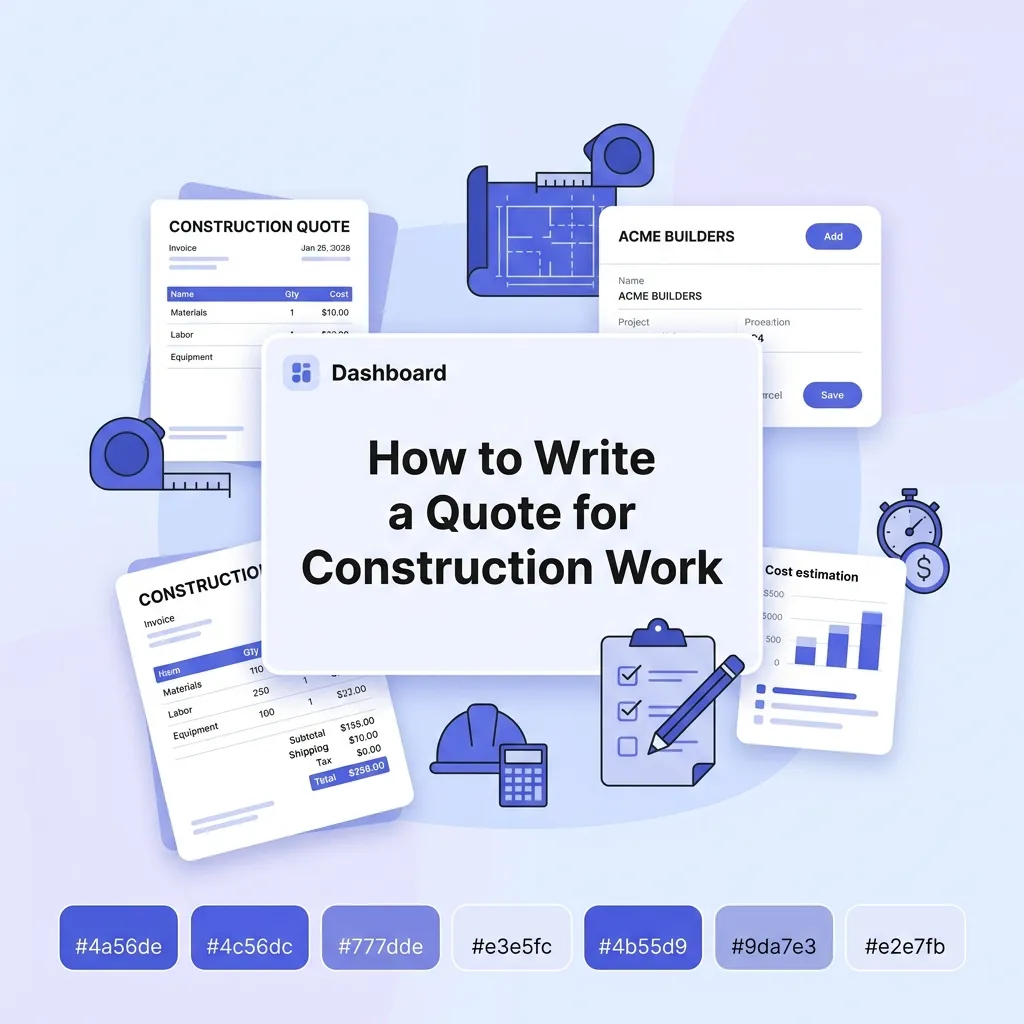
How to Write a Quote for Construction Work (With Template)
Learn how to write winning construction quotes that protect your profit margins. Master material breakdowns, labor estimates, and scope exclusions.
BT
Bizcalc Team
·May 13, 2026
Quick Answer & Key Summary
Quick Answer: A construction quote provides a detailed, legally binding cost estimate covering raw materials, subcontractor labor, permits, equipment rentals, and a contractor profit margin with explicit scope exclusions.
• Key Formula / Standard:Construction Bid = Direct Materials + Direct Labor + Subcontractors + Overhead (10–15%) + Profit (15–20%) • Rule of Thumb / Benchmark: Always include a 10%–15% contingency buffer in construction bids to protect against unforeseen site delays and material spikes.
For builders, tradespeople, and construction business owners around the world, the ability to accurately price a job is the difference between running a highly profitable enterprise and working yourself into the ground for free. Knowing exactly how to write a quote for construction work is not just an administrative task—it is the single most important sales and risk management tool your business possesses.
In the construction industry, margins are notoriously tight. A poorly written quote that omits crucial site preparation costs, underestimates labor hours, or fails to define what is excluded from the project scope can quickly turn a lucrative contract into a financial disaster. Conversely, a professional, highly detailed construction quote builds immense trust with the client, clearly defines the boundaries of the job, and legally protects your cash flow when unexpected issues arise on site.
Whether you are quoting a residential kitchen renovation, a commercial fit-out, or a large-scale civil engineering project, the principles of accurate quoting remain the same. This comprehensive guide will walk you through every step of the process, from distinguishing between estimates and quotes, to the exact anatomical structure of a winning proposal, and how to protect yourself against scope creep.
📋
Free Quote Generator for Construction
Create a detailed, itemized construction quotation with line items, tax, exclusions, and payment terms — formatted as a professional PDF, ready to send to the client.
The Difference Between an Estimate and a Quote in Construction
Before detailing how to write a quote for construction work, we must clarify a fundamental industry distinction that causes endless disputes: the difference between an estimate and a quote. While clients often use the terms interchangeably, legally and operationally, they are vastly different documents.
What is a Construction Estimate?
An estimate is an educated guess. It is a non-binding approximation of what a job might cost based on preliminary information, historical data, or an initial walkthrough. Estimates are typically used in the early stages of a project when architectural drawings are not yet finalized, or the exact scope of work is still fluid. Because it is non-binding, the final invoice can legally be higher or lower than the estimate.
What is a Construction Quote?
A quote (or quotation) is a legally binding offer to execute a specific scope of work for an exact, fixed price. When a client accepts your quote, you are legally obligated to complete the agreed-upon work for that exact amount, regardless of whether your material costs suddenly rise or your team takes three days longer than anticipated. This is why knowing how to quote a building job accurately is so critical—you own the risk.
Never write "Quote" on a document if you are not 100% certain of the costs, and never write "Estimate" if the client expects a fixed-price contract.
The Anatomy of a Winning Construction Quote
A professional construction quotation format leaves no room for ambiguity. A client should be able to read the document and understand exactly what they are paying for, what materials will be used, and when the work will occur. Every professional building quote must contain the following core elements.
1. Header and Business Details
Your quote must clearly identify who is making the offer. The document should be clearly titled "QUOTATION" to avoid any legal ambiguity. Include:
Your company logo and full registered business name.
Your physical business address, phone number, and email.
Your building license number or trade registration number (mandatory in many jurisdictions to prove you are legally permitted to undertake the work).
Your Tax Identification Number (VAT, GST, or EIN).
2. Client and Site Details
Clearly state who you are quoting and where the work will take place. This is especially important for landlords or property developers where the billing address is different from the site address.
The client's full name and contact details.
The exact site address where the construction work will be performed.
3. Quote Number and Dates
Quote Number: A unique, sequential reference number (e.g., QUT-2026-104) for easy tracking in your accounting software.
Issue Date: The date the document was sent.
Validity Period: Construction material prices fluctuate rapidly (especially timber, steel, and copper). You must include an expiry date, such as "This quote is valid for 30 days from the date of issue." If the client accepts on day 45, you reserve the right to re-price the materials.
4. The Scope of Work (The Most Critical Section)
This is where you explain exactly what you are going to do. Do not write a single vague line like "Bathroom Renovation." If a dispute goes to court or arbitration, the judge will look directly at this section. Break the project down into logical phases or areas:
Demolition: Strip out existing tiles, remove vanity and bathtub, cap plumbing lines.
Preparation: Install new waterproof membrane to walls and floor, level flooring.
Installation: Install client-supplied bathtub, fit custom double-vanity, tile floor to ceiling using 600x600mm porcelain tiles.
Finishing: Grout, silicone all joints, paint ceiling with anti-mold wet-area paint.
5. Itemized Breakdown of Costs
While some builders prefer to provide a single lump-sum figure, an itemized breakdown builds trust. You do not need to show the client your exact profit margins, but breaking down the quote into major cost centers helps the client understand the value. Common breakdowns include:
Equipment hire (Scaffolding, excavators, skips/dumpsters)
Subcontractor fees
6. The Exclusions (What You Are NOT Doing)
Knowing how to write a quote for construction work involves detailing what is not included just as heavily as what is included. If you are renovating a kitchen but the client is responsible for buying their own appliances, state: "Exclusions: Purchase of oven, cooktop, and dishwasher. Electrical upgrade to main switchboard if required by current regulations." Exclusions protect you from clients assuming you will handle related but unpriced tasks.
7. Payment Terms and Schedule
Construction is cash-flow intensive. You must outline exactly when you expect to be paid to avoid funding the client's build out of your own pocket. A standard progress payment schedule might look like:
10% Deposit upon acceptance to secure scheduling.
30% Upon completion of demolition and rough-in.
40% Upon installation of major fixtures/lock-up stage.
20% Final payment upon practical completion and handover.
Step-by-Step Guide: How to Write a Quote for Construction Work
Now that you understand the structure, here is the proven workflow for estimating construction jobs accurately.
Step 1: Conduct a Thorough Site Visit
Never quote a complex job off a set of photographs or a quick phone call. You must physically inspect the site to look for hidden complexities. Is access difficult? Will you have to carry materials up three flights of stairs? Is the ground rocky, requiring heavier excavation equipment? Site conditions drastically impact labor hours.
Step 2: Analyze Drawings and Specifications
If the client has architectural drawings or engineering plans, read every single page, including the fine print and specification schedules. If the architect has specified a rare, imported Spanish tile, you cannot price standard ceramic tiles. Your quote must align perfectly with the supplied specifications.
Step 3: Perform a Material Takeoff
A material takeoff is the process of listing every single physical item required to build the project. Count the doors, measure the linear meters of skirting boards, calculate the cubic meters of concrete, and quantify the framing timber. Once you have the quantities, apply a waste factor. Materials get damaged, cut wrong, or dropped. Always add a 10% to 15% waste margin to your material quantities to ensure you don't end up paying for the shortfall.
Step 4: Estimate Labor Hours
This is where most tradespeople lose money. Estimating labor requires deep experience. You must calculate not just the time it takes to swing a hammer, but the time it takes to drive to the supplier, unload the truck, set up the tools, take mandatory safety breaks, and clean the site at the end of the day. If a task takes 4 hours of pure work, quote 6 hours of labor to account for site logistics.
Step 5: Factor in Equipment and Subcontractors
Will you need to hire scaffolding, a scissor lift, or temporary fencing? Quote the exact hire rates. Furthermore, if you are acting as the main contractor, you must gather firm, written quotes from your subcontractors (plumbers, electricians, roofers) before you finalize your own quote to the client.
Step 6: Apply Overhead and Profit (Markup)
Once you have your total direct costs (Materials + Labor + Equipment + Subs), you must add your markup. Your markup must cover your Overhead (business insurance, vehicle leases, office rent, software, admin staff) and your Net Profit (the actual money the business retains).
Many builders use a standard 20% markup, but this is dangerous. You should use a Markup Calculator to determine exactly what percentage is required to cover your specific overhead and hit your target profit margin. For highly complex or risky jobs, your markup should be significantly higher to offset the risk.
🏷️
Markup Calculator
Calculate the exact markup percentage you need to cover overhead and hit your target profit margin — essential before finalizing any construction quote.
One of the most common mistakes in quoting for trades is relying on "square meter" or "square foot" rule-of-thumb pricing (e.g., quoting $2,500 per square meter for a residential extension).
While square-area pricing is useful for early-stage estimates, it is entirely inappropriate for fixed-price quotes. A 10-square-meter luxury bathroom with underfloor heating, custom stonework, and imported brass fittings will cost triple the amount of a 10-square-meter basic laundry room. Always price a job from the bottom up—quantifying every raw material and every labor hour—rather than relying on arbitrary industry averages.
The Importance of Documenting Exclusions and Variations
In construction, "scope creep" is the silent killer of profitability. Scope creep happens when a client asks for "just one more small thing" while you are on site.
"While you have the tools out, can you just move that power point over a bit?""Actually, can we change the paint color? We don't like this shade of white."
If you accommodate these requests without adjusting the price, your profit margin evaporates. Your quote must include a clear Variations Clause (also known as a Change Order policy). This clause should state:
"Any alterations or deviations from the above scope of work will be executed only upon written order, and will become an extra charge over and above the quote."
When the client asks for a change, you immediately issue a Variation Order, state the additional cost, have them sign it, and then perform the work. A well-written quote sets this boundary from day one.
Common Mistakes When Quoting Construction Jobs
Even experienced builders fall into quoting traps. Here are the most critical errors to avoid:
Forgetting site setup and cleanup costs: Mobilizing to a site, erecting safety signage, laying floor protection, and hiring commercial skips/dumpsters costs significant money and time. These are direct project costs that must be quoted.
Ignoring inflation on long-term projects: If you are quoting a massive commercial build that will take 18 months, the price of steel and concrete will likely rise before you finish. Include an escalation clause that allows you to adjust material prices if the manufacturer's costs increase by more than a certain percentage.
Optimism bias in labor: Tradespeople naturally assume everything will go perfectly. It never does. Always quote labor based on average, realistic site conditions, not the theoretical "best-case scenario" where every supplier delivers on time and it never rains.
How to Present Your Quote to the Client
Speed and presentation win jobs. If a client meets with three contractors, the one who delivers a professional, detailed, branded PDF quote within 48 hours is vastly more likely to win the job than the contractor who texts a single lump-sum figure a week later.
When you present your quote, format it cleanly. Use clear typography, break up massive blocks of text with bullet points, and ensure the final price is bold and easy to find. Send the quote via email with a professional cover note, and follow up with a phone call two days later to ask if they have any questions regarding the scope of work or the material selections.
Using a Construction Quote Template
Writing a highly detailed quote from scratch in Microsoft Word or Excel for every single job is incredibly inefficient and opens the door for mathematical errors (like a spreadsheet formula failing to capture a line item).
To streamline your bidding process and ensure mathematical accuracy, you should use an automated system. At Bizcalc Tools, we provide a Free Quote Generator designed to help tradespeople and builders create professional, itemized, mathematically flawless quotes in minutes. You simply input your line items, apply any relevant taxes, add your terms and conditions, and generate a pristine PDF ready to send to the client.
Construction Quote Cost Breakdown & Contingency Matrix
Project Cost Component
Standard % of Total Bid
Contingency Buffer
Markup Range
Payment Milestone Trigger
Direct Materials & Supplies
35% – 45% of total bid
10% – 15% for price volatility
15% – 25%
30% upfront deposit on contract signing
Direct Subcontractor Labor
30% – 40% of total bid
5% – 10% for schedule delays
20% – 35%
30% upon framing / rough-in completion
Site Prep & Equipment Rental
8% – 12% of total bid
5% buffer
15% – 20%
25% upon drywall / pre-finishing
Contractor Overhead & Profit
15% – 25% of total bid
N/A (Net business margin)
Built into bid
Final 15% balance upon walkthrough punch-list signoff
Final Thoughts on Bidding Construction Work
Learning how to write a quote for construction work takes time, patience, and a deep understanding of your own operational costs. The goal of quoting is not to be the cheapest contractor in town. The goal is to be the most transparent, reliable, and professional option.
When you provide a client with a meticulously detailed building quote example—one that outlines every step of the process, defines the exclusions, and establishes clear payment terms—you justify your pricing. You position yourself as a low-risk professional, and clients are almost always willing to pay a premium for peace of mind. Take the time to build a robust quoting workflow, utilize proper quoting tools, and watch your win rate—and your profit margins—climb.
📋
Free Quote Generator
Create professional, itemized construction quotes with automatic calculations and a clean PDF layout. Win more jobs with less admin.
A construction quote is a formal document detailing the fixed price a contractor will charge to complete a specific building or renovation project.
How is a quote different from a construction estimate?
An estimate is a rough guess of the final cost, subject to change. A quote is a fixed, binding price that the contractor commits to, provided the scope of work remains unchanged.
What should be included in a construction quote?
It must include a detailed breakdown of labor, materials, equipment costs, permit fees, a project timeline, payment schedules, and an expiration date for the quote.
Why do construction quotes need an expiration date?
Material costs (like lumber and steel) fluctuate constantly. An expiration date (typically 14-30 days) protects the contractor from losing money if material prices spike before the client accepts.
What are typical payment terms in construction?
Most construction quotes outline a progress payment schedule: a deposit upfront to cover initial materials, intermediate payments as milestones are met, and a final payment upon completion.
#how to write a quote for construction work#construction quote template#estimating construction jobs#building quote example#quoting for trades