How to Price Your Services: A Guide for Freelancers and Consultants
Master freelance service pricing with proven formulas. Compare hourly, project, and value-based pricing models to maximize profitability confidently.
BT
Bizcalc Team
·May 13, 2026
Quick Answer & Key Summary
Quick Answer: Pricing freelance services requires choosing between hourly rates, fixed project fees, and value-based pricing, calculating rates that reflect market positioning and business overhead rather than just salary.
• Key Formula / Standard:Value-Based Fee = Client Economic Value Created × Value Capture % (typically 10%–20%) • Rule of Thumb / Benchmark: Transition from hourly billing to fixed project pricing once your efficiency allows you to complete work in fewer hours.
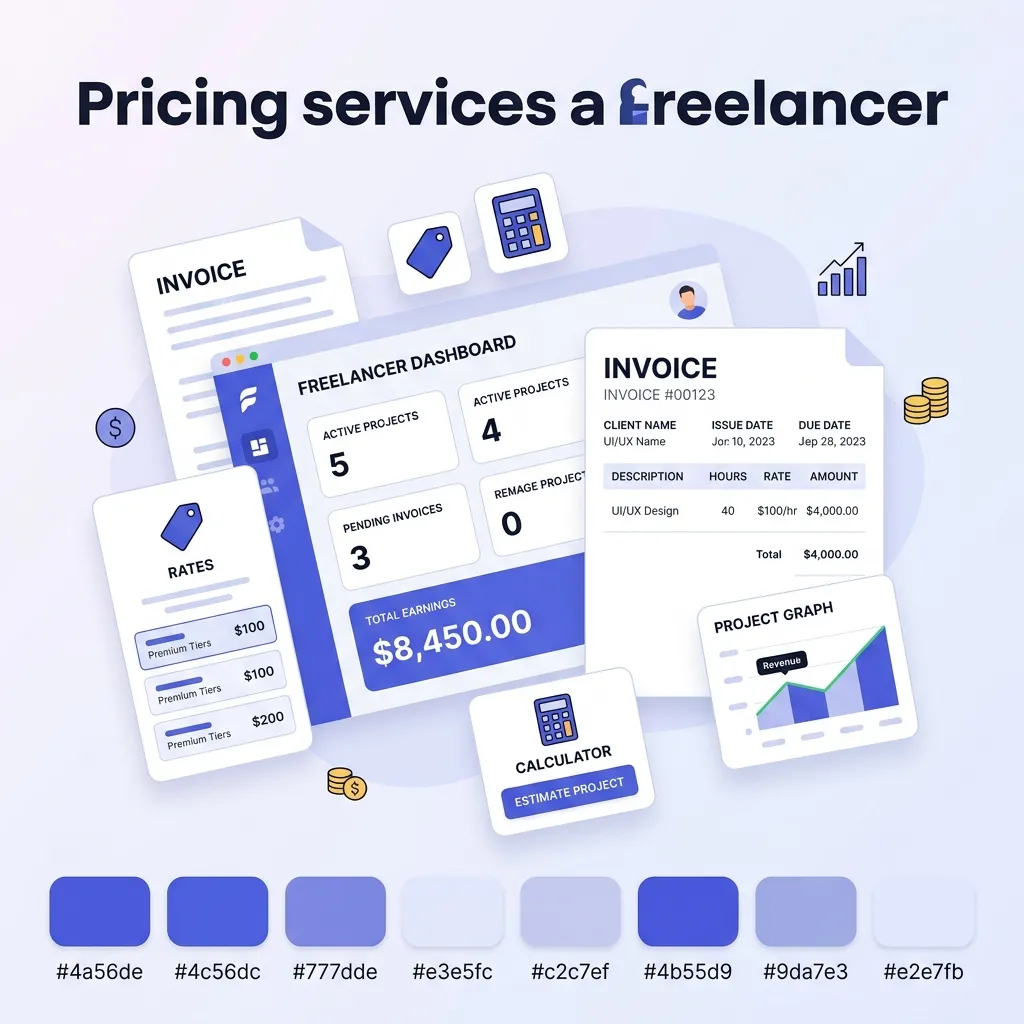
If you ask a group of independent professionals what the most stressful part of their business is, the answer is almost never the actual client work. It is the moment right before they hit "send" on a proposal. Knowing how to price your services as a freelancer or consultant is a constant source of anxiety.
If you price too high, you fear losing the project to a cheaper competitor. If you price too low, you end up resenting the client, burning out, and destroying your own profit margins. Worse, pricing too low often signals to high-end clients that your work is of low quality.
Pricing is not just a math equation; it is a marketing strategy and a reflection of your business positioning. Whether you are a freelance software developer, an independent management consultant, or a graphic designer, your pricing model dictates the type of clients you attract and the ultimate scalability of your business.
This comprehensive guide will walk you through exactly how to price your services. We will break down how to calculate your absolute baseline, compare the four major freelance pricing strategies (hourly, project-based, retainer, and value-based), and provide actionable scripts for dealing with price pushback and raising your rates.
⏰
Hourly to Salary Calculator
Reverse-engineer your ideal hourly rate from your target income, taxes, and business expenses. Find your exact baseline before you send your next proposal.
Step 1: Calculate Your Minimum Baseline (The Floor)
Before you can implement advanced pricing strategies, you must establish your absolute baseline. This is the minimum hourly rate you need to charge simply to keep the lights on and pay yourself a livable wage.
Many new freelancers make a fatal mathematical error: they take the salary they want to make, divide it by 2,080 (the standard number of working hours in a year), and set that as their hourly rate.
For example: You want to make $100,000 a year. $100,000 ÷ 2,080 hours = $48 per hour.
This formula guarantees you will go out of business. Why? Because as a freelancer, you do not have 2,080 billable hours, and you have massive overhead that an employee does not pay.
The Real Math for Freelancers
To calculate a realistic baseline, you must account for:
Unbillable Time: You will spend at least 30% to 40% of your time marketing, sending proposals, doing bookkeeping, and answering emails. If you work 40 hours a week, only 24 of those hours are actually billable to a client.
Self-Employment Taxes: In most countries, self-employed individuals pay double the payroll taxes of an employee (e.g., the Self-Employment Tax in the US).
Business Overhead: Software subscriptions, laptop depreciation, legal fees, accounting fees, website hosting, and marketing costs.
Benefits & Time Off: You no longer get paid sick days, paid vacation, or employer-sponsored health insurance. You must build these costs into your rate.
The Proper Calculation:
Take your target salary, add 30% for taxes, add your estimated yearly business overhead, and add the cost of your health insurance and retirement contributions.
Let's say that total is $150,000.
Now, divide that by your billable hours (e.g., 24 hours a week × 48 weeks a year = 1,152 billable hours).
$150,000 ÷ 1,152 = $130 per hour.
That $130/hr is your absolute floor. You cannot take a project that nets out to less than this, or you are effectively taking a pay cut. Use our Hourly to Salary Calculator to help reverse-engineer these numbers.
💰
Markup Calculator
Ensure your project quotes are hitting your target profit margins. Convert between cost and price to protect your earnings on every engagement.
Hourly pricing is the most common model for beginners. You trade time for money directly.
The Pros of Hourly Pricing
Protection against scope creep: If the client wants endless revisions, you simply bill them for the extra hours. You are never working for free.
Easy to explain: Clients understand the concept of an hourly rate natively.
Best for undefined scope: If a client hires you for "ongoing server maintenance" where the exact workload is impossible to predict, hourly billing is the safest approach.
The Cons of Hourly Pricing
It penalizes efficiency: If you spend two years mastering a software tool so you can do a job in 2 hours instead of 10, your client gets the same result 5 times faster, but you get paid 80% less.
It creates an adversarial relationship: The client wants you to work as fast as possible to save money; you want to work as long as possible to make money. This fundamental misalignment causes friction.
An income ceiling: You only have 24 hours in a day. Your revenue is strictly capped by your physical limits.
Project-based pricing involves quoting a single, fixed fee for a specific deliverable (e.g., "I will build a 5-page WordPress website for $5,000").
To calculate a flat rate, you internally estimate the number of hours the project will take, multiply it by your target hourly rate, and then add a 20% to 30% "buffer" for unexpected delays.
The Pros of Project-Based Pricing
Rewards efficiency: If you quote $5,000 for a project you estimated would take 40 hours, but you finish it in 20 hours because of your expertise, your effective hourly rate just doubled. The client doesn't care; they got the result they paid for.
Client peace of mind: Corporate budgets require certainty. A client prefers to get a PO approved for exactly $5,000 rather than signing an open-ended hourly contract.
The Cons of Project-Based Pricing
Scope creep destroys profit: If you do not explicitly define the boundaries of the project, the client will ask for "just one more tiny change." If you haven't built a strict revision clause into your contract, your effective hourly rate will plummet below minimum wage.
Estimation risk: If you misjudge how complex a project is, you eat the cost.
Pricing Strategy 3: Value-Based Pricing (The Gold Standard)
Learning how to price your services as a freelancer reaches its peak with value-based pricing. This is how top-tier independent consultants and elite freelancers charge.
Instead of pricing based on your costs or your time, you price based on the financial value the project creates for the client.
How Value-Based Pricing Works
Imagine a B2B SaaS company asks you to rewrite the sales copy on their main landing page.
The Hourly Freelancer looks at the job, realizes it will take 10 hours, and quotes $1,000 ($100/hr).
The Value-Based Consultant asks the client during the discovery phase: "How much traffic does this page get? What is your current conversion rate? What is the lifetime value of a customer?"
The consultant discovers the page gets 100,000 visitors a month, converts at 1%, and a customer is worth $500. The page generates $500,000 a month. If the new copy increases the conversion rate by just a quarter of a percent (from 1% to 1.25%), the company will make an additional $1.5 million over the next year.
The consultant quotes $50,000 for the project. To the client, paying $50,000 to generate $1.5 million is a phenomenal return on investment (ROI). It does not matter if it takes the consultant 10 hours or 100 hours to write the copy.
Flat-Rate vs. Value-Based Pricing Comparison
Feature
Flat-Rate Pricing
Value-Based Pricing
Focus of the Proposal
Your time and the physical deliverables.
The client's business outcomes and ROI.
Client's Perception
You are an expense to be minimized.
You are an investment to be maximized.
Information Required
A detailed list of tasks to be completed.
Deep understanding of the client's financial metrics.
Profit Potential
Capped by market rates for your specific skill.
Virtually unlimited; scales with the client's size.
Best Used For
Execution-level tasks (e.g., coding a PSD to HTML).
Value-based pricing requires massive confidence and elite sales skills. You cannot use it for basic commodity tasks, but if your work directly impacts a company's revenue or costs, it is the only way to scale your income.
Pricing Strategy 4: Retainer Agreements
A retainer is a recurring fee paid in advance (usually monthly) to secure your ongoing services or availability. Retainers are the holy grail of freelance cash flow because they eliminate the "feast or famine" cycle of project work.
Types of Retainers
Pay for Output (The Subscription): The client pays $3,000 a month for exactly 4 blog posts and 10 social media graphics. If they don't use it, they lose it. This is highly predictable for both sides.
Pay for Access (The Advisory Retainer): Common for senior consultants. The client pays $5,000 a month simply to have you on speed dial for strategy questions, reviewing documents, or joining executive board calls. You are selling your brain, not your hands.
How to Deal with Price Pushback
No matter how well you price your services, you will eventually hear: "That is a lot more than we budgeted. Can you do it for less?"
Amateur freelancers immediately drop their price by 20% to win the job. This is a massive mistake. It tells the client that your original price was inflated and that your pricing is entirely arbitrary.
Strategy 1: Reduce the Scope, Not the Rate
If a client cannot afford your $10,000 proposal, never give them the same work for $8,000. Instead, say:
"I understand you have a strict budget of $8,000. To accommodate that, we can remove the competitor analysis phase and limit the revisions to one round instead of three. Let me know if you’d like me to draft a revised proposal reflecting that reduced scope."
This holds your value firm while working within their financial constraints.
Strategy 2: The Good / Better / Best Model
Never send a proposal with a single, "take it or leave it" price. Always provide three tiered options.
Tier 1 (The Baseline): Exactly what they asked for, executed perfectly. ($5,000)
Tier 2 (The Recommended): What they asked for, plus a highly valuable strategic add-on. ($8,500)
Tier 3 (The Premium): A comprehensive "done-for-you" package that solves their problem completely with white-glove service. ($15,000)
Psychologically, offering tiers shifts the client's mindset from "Should I hire this freelancer?" to "Which level of this freelancer should I hire?" Furthermore, the existence of the $15,000 tier makes the $8,500 tier look entirely reasonable via price anchoring.
When and How to Raise Your Freelance Rates
If you are closing 90% of the proposals you send out, you are leaving money on the table. A healthy close rate is around 50% to 60%. If everyone is saying yes, your prices are too low.
The 80% Capacity Rule
A simple benchmark for raising rates: When you are consistently booked at 80% capacity for 6 weeks out, raise your rates by 15% to 20% for all new clients. Continue doing this until your pipeline stabilizes.
Raising Rates on Existing Clients
Raising rates on a loyal, long-term client is terrifying, but it is necessary to prevent inflation from eroding your margins. Never apologize for raising your rates, and give plenty of notice.
Email Template for Raising Rates:
Subject: Update regarding my consulting rates for 2027
Hi [Client Name],
It has been fantastic working with your team over the past year, and I'm incredibly proud of the results we achieved on [Project Name].
I am writing to let you know that as of January 1st, my standard rate will be increasing from $100/hr to $125/hr.
Because I deeply value our ongoing partnership, I want to offer you the opportunity to lock in my current rate by pre-purchasing a block of hours before December 15th. Alternatively, any new contracts signed after January 1st will reflect the new rate.
Please let me know if you would like to discuss setting up a pre-paid block. I look forward to continuing our work together!
Best regards,
[Your Name]
Pricing Checklist for Your Next Proposal
Before you hit send on your next quote, run through this checklist to ensure you are protecting your profit margin:
Does this price clear my absolute minimum hourly baseline?
Have I factored in a 20% buffer for unexpected delays and revisions?
Is the Scope of Work strictly defined to prevent scope creep?
Have I clearly listed what is excluded from this price?
Did I provide 3 tiered options (Good/Better/Best) to anchor the price?
Did I ask enough discovery questions to understand the ROI the client expects?
Are my payment terms (deposits and milestones) clearly stated?
Final Thoughts on Pricing Your Services
Mastering how to price your services as a freelancer is an ongoing journey of testing, failing, and iterating. As your portfolio grows and your expertise deepens, your prices must scale to reflect the reduced risk and increased speed you offer clients.
Stop pricing based on what you think a client is willing to pay or what your competitors are charging. Start pricing based on the financial value you generate and the specialized expertise you bring to the table. When you transition from being an hourly expense to being a strategic investment, your entire freelance business changes.
⏰
Hourly to Salary Calculator
Ready to run the math on your baseline? Find your minimum hourly rate based on your target income and business costs — no guesswork.
There is no single 'best' model. Hourly billing is great for consulting, project-based pricing is ideal for clear deliverables, and retainer pricing provides stable income for ongoing work.
How do I calculate my minimum hourly rate?
Add your desired salary, business expenses, and taxes. Divide that total by the number of billable hours you plan to work in a year (usually around 1,000 hours, accounting for admin and time off).
What is value-based pricing?
Value-based pricing charges the client based on the financial value the project brings them, rather than the time it takes you to complete it. It often results in higher margins.
Should I list my prices on my website?
Listing starting prices or packages filters out low-budget leads and saves time. However, complex services often require custom quotes, making public pricing difficult.
How do I tell existing clients I'm raising my prices?
Give them plenty of notice (e.g., 30-60 days), focus on the increased value you now provide, and optionally offer them a grace period before the new rates apply.
#how to price your services as a freelancer#freelance pricing strategies#consulting fees#value-based pricing#hourly vs flat rate#raising freelance rates