How Consultants Should Invoice Their Clients: The Complete Guide
Master consultant invoicing to get paid faster. Learn how to structure retainers, hourly rates, project milestones, and corporate payment terms.
BT
Bizcalc Team
·May 13, 2026
Quick Answer & Key Summary
Quick Answer: Invoicing as a consultant requires structuring fee agreements—hourly billing with timesheets, fixed monthly retainers, or milestone deliverables—while complying with corporate accounts payable (AP) vendor requirements.
• Key Formula / Standard:Invoice Total = (Billable Consulting Hours × Hourly Rate) + Pre-Approved Expenses (e.g. Travel, Software) • Rule of Thumb / Benchmark: Bill monthly retainers on the 1st of each month in advance to maintain consistent positive operating cash flow.
As an independent consultant, your expertise is your product. Whether you are advising a Fortune 500 company on a multi-million dollar digital transformation or helping a local startup streamline their HR operations, you are hired for your specialized knowledge. However, delivering incredible strategic value is only half the job. The other half is ensuring you actually get paid for it.
Learning exactly how to invoice as a consultant is a fundamental business skill that directly impacts your cash flow, your professional reputation, and your ability to scale.
Consulting invoices are uniquely challenging. Unlike selling a physical product where the exchange of value is obvious, consulting services are intangible. If your invoice simply says "Consulting Services - $15,000," you are inviting scrutiny from your client's accounts payable (AP) department. Furthermore, corporate clients have strict procurement rules, requiring purchase order (PO) numbers, specific tax identifiers, and detailed expense breakdowns.
This comprehensive guide is designed for independent consultants worldwide. We will break down exactly what needs to be on your invoice, how to itemize different pricing models (hourly, project-based, and retainers), and how to navigate international taxes and late payments.
📤
Free Invoice Generator
Create AP-compliant consulting invoices with itemized line items, PO reference fields, and instant PDF download. No account required.
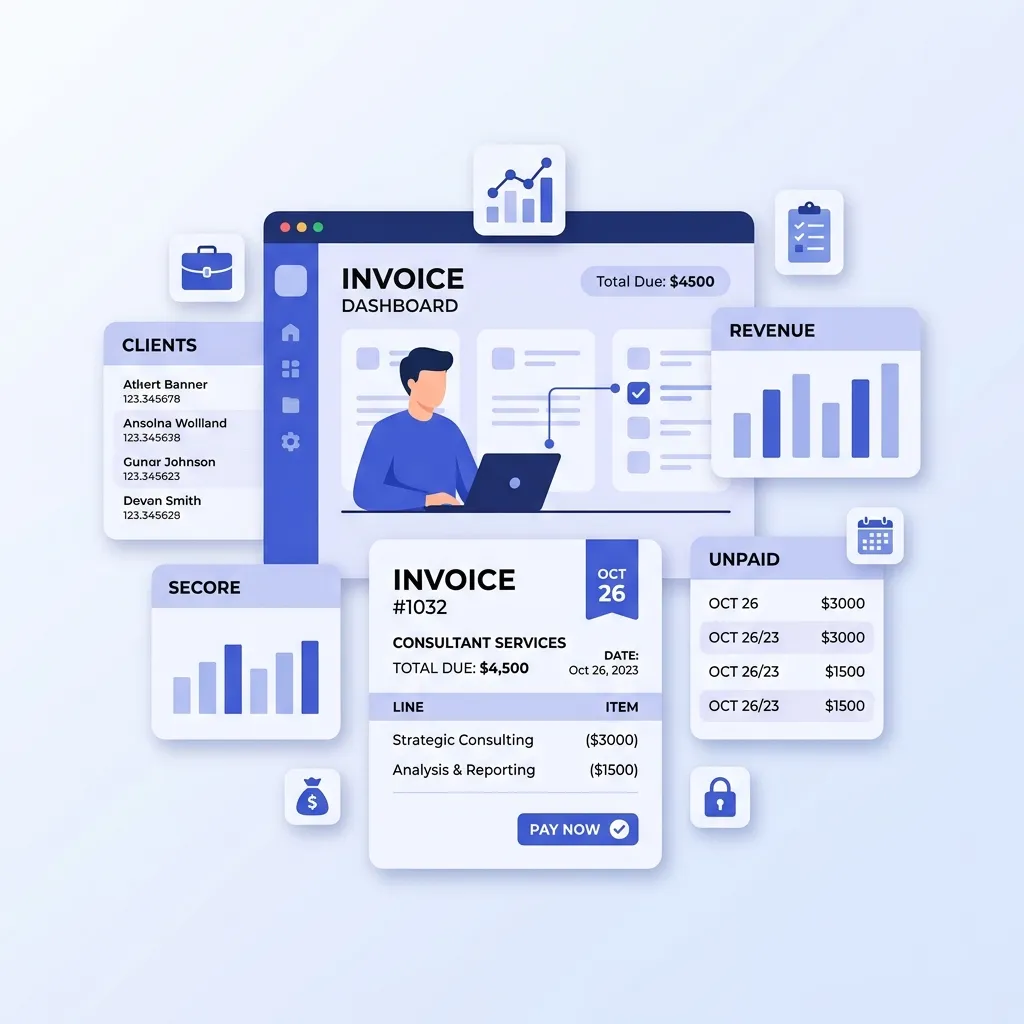
A professional invoice leaves absolutely no room for interpretation. When a corporate AP clerk looks at your document, they should immediately understand who you are, what you did, who authorized it, and how to pay you. Every consulting invoice must contain the following core elements:
1. Professional Header and Branding
Your invoice is an extension of your consulting brand. It should look clean, minimalist, and highly professional.
The word INVOICE should be the most prominent text on the page.
Your business logo (if you have one).
Your full legal name or registered corporate entity name (e.g., "Jane Doe Consulting LLC").
Your registered business address and contact information.
2. Client Details and the "Attention" Line
Corporate structures are complex. If you address an invoice simply to "Acme Corp," it will get lost in their mailroom.
List the exact legal name of the client's business.
List the client's official billing address (which is often different from their physical headquarters).
Crucial: Include an "Attention To" line with the name of the executive who hired you (e.g., "Attn: Sarah Jenkins, Chief Marketing Officer"). This ensures the AP department knows exactly whose budget this is coming out of.
3. Tracking Numbers and Dates
Invoice Number: Every invoice must have a unique, sequential number (e.g., INV-2026-089). Never duplicate invoice numbers, as this will trigger fraud alerts in corporate accounting systems.
Issue Date: The date the invoice is generated and sent.
Due Date: The exact calendar date the payment is required. Do not make the client calculate "Net 30" in their head; explicitly state "Due Date: October 15, 2026."
4. The Purchase Order (PO) Number
If you are consulting for a mid-market or enterprise company, this is the most important field on the document. Before you start any work, the client's procurement team should issue you a Purchase Order. If your invoice does not reference this PO Number, their system will automatically reject it. Always ask your client contact: "Do I need a PO number for this engagement before I submit my invoice?"
5. Detailed Line Items
This is where consultants frequently make mistakes. Your line items must explicitly detail the value delivered. We will cover exactly how to write these descriptions based on your pricing model in the next section.
6. Expense Itemization
If your consulting agreement allows you to bill for out-of-pocket expenses (like flights, hotels, or specialized software licenses), these must be listed as separate line items at the bottom of the invoice. You must also append copies of the receipts to the invoice PDF. Do not bury a $500 hotel room inside your "Consulting Fee" line item.
7. Explicit Payment Instructions
Corporate clients rarely pay via credit card; they pay via bank transfer (ACH, wire, or SWIFT/SEPA). Provide your complete banking details:
Bank Name and Account Holder Name.
Account Number and Routing Number (or Sort Code/BSB).
For international payments: IBAN and SWIFT/BIC codes.
How to Itemize Based on Your Pricing Model
The way you write your line items depends entirely on how you structure your consulting fees. A vague invoice leads to disputes. Here is how to structure your line items for the three main consulting pricing models.
1. The Hourly / Time-and-Materials Model
If you bill by the hour, the client will want to know exactly what you did during those hours. Providing a vague "40 hours @ $150/hr" is guaranteed to result in a phone call asking for a timesheet.
❌ Bad Example:
Strategic Consulting (40 hours) — $6,000
✅ Good Example:
Executive Stakeholder Interviews: Conducted 1-on-1 interviews with the CEO, CFO, and VP of Sales regarding Q3 strategy. (10 hours @ $150/hr) — $1,500
Market Research Analysis: Compiled competitor pricing matrix and churn data. (20 hours @ $150/hr) — $3,000
Strategy Deck Preparation: Drafted final Q3 pivot presentation for the board. (10 hours @ $150/hr) — $1,500
2. The Project-Based / Value-Based Model
If you are charging a flat fee for a specific outcome, you do not need to list your hours. Instead, tie the invoice to specific milestones outlined in your Statement of Work (SOW).
❌ Bad Example:
Website Audit Project — $10,000
✅ Good Example:
Technical SEO Audit (Milestone 1 of 3): Delivery of comprehensive 50-page site architecture analysis, including backlink profile review and mobile-usability scoring. As per SOW section 2.1. — $10,000
3. The Retainer Model
Retainers are fixed monthly fees paid in advance to guarantee your availability. Retainer invoices should be sent on the same day every month and should clearly define the period of time they cover.
✅ Good Example:
Monthly Advisory Retainer (November 2026): Includes up to 4 weekly strategy calls, unlimited email support for the executive team, and ad-hoc crisis management. — $5,000
Navigating International Taxes and Compliance
In the era of remote work, an independent consultant based in London can easily advise a tech startup in San Francisco or a manufacturing firm in Sydney. However, cross-border invoicing introduces strict tax and compliance rules.
Understanding VAT and GST
If you are based in a country with a Value Added Tax (VAT) or Goods and Services Tax (GST), you must understand the "Place of Supply" rules.
Domestic Clients: If you and your client are in the same country, you must charge VAT/GST if your total revenue exceeds the government threshold (e.g., £90,000 in the UK, $75,000 in Australia). Your invoice must include your tax registration number and be clearly labeled as a "Tax Invoice."
International B2B Clients: Generally, if you are exporting B2B consulting services to a client in another country, the service is considered to be "supplied" where the client belongs. Therefore, you do not charge your local VAT/GST. Instead, you add a note to your invoice stating: "Services subject to the reverse charge mechanism." (Always consult a local tax advisor, as rules vary by jurisdiction).
Handling US Clients (W-8BEN and W-9 Forms)
If you are consulting for a US-based company, their AP department will require a tax form from you before they pay your first invoice.
If you are a US citizen/resident: You must provide a W-9 form, which includes your SSN or EIN.
If you are a non-US citizen/resident: You must provide a W-8BEN form (or W-8BEN-E for corporate entities). This proves to the IRS that you are a foreign contractor and exempts the client from withholding 30% of your payment for US taxes.
Managing Currencies and Transfer Fees
If an American client agrees to pay you $10,000 USD, and you give them your UK bank account details, traditional SWIFT transfers will result in terrible exchange rates and up to $50 in intermediary bank fees.
Best Practice: Use a borderless business account like Wise (TransferWise), Payoneer, or Revolut Business. These platforms provide you with local US routing numbers, European IBANs, and Australian BSBs. Your client can pay you via a free, local bank transfer in their native currency, and you can convert the funds to your home currency at the mid-market exchange rate.
Setting Payment Terms for Consulting Services
Your payment terms are the rules of engagement for your cash flow. As an independent consultant, your primary goal is to minimize your days sales outstanding (DSO)—the average number of days it takes to collect payment.
The Problem with "Net 30"
"Net 30" means the client has 30 days from the invoice date to pay. While this is the global standard for corporate accounts payable, it is terrible for an independent consultant's cash flow. If you do a month of work in October, invoice on November 1st, and the client pays on Net 30 terms, you don't see that cash until December 1st.
Best Practices for Payment Terms:
Deposits are Mandatory: Never begin a large strategy project without a deposit. A standard structure is 50% upfront, 25% at a midway milestone, and 25% upon final delivery. If a corporate client refuses a deposit, walk away.
Net 14 for Small-to-Medium Businesses (SMBs): If you are consulting for startups or SMBs, enforce Net 14 terms. Their AP processes are agile enough to accommodate this.
Retainers are Paid in Advance: Never do retainer work in arrears. If you are on a monthly retainer for June, your invoice should be sent on May 15th with a due date of June 1st. If the invoice is not paid, you do not provide services in June.
Include Late Fees: Add a clear clause to your invoice notes: "Invoices not paid by the due date are subject to a late fee of 1.5% per month." You may choose not to enforce this for a good client who is two days late, but having the clause gives you immense leverage when dealing with problematic payers.
Step-by-Step Consulting Invoice Checklist
Before sending your next invoice to a client's accounting department, run it through this compliance and formatting checklist:
Invoice Element
Check
Why it Matters
Document Title
[ ]
Must explicitly state "INVOICE" at the top to avoid legal ambiguity.
Your Legal Details
[ ]
Your registered business name, address, and Tax ID/VAT number (if required).
Client Details
[ ]
Exact legal company name and the "Attention To" contact person.
PO Number
[ ]
Essential for corporate clients; the invoice will bounce without it.
Invoice & Due Date
[ ]
Explicit calendar dates (e.g., "Due: Nov 15, 2026"), not just "Net 30".
Detailed Line Items
[ ]
Clear descriptions matching the Statement of Work (SOW). No vague summaries.
Expense Receipts
[ ]
If billing for travel/software, attach copies of receipts to the PDF.
Total Amount
[ ]
Bold, clear final amount, explicitly stating the currency (e.g., USD or EUR).
Bank Details
[ ]
Account Name, Number, Routing/Sort Code, and SWIFT/IBAN for international.
Managing Late Payments Politely but Firmly
As a consultant, your relationship with the client's executive team is likely excellent, but the AP department operates in a different silo. When an invoice goes past due, you must follow up systematically without damaging the executive relationship.
Here is a proven 3-step email sequence for chasing late consulting invoices:
Step 1: The Day After Due Date (The Friendly Nudge)
Assume the invoice was simply buried in their inbox. Send this directly to the AP department and CC your executive sponsor.
Hi [AP Contact Name],
I hope you’re having a great week. I’m just sending a quick note to check on the status of Invoice #INV-089 for the Q3 Strategy Project, which was due yesterday.
I’ve re-attached the PDF here for your convenience. Please let me know if you need any additional documentation (like a W-9 or vendor form) from my end to process this.
Best regards,
[Your Name]
Step 2: Seven Days Late (The Status Request)
Remove the friendly exclamation marks. You need a firm date.
Subject: Overdue: Invoice #INV-089 for [Client Name]
Hi [AP Contact Name],
I am following up on Invoice #INV-089, which is now a week overdue.
Could you please advise what date this is scheduled to be released in your next payment run?
Thank you,
[Your Name]
Step 3: Fourteen Days Late (Enforcing Terms & Halting Work)
If the invoice reaches 14 days late, you must escalate. Send this to the executive who hired you.
Subject: URGENT: Pausing Consulting Services - Invoice #INV-089 is Overdue
Hi [Executive Contact Name],
I'm reaching out because my invoice for the Q3 Strategy Project (#INV-089) is now two weeks overdue. I have followed up with the AP team but haven't received a payment date.
As a policy, I have to pause all ongoing advisory work and scheduled meetings until outstanding balances are cleared. I would love to jump back into our Q4 planning as soon as this is resolved. Can you help look into this internally?
Best,
[Your Name]
Automating Your Consulting Invoices
If you are using Microsoft Word or Excel to manually type out your consulting invoices, you are risking mathematical errors and wasting valuable billable hours on administrative work. A broken formula in Excel can easily result in you undercharging a client by thousands of dollars.
To ensure your invoices are mathematically flawless, professionally formatted, and corporate-ready, use an automated tool.
At Bizcalc Tools, we offer a free invoice generator specifically designed for B2B professionals. You simply enter your consulting firm's details, add your line items (whether hourly or project-based), specify your tax rates, and the tool instantly generates a pristine, AP-compliant PDF. There are no subscriptions or watermarks — just a clean document that helps you get paid faster.
📤
Free Invoice Generator
Hourly or project-based, PO number fields, multi-currency, and deposit tracking. Everything a consultant's invoice needs.
Learning how to invoice as a consultant is about commanding respect. Your invoice is a reflection of your operational maturity.
When you send a beautifully formatted, highly detailed document that anticipates the needs of a corporate accounting department — complete with PO numbers, specific line items, and clear banking details — you remove all friction from the payment process. You prove to the client that you are a serious professional who values precision, which reinforces the premium fees you charge for your consulting expertise.
⏰
Hourly to Salary Calculator
Wondering if your consulting rate translates to a competitive equivalent salary? Convert between hourly and annual figures instantly.
A consultant's invoice should clearly detail the scope of work. Instead of just listing 'Consulting', itemize the work: 'Strategy Session', 'Market Research Report', 'Implementation Review'.
Should consultants charge by the hour or by the project?
Value-based or project-based pricing is usually better for experienced consultants because it rewards efficiency. Hourly billing limits your earning potential to the number of hours you can work.
When should a consultant send an invoice?
Consultants often require a 50% deposit upfront before beginning work, with the remaining 50% invoiced upon delivery of the final report or completion of the project milestone.
Do consultants need to charge sales tax?
It depends on your jurisdiction. In many US states, professional consulting services are exempt from sales tax, but in the EU/UK, B2B services often require VAT. Always consult a local tax professional.
How detailed should a consulting invoice be?
It should be detailed enough that the client understands exactly what they are paying for, but not so detailed that it reads like a timesheet (unless the client specifically requested hourly tracking).
#how to invoice as a consultant#consultant invoice template#consulting fees#retainer invoice#independent consultant#getting paid