How to Send an Invoice as a Photographer: The Complete Guide
Master photographer invoicing to protect copyright, get paid faster, and structure shoot fees, licensing, and print deliverables clearly.
BT
Bizcalc Team
·May 13, 2026
Quick Answer & Key Summary
Quick Answer: Photographer invoicing balances creative shoot fees, assistant labor, equipment rentals, and image licensing rights, using milestone billing to protect creative intellectual property until invoices are settled in full.
• Key Formula / Standard:Invoice Total = Creative Day Rate + Production Expenses + Commercial Usage License Fee • Rule of Thumb / Benchmark: Require a 50% non-refundable retainer upon booking, with the final 50% due before delivering high-resolution master files.
For many professional photographers, the transition from shooting as a passionate hobbyist to running a profitable photography business is marked by one distinct milestone: sending your first professional invoice. Knowing how to invoice as a photographer is not just an administrative chore; it is the cornerstone of your business operations, your legal protection, and your financial survival.
The photography industry is unique because you are rarely just selling your "time." Depending on the niche you operate in, you are selling creative direction, technical execution, physical products (like prints or albums), and highly complex intellectual property rights (image licensing). If your invoice does not clearly itemize these different components, you risk leaving thousands of dollars on the table and opening yourself up to copyright infringement.
Whether you are a wedding photographer managing payment plans for anxious brides, a commercial photographer dealing with strict corporate accounts payable departments, or a freelance portrait photographer shooting headshots, this guide covers everything you need to know about creating bulletproof photography invoices.
We will break down how to structure your line items, the critical difference between deposits and non-refundable retainers, and how to successfully bill for image usage rights.
📤
Free Invoice Generator
Create professional photography invoices with custom line items, licensing fee fields, deposit tracking, and instant PDF. No account required.
A professional photography invoice must leave no room for ambiguity. If a client is confused by a line item, they will delay paying the invoice until they get clarification. A clean, structured invoice speeds up your cash flow.
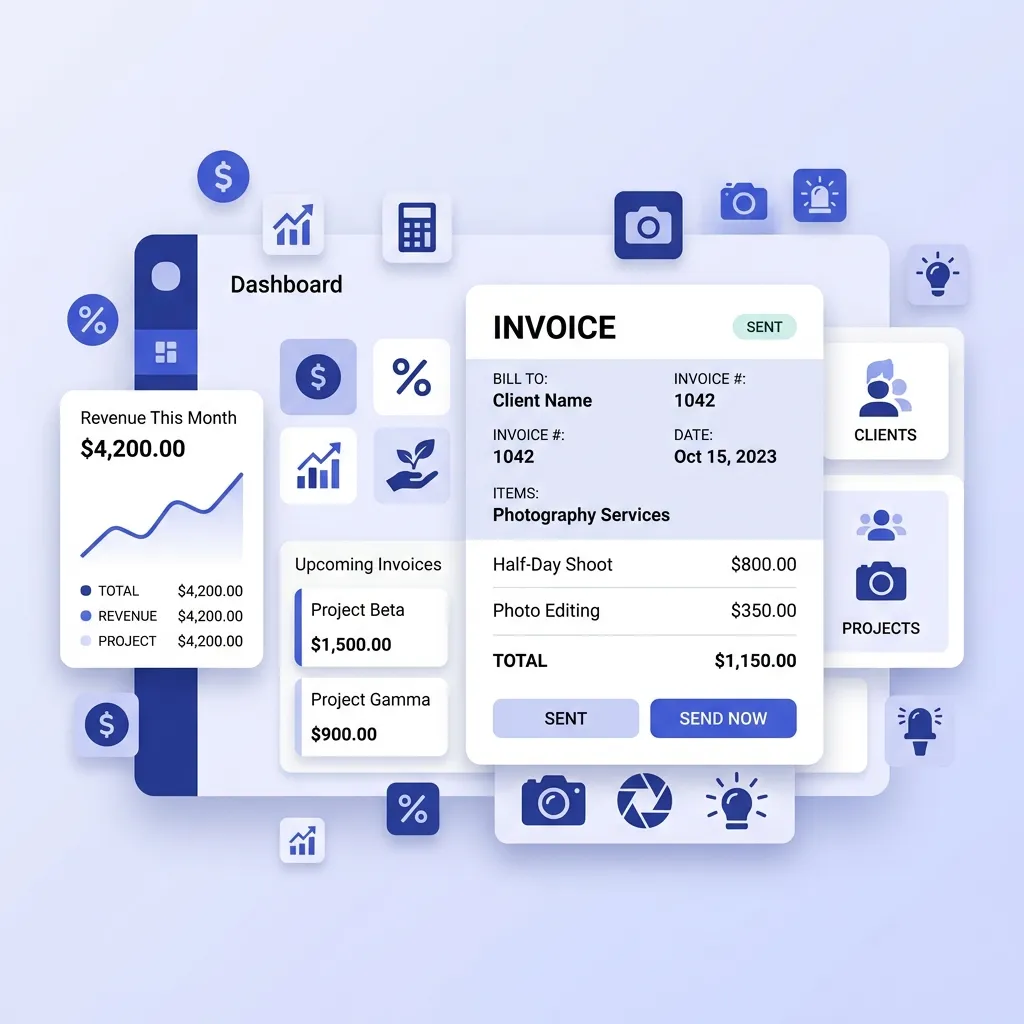
Every photography invoice should contain the following core elements:
1. Professional Branding and Header
Your invoice is a reflection of your creative brand. It should look as polished as your portfolio.
The word INVOICE must be clearly visible at the top.
Your photography business logo.
Your full legal name or registered business entity (e.g., "John Smith T/A Smith Photography").
Your physical business address, email, and phone number.
Tax Identifiers: If you are registered for VAT (UK/EU), GST (Australia/Canada/NZ), or hold a state Sales Tax license (US), your tax registration number must be legally displayed.
2. Client Details
Retail Clients (Weddings/Portraits): List the full names of the couple or the individual client, along with their billing address.
Commercial Clients: List the exact legal entity name of the brand or agency that hired you (e.g., "Ogilvy & Mather" or "Nike Inc."). Include the "Attention To" line so the accounts payable department knows who authorized the shoot.
3. Invoice Numbers and Dates
Invoice Number: Every invoice must have a unique, sequential tracking number (e.g., INV-2026-042). Never reuse an invoice number.
Date of Issue: The exact date you generated the invoice.
Due Date: The specific calendar date the payment is required (e.g., "Due: October 15, 2026"). Avoid vague terms like "Net 14" for retail clients, as they often don't understand corporate accounting terminology.
4. Detailed Line Items
Never send an invoice that simply says "Photography Services - $3,000." You must break down the value you are providing. (See the detailed section on structuring line items below).
5. Licensing and Usage Terms
For commercial photography, the invoice must reiterate the usage rights granted to the client. This legally links the payment to the permission to use the images. (e.g., "Licensing: 1-Year Digital Web Usage, North America only. Non-exclusive.").
6. The Financial Summary
Subtotal: The total of all line items before tax.
Taxes: Your applicable local sales tax, VAT, or GST. (Note: Many jurisdictions have complex rules where digital files are tax-exempt but physical prints are taxable. Always consult a local accountant).
Total Amount Due: The final amount the client must pay, displayed prominently.
7. Explicit Payment Instructions
Make paying you completely frictionless. Include:
Bank Transfer details (Account Name, Account Number, Routing/Sort Code, and IBAN/SWIFT for international clients).
A direct link to pay via credit card (Stripe, PayPal, or Square), if you choose to absorb or pass on the merchant processing fees.
Pricing Models: How to Structure Your Line Items
The way you write your line items depends entirely on the type of photography you shoot. A wedding photography invoice looks drastically different from an advertising campaign invoice.
Here is how to structure your line items so they are never questioned.
1. Commercial Photography (The Creative Fee + Usage Model)
In commercial, editorial, and advertising photography, you do not charge an "hourly rate." You charge a Creative Fee (your time, expertise, and execution on the day of the shoot) plus a Licensing/Usage Fee (the right for the client to use the images to make money). You also bill separately for pre-production and post-production.
✅ Good Commercial Example:
Creative Fee: 1-Day Studio Shoot for Summer Campaign — $2,500
Pre-Production: Location scouting, casting, and mood board development — $800
Post-Production: High-end retouching of 15 final hero images ($100 per image) — $1,500
Usage/Licensing Fee: 1-Year Digital Web and Social Media Usage, Worldwide, Non-Exclusive for 15 images — $3,000
Studio Hire & Equipment Rental (Pass-through expense) — $1,200
2. Retail Photography (The Package Model)
For weddings, family portraits, and senior photos, clients do not want to see a complex breakdown of usage rights and equipment rentals. They want to buy a "Package." However, your package description must explicitly state what is included to prevent scope creep.
✅ Good Wedding Example:
The Gold Wedding Package: Includes 8 hours of consecutive coverage by one lead photographer and one second shooter. Delivery of minimum 500 high-resolution, color-corrected images via digital gallery. Includes print rights for personal use. — $4,500
3. Freelance Event or Real Estate Photography (The Hourly/Flat Rate Model)
For high-volume, quick-turnaround work, a flat rate or hourly structure works best.
✅ Good Real Estate Example:
Real Estate Photography (123 Main Street): Up to 2 hours on-site, including exterior and interior shots. Delivery of 25 MLS-optimized digital files within 24 hours. — $350
Invoicing for Usage and Licensing (Crucial for Commercial Work)
The biggest mistake amateur photographers make when transitioning to commercial work is "selling" their images. As a photographer, you own the copyright to every image you take the moment the shutter clicks. You never sell the image; you license the right to use it.
If a local bakery hires you to shoot their pastries for Instagram, the value of those images to the bakery is relatively small. If Nike hires you to shoot a billboard that will be seen by millions of people, the value of the image is massive. Your Usage Fee scales with the value the client derives from the image.
When learning how to invoice as a photographer for commercial work, you must include a licensing clause directly on the invoice. This clause should define four things:
Media: Where can they use it? (e.g., Social media only, Print Advertising, Billboard, Worldwide Web).
Duration: How long can they use it? (e.g., 1 Year, 5 Years, Perpetuity).
Territory: Where in the world can they use it? (e.g., North America, Europe, Worldwide).
Exclusivity: Can you sell this image as stock to a competitor? (e.g., Exclusive, Non-Exclusive).
Pro Tip: Always include a clause on your invoice that states: "Usage rights are not granted until this invoice is paid in full." This prevents agencies from running your ad campaign while making you wait 90 days for payment.
The Importance of Deposits and Non-Refundable Retainers
Photography is a calendar-based business. You can only shoot one wedding on a Saturday. If a client books you six months in advance and cancels two weeks before the date, you have lost that income entirely because it is too late to book another client.
Therefore, you must invoice for upfront money to secure the date. However, the legal terminology you use on your invoice is critical.
"Deposit" vs. "Non-Refundable Retainer"
In many legal jurisdictions, a "deposit" is viewed as an advance payment for services. If the service is not rendered (e.g., the wedding is canceled), courts often rule that the deposit must be refunded.
A "Non-Refundable Retainer," on the other hand, is a fee paid to secure your calendar availability and turn away other clients. If the client cancels, you keep the retainer because you fulfilled the obligation of holding the date.
Invoice Line Item Example: "Non-Refundable Retainer to secure October 15, 2026, for Wedding Photography. This amount is applied to the final balance."
Structuring Payment Milestones
For large projects (like a $5,000 wedding or a $15,000 commercial shoot), break the payments up to protect your cash flow:
Invoice 1 (Booking): 30% Non-Refundable Retainer due upon signing the contract.
Invoice 2 (Pre-Production/Pre-Wedding): 40% due 30 days before the shoot date.
Invoice 3 (Final Delivery): 30% due before the final high-resolution files are delivered.
Handling Out-of-Pocket Expenses
Photographers frequently incur expenses on behalf of the client: studio hire, specialized gear rental (like renting a $3,000 tilt-shift lens for architecture), hiring lighting assistants, or travel costs.
How you invoice for these depends on your contract:
Pass-Through Expenses: You charge the client exactly what the vendor charged you. You must attach the receipts to the invoice PDF.
Marked-Up Expenses: Many commercial photographers add a 15% to 20% markup on expenses to cover the administrative time required to organize and front the cash for the production.
Travel and Mileage: If you are driving to a location, use the standard government mileage rate (e.g., IRS rate in the US, HMRC rate in the UK) to bill for mileage. List this clearly: "Travel: 150 miles @ $0.67/mile — $100.50". For flights and hotels, bill them as marked-up expenses or require the client to book them directly.
Dealing with Late Paying Clients (The Hostage Strategy)
Dealing with late payments is the most stressful part of freelance photography. For commercial clients, accounts payable departments are notorious for stretching "Net 30" terms to 60 or 90 days.
However, photographers have the ultimate leverage: The High-Resolution Files.
The golden rule of how to invoice as a photographer is: Never deliver the final, unwatermarked, high-resolution source files until the final invoice is paid.
You can deliver heavily watermarked, low-resolution proofs for the client to review and select their favorites. But the transfer of the final assets should be treated as a hostage exchange. Money goes in, files go out.
If a client is late on a payment, use this polite but firm follow-up sequence:
1. The Day After Due Date (Friendly Reminder):
"Hi [Client Name], I hope you love the watermarked proofs! I'm just sending a quick reminder that Invoice #INV-042 was due yesterday. Once that is processed, I will immediately unlock the gallery so you can download the high-resolution, unwatermarked images."
2. Seven Days Late (Firm Check-In):
"Hi [Client Name], checking in on Invoice #INV-042, which is now a week overdue. Please let me know when this is scheduled for payment so I can ensure your final gallery is delivered without further delay."
VAT, Sales Tax, and International Photography Clients
Tax compliance for photographers is notoriously complex because the product you deliver straddles the line between a "service" and a "physical good."
United States: Sales tax laws vary by state. In some states, digital files transferred over the internet are tax-exempt, but the moment you hand the client a physical USB drive or a printed photo album, the entire package becomes subject to sales tax. You must understand your state's specific "tangible personal property" laws.
UK and Australia (VAT/GST): If your total business revenue is over the registration threshold (e.g., £90,000 in the UK), you must charge VAT on your photography services. If you are shooting for an international client, the rules of "exporting services" apply, and you generally do not charge your local VAT, applying the reverse-charge mechanism instead.
Always consult a certified public accountant (CPA) or tax professional to ensure you are collecting and remitting tax correctly. If you get audited and haven't been collecting required sales tax, the government will demand the money from you, not your clients.
Using a Photography Invoice Template
You should not be designing your invoices in Adobe Illustrator or Photoshop. While they might look beautiful, manual invoices are prone to math errors, require manual updating of dates and invoice numbers, and make tracking late payments a nightmare.
For simple, one-off invoices, the easiest method is to use a dedicated, automated tool that does the math for you and generates a pristine PDF.
At Bizcalc Tools, we built a free invoice generator specifically designed for creative professionals and freelancers. It automatically calculates subtotals, handles multiple tax rates, allows you to add custom line items (like "Creative Fee" or "Usage Licensing"), and formats everything into a professional, corporate-ready PDF. You can download it instantly without signing up for a subscription.
📤
Free Invoice Generator
Custom line items for creative fees, licensing, and expenses. Deposit tracking, watermark status, and one-click PDF.
Learning how to invoice as a photographer is the dividing line between being a talented artist and being a successful business owner.
By structuring your line items clearly, protecting your intellectual property with explicit licensing clauses, and enforcing non-refundable retainers, you protect your cash flow and establish professional boundaries. When you send a beautifully formatted, highly detailed invoice, you signal to your clients — whether they are nervous brides or Fortune 500 art directors — that you run a serious, trustworthy operation.
Treat your financial paperwork with the same level of care and precision that you apply to your lighting and composition, and your photography business will thrive.
💰
Profit Margin Calculator
Know your shoot costs and make sure each job you take on is actually building a profitable photography business.
Include your business info, client details, the shoot date, location, itemized services (e.g., '2-hour portrait session', '50 edited digital images'), licensing fees, and total cost.
Should photographers charge a deposit?
Yes, it is standard practice to require a non-refundable retainer (often 25% to 50%) to secure the booking date, with the balance due before the final images are delivered.
How do I invoice for travel expenses?
You can either bundle travel costs into your overall package price, or itemize them separately on the invoice (e.g., 'Mileage: 50 miles @ $0.65/mile' or 'Hotel accommodation').
What is an image licensing fee?
A licensing fee is a charge for the rights to use your photos. Commercial clients often pay extra to use images in advertisements, which should be clearly separated from the 'shooting fee' on your invoice.
When do photographers hand over the final photos?
Most professional photographers only release the final, high-resolution images (without watermarks) after the final invoice has been paid in full.
#how to invoice as a photographer#photography invoice template#wedding photography invoice#commercial photography invoice#image licensing fees#creative fee