How to Calculate Sales Commission for Your Sales Team
Learn how to calculate sales commission across tiered, revenue, and gross-margin structures. Includes worked examples and incentive plan templates.
BT
Bizcalc Team
·May 14, 2026
Quick Answer & Key Summary
Quick Answer: Sales commission determines variable compensation paid to sales reps based on quota attainment, gross revenue generated, or gross profit margin earned on closed deals, aligning team incentives with company growth.
• Key Formula / Standard:Gross Commission = Total Closed Sales Volume × Tiered Commission Rate % • Rule of Thumb / Benchmark: Standard B2B tech commission plans feature a 50/50 split between base salary and on-target commission earnings (OTE).
A highly motivated sales team is the absolute lifeblood of any growing business. However, managing and compensating that team is a fragile balancing act. If you design a compensation plan that is too stingy, your top performers will immediately leave for your competitors. If you design a plan that is too generous, your sales reps will make a fortune while the business quietly bleeds cash and goes bankrupt.
The secret to sustainable growth lies in aligning the financial interests of your sales representatives with the financial realities of the business. You achieve this by understanding exactly how to calculate sales commission in a way that drives aggressive revenue growth while strictly protecting your profit margins.
This comprehensive guide will walk you through the fundamental formulas for calculating commission, the five most common compensation structures used globally, the critical difference between revenue-based and margin-based plans, and a step-by-step framework for designing a sales compensation plan from scratch.
🤝
Sales Commission Calculator
Calculate commissions across flat-rate, tiered, and draw structures instantly. Model different scenarios before committing to a plan.
The Foundation: Revenue Commission vs. Gross Margin Commission
Before you do any math, you must make a fundamental strategic decision: What exactly are you paying commission on?
There are two primary methods for calculating the base value of a sale, and choosing the wrong one can destroy your company's profitability.
1. Revenue-Based Commission
In this model, the commission is calculated based on the total gross invoice value of the sale. If a sales rep sells a $100,000 software contract, they get paid a percentage of that $100,000.
Pros: It is incredibly easy to calculate. The sales rep knows exactly what they will make the moment the contract is signed. It works exceptionally well for Software as a Service (SaaS) or consulting firms where the Cost of Goods Sold (COGS) is practically zero.
Cons: If your business sells physical products with hard costs, paying commission on total revenue is dangerous. A desperate sales rep might heavily discount a product just to close the deal and get their commission, completely destroying your profit margin in the process.
2. Gross Margin Commission
In this model, the commission is calculated only on the gross profit generated by the sale, not the total revenue.
For example, a rep sells a physical machine for $100,000. The machine cost the company $80,000 to manufacture. The gross profit is $20,000. The rep earns their commission percentage solely on that $20,000.
Pros: This completely aligns the rep's motivation with the company's survival. The rep is highly incentivized to sell at full price and avoid giving discounts because giving a discount directly reduces their own commission pool.
Cons: It requires open-book management. You have to reveal your exact product costs and profit margins to your sales team, which some owners are uncomfortable doing.
*(Note: If you need to establish your margins before designing a commission plan, use our Profit Margin Calculator).*
The Basic Formula: How to Calculate Sales Commission
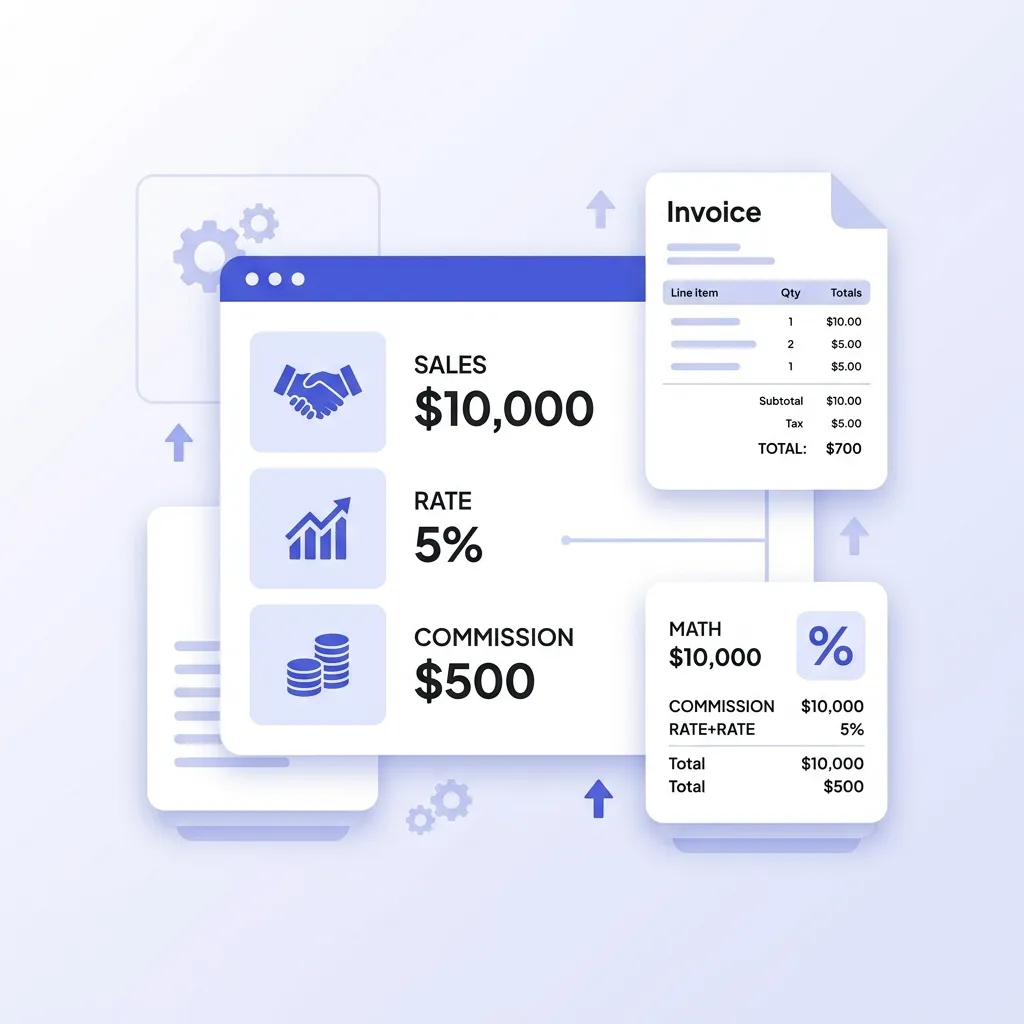
If you are using a flat-rate commission structure, the math is straightforward. You take the base value of the sale (either the Total Revenue or the Gross Margin, depending on your choice above) and multiply it by the commission rate.
The Formula:Base Sale Value × Commission Percentage = Commission Earned
(Note: Skip the manual math and run different tiered scenarios instantly using the Sales Commission Calculator above).
Worked Example:
Sarah is a real estate agent. She sells a commercial property for $500,000. Her brokerage pays her a straight 3% commission on total revenue.
Convert the percentage to a decimal: 3% = 0.03
Multiply the Sale Value by the decimal: $500,000 × 0.03 = $15,000
Sarah earns a $15,000 commission for that transaction.
The 5 Most Common Sales Commission Structures
Very few modern companies use a simple, flat-rate structure for all employees. To drive specific behaviors—like hunting for new business versus managing existing accounts—companies utilize different compensation models.
1. Straight Commission (100% Variable)
In a straight commission plan, the sales representative receives absolutely no base salary. Their income is 100% dependent on what they sell. If they sell zero units in a month, their paycheck is $0.
Best For: Independent contractors, real estate agents, high-ticket closers, and startups with extremely limited cash reserves.
The Math: Total Sales ($50,000) × High Commission Rate (20%) = $10,000 Take Home Pay.
Pros: Zero risk for the company. You only pay for performance.
Cons: Extremely high turnover rate. It breeds an aggressively cut-throat culture where reps will say anything to close a deal because their rent depends on it.
2. Base Salary Plus Commission (The Industry Standard)
This is the most common compensation structure in B2B sales, SaaS, and medical devices. The rep receives a fixed base salary to cover their basic living expenses, plus a smaller commission percentage on everything they sell.
Typically, the compensation is split into a ratio, such as 50/50 or 60/40. (A 50/50 split means that if the rep hits their quota, half their total income came from their base salary, and half came from commission).
Best For: Most professional sales teams where building long-term relationships with clients is important.
The Math: Base Salary ($4,000/month) + (Total Sales of $100,000 × 5% Commission) = Total Monthly Pay of $9,000.
Pros: Provides financial stability for the rep, reducing desperate selling tactics, while still heavily rewarding high performance.
3. Tiered Commission (Accelerators)
A tiered commission structure is designed to heavily reward your absolute best performers who blow past their quotas. The commission rate increases as the rep hits higher sales thresholds within a given month or quarter.
Example Structure:
Tier 1 (Sales from $0 to $50,000): 5% Commission
Tier 2 (Sales from $50,001 to $100,000): 8% Commission
Tier 3 (Sales above $100,000): 12% Commission
Best For: Scaling companies that want to incentivize their "A-Players" to keep selling hard even after they hit their monthly goal.
Pros: It solves the "end-of-month slump" where a rep hits their quota on the 20th of the month and stops working until the 1st of the next month.
4. Draw Against Commission
A "Draw" acts like an advance or a loan from the company to the sales rep. It guarantees the rep a minimum amount of money each month, which is particularly useful when a new rep is ramping up and hasn't built a pipeline yet.
Recoverable Draw: The company advances the rep $3,000. If the rep only earns $2,000 in actual commissions that month, they owe the company $1,000, which will be deducted from future commission checks.
Non-Recoverable Draw: The company advances the rep $3,000. If the rep only earns $2,000, they keep the $3,000 and the company eats the $1,000 loss. (This is highly common for the first 3 months of a new hire's employment).
5. Residual / Recurring Commission
If your business operates on a subscription model (like software, insurance, or monthly consulting retainers), you can pay a recurring commission. The rep gets a percentage of the client's monthly payment for as long as that client remains active.
Best For: Agencies and SaaS businesses where customer retention (minimizing churn) is just as important as customer acquisition.
The Math: The rep closes a $1,000/month contract. They earn 10% ($100) every single month the client stays. If the client stays for 3 years, the rep earns $3,600 total over time.
Step-by-Step Guide: Designing a Sales Compensation Plan
If you are a business owner building a sales team from scratch, you cannot just pick a commission percentage out of thin air. You must reverse engineer the math based on market rates and your business margins.
Step 1: Define Target On-Target Earnings (OTE)
Before setting a commission rate, you must determine what a successful sales rep should earn in a year if they hit 100% of their quota. This is called On-Target Earnings (OTE). Research your local market. If a solid Account Executive in your city expects to make $120,000 a year, your OTE is $120,000.
Step 2: Choose the Pay Mix
How much of that $120,000 should be guaranteed, and how much should be at risk?
For an outbound "hunter" role, a 50/50 split is common.
Base Salary = $60,000
Target Commission Pool = $60,000
Step 3: Set the Annual Quota
How much revenue must the rep bring in to justify paying them $120,000? A standard benchmark in B2B sales is that a rep's quota should be roughly 4x to 5x their total OTE.
OTE ($120,000) × 5 = $600,000 Annual Quota
Step 4: Calculate the Commission Rate
Now, the math is simple. The rep needs to earn $60,000 in commission by selling $600,000 worth of product.
You now have a fully functioning compensation plan: A $60k base salary, a 10% commission on all sales, and an annual quota of $600k.
The Danger of Capping Sales Commissions
A commission "cap" is a policy stating that once a sales rep earns a certain amount of money in a year, they are no longer eligible to earn further commissions.
Never cap your commissions.
Business owners often panic when they realize a top-performing sales rep is on track to make more money than the CEO. They introduce a cap to "save money." This is incredibly destructive. If your compensation plan is mathematically aligned with your profit margins, a rep making a massive commission check means the company is also making massive amounts of profit.
If you cap a high performer, they will immediately stop selling the moment they hit the cap, stunting your company's growth, and they will likely leave for a competitor who offers uncapped earning potential.
Handling Clawbacks and Canceled Deals
In the real world, deals fall through. A client might sign a contract on Friday, generating a commission for the rep, but demand a full refund on Monday.
Your sales compensation plan must include a Clawback Clause. A clawback dictates that if a customer churns, cancels, or refunds their purchase within a specific timeframe (usually 90 to 120 days), the company has the right to reclaim the commission paid to the sales rep.
Usually, the company does not literally ask the rep to wire money back to the corporate account. Instead, the clawed-back amount simply results in a negative balance that is deducted from the rep's next commission check.
This policy prevents reps from intentionally selling poor-fit clients or offering shady guarantees just to get a quick commission payout.
Sales Commission Structures Comparison Matrix
Commission Model
Core Formula
Typical Commission Rate
Best Fit For
Primary Advantage
Revenue-Based
Total Sales Revenue × Commission %
5% – 12%
High-volume retail, simple transactional sales
Easy to track; directly motivates gross sales
Gross-Profit-Based
(Revenue − COGS) × Commission %
15% – 35%
Wholesale, B2B contracting, distribution
Discourages excessive discounting by sales reps
Tiered Commission
Accelerating rates based on quota tiers
5% (to 100%), 10% (100–120%), 15% (>120%)
Enterprise B2B tech, high-growth sales teams
Motivates top performers to exceed annual quotas
Summary Checklist for a Successful Commission Plan
Is it simple? If a sales rep cannot calculate their expected commission on the back of a napkin in under 60 seconds, your plan is too complicated. (Give them our Sales Commission Calculator to make it even easier).
Is it aligned with margins? Ensure your commission payouts do not push your net profit below zero. Use a Markup Calculator to double-check your pricing structure before setting commission rates.
Does it reward the right behavior? If you desperately need to offload old inventory, put a massive "accelerator" tier specifically on those old items.
Is it in writing? Every single sales rep must sign a legally binding compensation document that clearly outlines quotas, base salaries, payment schedules (e.g., paid monthly on the 15th), and clawback periods.
Learning how to calculate sales commission isn't just about math; it is about human psychology. By designing a clear, uncapped, margin-protected compensation plan, you will attract elite sales talent who are highly motivated to push your revenue to new heights.
💰
Profit Margin Calculator
Before setting commission rates, verify your product margins are strong enough to support your compensation plan without eroding profitability.
Sales commission is a form of variable pay given to sales representatives based on the amount of revenue or profit they generate for the company.
How is sales commission calculated?
Commission is usually calculated as a percentage of the total sales price. For example, if a rep sells a $1,000 product at a 5% commission rate, they earn $50.
What is a tiered commission structure?
In a tiered structure, the commission rate increases as the rep hits higher sales targets. For example: 5% on the first $10k in sales, and 8% on anything above $10k.
Is commission paid on gross revenue or gross margin?
It depends on the company's goals. Paying on gross revenue drives higher sales volume, while paying on gross margin encourages reps to protect profitability and avoid excessive discounting.
What is a draw against commission?
A 'draw' is an advance payment given to a sales rep that is later deducted from their earned commissions. It provides a stable income during slow sales months or onboarding.
#how to calculate sales commission#sales compensation plan#tiered commission#base salary plus commission#gross margin commission