How to Calculate Profit Margin for Small Businesses
Learn how to calculate gross, operating, and net profit margins. Understand key formulas, industry benchmarks, and proven strategies to grow profit.
BT
Bizcalc Team
·May 14, 2026
Quick Answer & Key Summary
Quick Answer: Profit margin calculates the percentage of top-line sales revenue that a business retains as earnings across three distinct tiers: gross margin, operating margin, and bottom-line net profit margin.
• Key Formula / Standard:Net Profit Margin = (Net Profit ÷ Revenue) × 100 • Rule of Thumb / Benchmark: Average net profit margins across all small businesses hover around 7% to 10%, with top performers exceeding 15%.
Every day, small business owners celebrate closing a massive client or hitting a new monthly revenue record. While high sales numbers are exciting, they can also be deeply deceptive. The harsh reality of business is that revenue is vanity, profit is sanity, and cash is reality.
You can run a business that generates two million dollars a year in top-line revenue, but if your expenses are two million and one dollars, your business is failing. To truly understand the financial viability of your company, you must master how to calculate profit margin for small businesses.
Profit margin is the ultimate scoreboard of business efficiency. It strips away the illusion of massive revenue numbers and tells you exactly how much of every dollar you make actually ends up in your bank account. If you do not know your profit margins, you are flying blind—making pricing, hiring, and expansion decisions based entirely on guesswork.
This comprehensive guide will walk you through the three distinct types of profit margins (Gross, Operating, and Net), the exact mathematical formulas required to calculate them, industry benchmarks so you know where you stand, and actionable strategies to rapidly increase your profitability.
💰
Profit Margin Calculator
Enter your revenue and costs to instantly see your gross, operating, and net profit margins side by side.
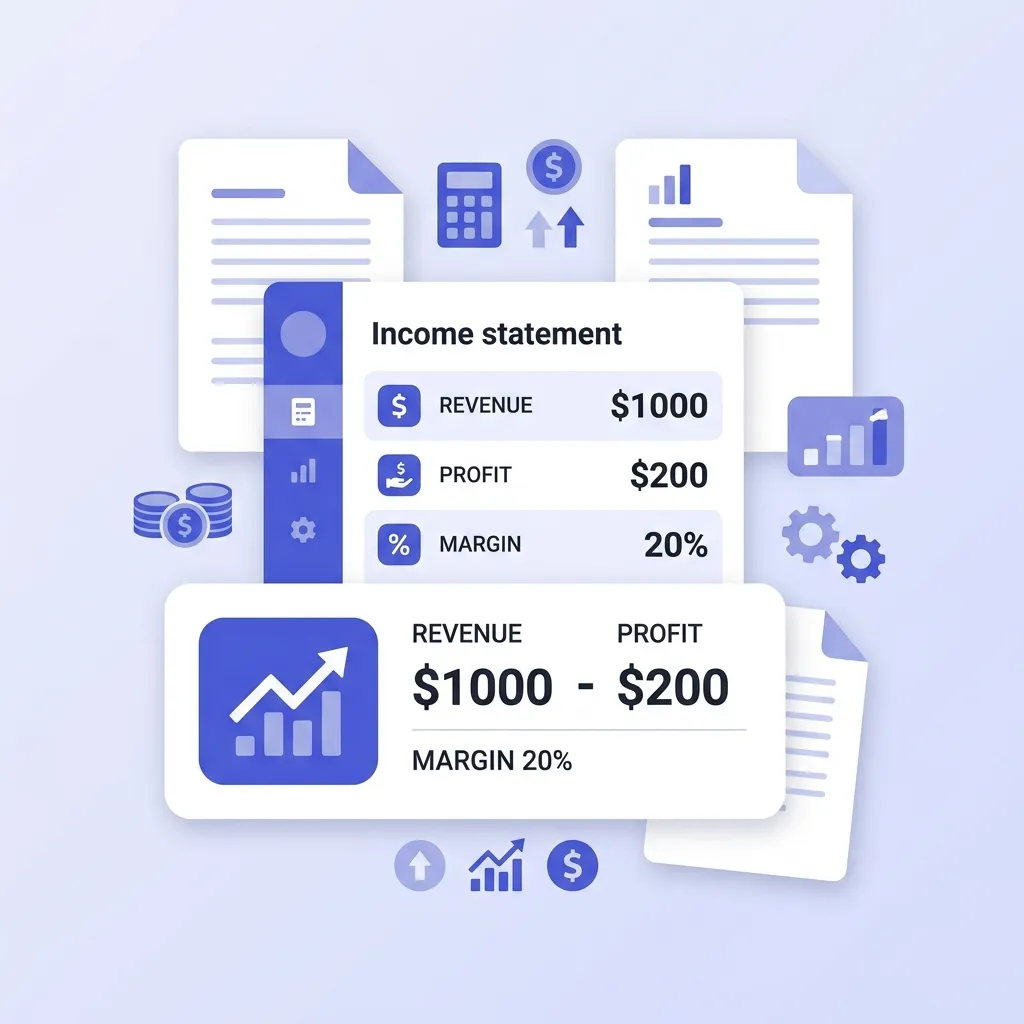
A profit margin is a financial ratio that measures the percentage of revenue that a company retains as profit after accounting for its costs.
We use percentages rather than raw dollar amounts because percentages allow us to accurately compare efficiency.
Company A makes $1,000,000 in revenue and $50,000 in profit.
Company B makes $200,000 in revenue and $40,000 in profit.
Company A made more money in raw dollars, but Company B is a vastly superior business. Company A has a profit margin of 5%, while Company B has a profit margin of 20%. Company B is four times more efficient at turning sales into actual wealth.
The Three Tiers of Profitability (The Financial Ladder)
When small business owners ask "What is my profit margin?", they usually mean the final "Net" profit. However, to truly diagnose the health of your business, you must calculate margins at three different levels of the income statement. Think of it as a ladder.
Tier 1: Gross Profit Margin
This is the very top of the ladder. Gross profit margin measures the profit you make directly from producing your goods or delivering your services, before you pay for any general business overhead. It tells you if your core product pricing is viable.
Tier 2: Operating Profit Margin
Moving down the ladder, operating margin subtracts all of your day-to-day business expenses (rent, marketing, payroll, utilities) from your gross profit. This tells you if your overall business model is structurally sound, excluding taxes and debt.
Tier 3: Net Profit Margin
This is the absolute bottom line. It subtracts everything—including taxes, interest payments on loans, and one-off expenses. It is the final amount of money you are left with.
Let's break down exactly how to calculate each tier.
1. How to Calculate Gross Profit Margin
Your Gross Profit Margin relies entirely on calculating your Cost of Goods Sold (COGS) or Cost of Sales. COGS includes only the direct costs required to create a product (raw materials, direct manufacturing labor, wholesale purchasing costs). It does not include rent or marketing.
The Formula:Gross Profit Margin = ((Total Revenue - COGS) / Total Revenue) × 100
Worked Example: The Custom Furniture Maker
David runs a custom woodworking shop. Last month, his total revenue was $20,000.
His direct costs to build the furniture (wood, varnish, hardware, and an hourly assistant who helped assemble the tables) totaled $8,000.
This means that for every dollar David brings in, he spends 40 cents creating the product, and retains 60 cents to pay his overhead and generate a net profit.
2. How to Calculate Operating Profit Margin
Once you have your Gross Profit, you must subtract your Operating Expenses (OPEX). These are the fixed and variable costs required to keep the lights on, regardless of how many products you sell. OPEX includes office rent, administrative salaries, marketing, software subscriptions, insurance, and utilities.
The Formula:Operating Profit Margin = ((Gross Profit - Operating Expenses) / Total Revenue) × 100
(Note: Gross Profit - Operating Expenses is also known as Operating Income or EBIT - Earnings Before Interest and Taxes).
Worked Example: The Custom Furniture Maker (Continued)
David has $12,000 in Gross Profit. Now he must pay his monthly overhead.
Multiply by 100: 0.4325 × 100 = 43.25% Operating Margin
3. The Master Formula: How to Calculate Net Profit Margin
The Net Profit Margin is the most important metric of all. It is the final percentage of revenue that drops to the absolute bottom line after every conceivable expense has been paid, including taxes and interest on debt.
The Formula:Net Profit Margin = ((Total Revenue - All Expenses) / Total Revenue) × 100(Where "All Expenses" = COGS + OPEX + Taxes + Interest)
💰
Profit Margin Calculator
Run your revenue and expense figures through our calculator to instantly see all three margin tiers without manual math.
Worked Example: The Custom Furniture Maker (Final)
David has an Operating Income of $8,650. But he has a business loan for his heavy machinery, and he must pay taxes.
Interest payment on machinery loan: $400
Estimated monthly taxes: $1,200
Total Non-Operating Expenses: $1,600
Calculate Net Income: $8,650 (Operating Income) - $1,600 = $7,050
Divide by Revenue: $7,050 / $20,000 = 0.3525
Multiply by 100: 0.3525 × 100 = 35.25% Net Profit Margin
Out of the original $20,000 David collected from his customers, he gets to keep $7,050. His business operates at an incredibly healthy 35.25% Net Profit Margin.
What is a "Good" Profit Margin for a Small Business?
Now that you know how to calculate profit margin for small businesses, you will inevitably ask: "Is my number good?"
The answer is entirely dependent on your industry. A 10% net margin might be considered world-class in one sector and an absolute disaster in another. Here are general benchmarks for Net Profit Margins across different small business models:
Software as a Service (SaaS): 15% - 25%
SaaS companies have massive upfront development costs but incredibly low COGS. Once the software is built, margins are extremely high.
Consulting & Professional Services: 15% - 30%
Agencies, law firms, and accountants have high margins because they sell knowledge, not physical inventory. However, their operating expenses (salaries) are very high.
E-commerce & Retail: 5% - 15%
Retailers must buy physical inventory, pay for warehousing, and manage returns, making margins notoriously tight.
Restaurants & Food Service: 3% - 9%
Restaurants operate on razor-thin margins due to high labor costs, food spoilage, and expensive commercial leases.
Grocery Stores: 1% - 3%
Grocery stores have the lowest margins in the world. They survive purely through astronomical, daily sales volume.
Common Mistakes Small Businesses Make When Calculating Margins
When entrepreneurs calculate their margins manually for the first time, they frequently make one of three fatal errors that completely skew their financial reality.
1. Confusing Markup with Margin
This is the most dangerous pricing mistake in business. Markup is the percentage added to your cost to determine the price. Margin is the percentage of the selling price that is profit.
If a product costs $100 and you sell it for $150, the profit is $50.
The Markup is 50% ($50 / $100).
The Profit Margin is 33.3% ($50 / $150).
If you tell an investor you have a 50% margin, but you actually have a 50% markup, your math is off by 17%. (Use our Markup Calculator to avoid this trap).
2. Forgetting the Value of the Owner's Labor
Many sole proprietors calculate an amazing 50% Net Margin simply because they are not paying themselves a salary. If you work 60 hours a week in your business and don't deduct a fair market wage for that labor in your operating expenses, your profit margin is artificially inflated. You haven't built a highly profitable business; you have just volunteered to work for free.
3. Ignoring Hidden Costs and Depreciation
If you own expensive equipment (trucks, computers, manufacturing gear), that equipment is slowly dying. It will eventually need to be replaced. Depreciation is the accounting method of factoring that slow death into your expenses. If you ignore depreciation, your profit margins look higher than they actually are, and you will not have the cash on hand when the equipment inevitably breaks.
5 Strategies to Improve Your Small Business Profit Margin
If you run the formulas above and realize your margins are dangerously low, you must take immediate action. You can improve your margins by pulling two fundamental levers: increasing revenue without increasing costs, or decreasing costs without losing revenue.
1. Raise Your Prices (The Fastest Method)
Small business owners are terrified of raising prices because they fear losing customers. However, mathematically, a small price increase almost always results in higher net profit, even if you lose a few price-sensitive clients. If your Net Margin is currently 10%, a 5% price increase across the board will drastically increase your bottom line, requiring zero extra labor.
2. Audit and Cut Operating Expenses
Review your credit card statements and ruthlessly cut "zombie subscriptions"—the software tools, premium apps, and marketing services you pay for but rarely use. Negotiate better rates on your business insurance and internet. Every dollar saved in OPEX drops straight to your net profit.
3. Stop Competing on Price (Differentiation)
If you are competing purely on price, you are engaged in a race to the bottom, and the winner of that race goes bankrupt. You must find a way to justify premium pricing. This could be through superior customer service, better packaging, faster shipping, or highly specialized niche expertise.
4. Optimize Inventory (Retail/E-commerce)
Holding inventory costs money (warehousing, insurance, risk of obsolescence). If you have products that haven't sold in 6 months, they are destroying your margins. Liquidate dead stock and reinvest that cash into your fastest-moving, highest-margin products.
5. Fire Unprofitable Clients (The 80/20 Rule)
If you run an agency or consulting firm, you likely have clients who demand 80% of your time but only generate 20% of your revenue. These clients destroy your operating margin by eating up your direct labor hours. Fire them, and replace them with clients who respect your pricing and your time.
Profit Margin Benchmarks Across Small Business Sectors
Industry Sector
Average Gross Margin
Average Operating Margin
Average Net Profit Margin
Primary Cost Pressure
Retail & E-commerce
35% – 55%
4% – 9%
2% – 6%
Inventory purchase costs, shipping, advertising
Professional Services
60% – 85%
15% – 28%
12% – 22%
Billable consultant salaries and client overhead
Restaurants & Food Service
65% – 72%
5% – 10%
3% – 7%
Food waste, kitchen labor, prime rent location
Software & SaaS
75% – 88%
18% – 32%
15% – 28%
Cloud hosting infrastructure and engineering salaries
Final Thoughts on Business Profitability
Learning how to calculate profit margin for small businesses is not a one-time event; it is a discipline that you must practice every single month. Your margins will fluctuate based on seasonality, inflation, and hiring phases.
By constantly monitoring your Gross, Operating, and Net Margins, you transform from a small business owner relying on "gut feeling" into a true CEO making data-driven decisions. You will know exactly when you can afford to hire, when you need to cut costs, and when it is time to raise your prices.
🏷️
Markup Calculator
Set the right selling price from the start. Use the Markup Calculator to ensure your product pricing generates the margin your business needs.
Profit margin is a financial ratio that shows what percentage of sales has turned into profits. It measures how effectively a company turns revenue into profit.
What is the difference between gross, operating, and net profit margins?
Gross margin only subtracts the direct cost of goods sold. Operating margin also subtracts operating expenses like rent and salaries. Net margin subtracts all expenses, including taxes and interest.
How do you calculate net profit margin?
To calculate net profit margin, divide your net income (total revenue minus all expenses) by your total revenue, then multiply by 100.
What is a good net profit margin for a small business?
A 'good' margin depends heavily on the industry. A 10% net profit margin is considered average, 20% is excellent, and 5% is low. Software businesses generally have much higher margins than retail.
How can I improve my profit margin?
You can improve your profit margin by increasing your prices, negotiating lower costs from suppliers, reducing overhead expenses, or upselling higher-margin products to existing customers.
#how to calculate profit margin for small businesses#net profit margin formula#gross vs net margin#operating profit#small business profitability