How to Calculate Your Freelance Hourly Rate (Formula + Calculator)
Calculate your ideal freelance hourly rate with proven formulas. Account for taxes, overhead, and non-billable time to hit your target income.
BT
Bizcalc Team
·May 14, 2026
Quick Answer & Key Summary
Quick Answer: Calculating a freelance hourly rate requires factoring in target take-home salary, self-employment taxes (15.3%), overhead software/equipment expenses, and 25%–35% non-billable administrative hours.
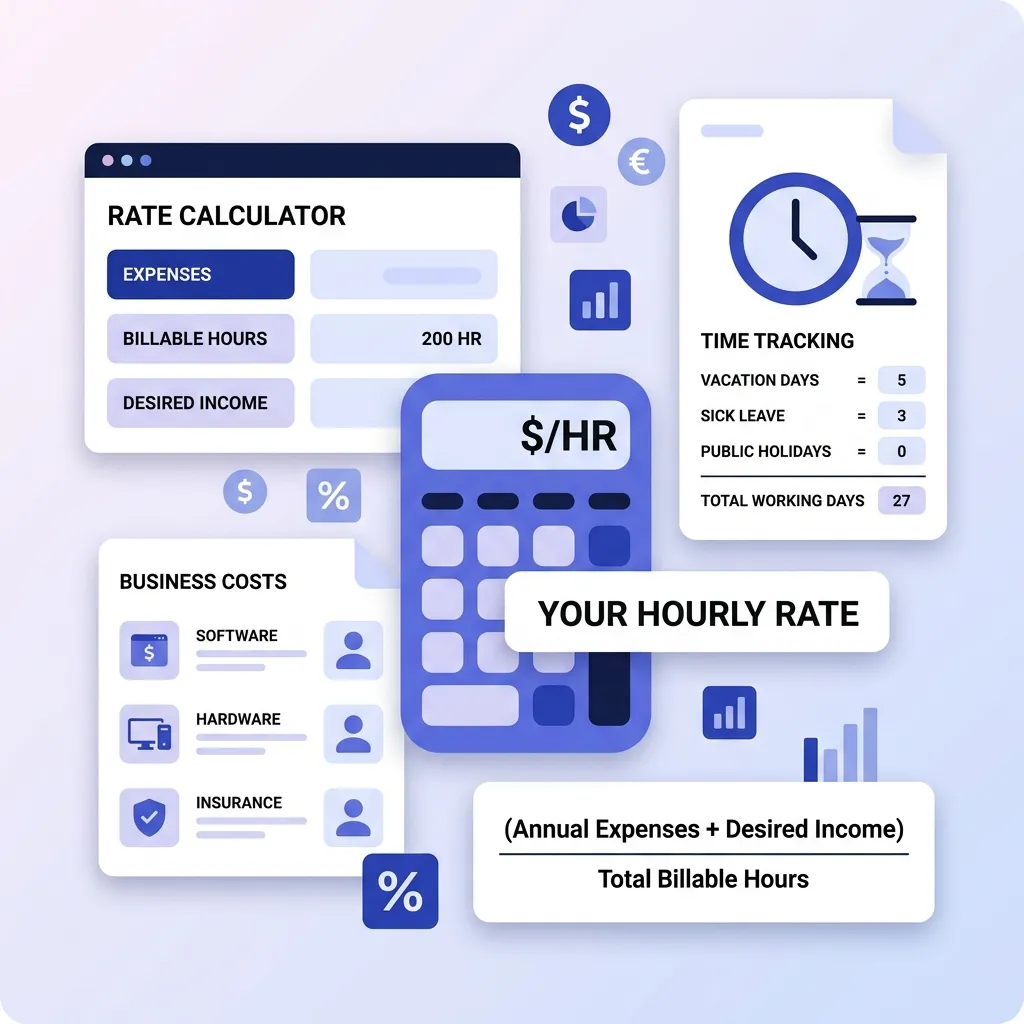
• Key Formula / Standard:Hourly Rate = (Target Income + Taxes + Overhead Costs) ÷ (Annual Billable Hours, typically 1,000–1,200 hrs) • Rule of Thumb / Benchmark: Multiply your target traditional employee wage by 1.8x to 2.2x to arrive at a healthy sustainable freelance rate.
When transitioning from a full-time corporate job to working for yourself, the first and most critical question you will ask is: "How much should I charge?" Unfortunately, the vast majority of independent contractors get the answer disastrously wrong.
When trying to figure out how to calculate your freelance hourly rate, most beginners use a dangerously flawed mathematical formula. They take their desired annual salary (let's say $100,000), and divide it by the standard number of working hours in a year (2,080 hours). This results in an hourly rate of roughly $48 per hour.
If you use this formula, your freelance business will almost certainly fail within the first two years.
Why? Because a freelancer does not have 2,080 billable hours in a year. Furthermore, a freelancer carries a massive financial burden that an employee does not: self-employment taxes, unbillable administrative time, expensive software subscriptions, laptop depreciation, and the cost of funding your own vacation and sick days.
If you want to build a sustainable, profitable consulting or freelance business, you must treat yourself like a standalone corporation. This comprehensive guide will walk you through the exact, step-by-step master formula to calculate a realistic freelance hourly rate that protects your livelihood and ensures you never work for less than your true worth.
⏰
Hourly to Salary Calculator
Use this calculator to quickly convert between hourly rates and annual salaries — and check if your freelance rate stacks up.
To understand how to price yourself, you must first understand why your former corporate salary is completely irrelevant to your freelance rate.
When a company hires an employee for $100,000 a year, the actual cost to the employer is much higher. They pay a portion of the employee's payroll taxes, they contribute to a retirement fund, they pay for health insurance, and they provide the office space, the electricity, the software licenses, and the physical computer. In many developed nations, the true cost of an employee is 1.25 to 1.4 times their base salary.
When you become a freelancer, all of those hidden costs suddenly land directly on your shoulders.
The Tax Burden: In the United States, employees pay 7.65% in FICA taxes (Social Security and Medicare), and the employer pays the other 7.65%. As a freelancer, you are both the employer and the employee, meaning you are liable for the full 15.3% Self-Employment Tax, before you even pay standard income tax. Similar tax structures exist globally.
The Benefit Burden: If you get the flu as an employee, you still get paid. If you get the flu as a freelancer, your income drops to zero.
Your freelance hourly rate must be mathematically inflated to absorb these costs.
Step 1: Determine Your Target Annual Salary
The first variable in our master formula is your Target Net Salary. This is the amount of money you actually want to take home to your personal bank account to live your life, pay your personal rent, buy groceries, and save for personal goals.
Do not be overly modest here. Freelancing carries immense risk—you could lose your biggest client tomorrow without warning. To justify taking on that financial risk, your target salary should ideally be higher than what you would make as a comfortable W-2 employee.
Example Target Salary:$90,000
Step 2: Calculate Your Business Overhead Costs
Your business costs money to exist, even if you have zero clients. These are your overheads or the Cost of Doing Business (CODB). You must project these costs annually.
Every freelancer's overhead is different, but you must account for everything.
Hardware and Equipment: You need a new $3,000 laptop every three years ($1,000/year).
Software Subscriptions: Adobe Creative Cloud, Microsoft Office, accounting software like Xero, CRM tools, cloud storage, web hosting ($1,500/year).
Professional Services: An accountant to file your taxes, legal fees to review your contracts ($1,200/year).
Marketing and Sales: Website domains, paid advertising, networking event tickets, taking clients to lunch ($1,500/year).
Insurance: Professional liability insurance, business renter's insurance, and crucially, your own health insurance premiums ($8,000/year).
Workspace: Co-working space membership or home office expenses like a portion of your internet bill ($3,000/year).
Example Total Annual Overhead:$16,200
Step 3: Factor in the Profit Margin
This is a concept that eludes almost all freelancers: A salary is not a profit.
Your target salary pays you for the labor you provide to the business. The business itself must also generate a profit margin. This profit stays in the business checking account to act as a financial buffer for slow months, to fund future business expansion, or to pay for unexpected emergencies (like your camera breaking or a client going bankrupt and refusing to pay).
A healthy freelance business should aim for a 10% to 20% profit margin on top of expenses and salary.
If your Target Salary is $90,000 and your Overhead is $16,200, your base operating cost is $106,200.
To achieve a 15% profit margin, you multiply by 1.15.
Base Cost: $106,200
Target Revenue with Profit: $106,200 × 1.15 = $122,130
You must generate $122,130 in gross revenue to pay your overhead, pay your $90k salary, and leave a healthy profit buffer in the business.
*(Note: If you need to calculate exact margins for specific projects, use our Profit Margin Calculator).*
Step 4: Calculate Your True Billable Hours
This is where the math gets brutal. You do not have 2,080 hours to sell.
Subtracting Time Off
First, you must subtract the time you will not be working.
Total days in a year: 365
Minus weekends: 104 days
Minus public holidays: 10 days
Minus vacation: 15 days (3 weeks)
Minus sick days/emergencies: 5 days
Total Working Days: 231 days
Total Working Hours (at 8 hours/day):1,848 hours
The 60/40 Rule of Unbillable Time
You have 1,848 hours sitting at your desk. But you cannot bill a client for all of them.
As a freelancer, you wear every hat. You are the CEO, the marketing manager, the bookkeeper, and the janitor. You will spend hours every week pitching new clients, writing proposals, sending invoices, reconciling bank feeds, and answering administrative emails. None of this time is billable to a client.
A widely accepted industry standard is the 60/40 Rule. Only 60% of your time at your desk will be billable; the other 40% is eaten by administrative overhead.
The Master Formula: How to Calculate Freelance Hourly Rate
Now we bring all the variables together. To find your absolute minimum hourly rate, you divide your Target Gross Revenue (Salary + Overhead + Profit) by your True Billable Hours.
⏰
Hourly to Salary Calculator
Plug in your rate and hours to see the annual equivalent income and benchmark your pricing against market rates.
If you round up to make the math easier for your clients, your freelance hourly rate is $115 per hour.
Compare this to the beginner who simply divided $100,000 by 2,080 to get $48/hour. If the beginner charged $48/hour and only managed to bill 1,108 hours (which is realistic), their gross revenue would be $53,184. After paying $16,200 in overhead, their pre-tax take-home pay is just $36,984—less than half of what they wanted to make.
This is exactly why most freelancers fail. They do not account for unbillable time.
Checklist: Adjusting Your Rate for Specific Projects
Your calculated rate of $115/hr is your baseline average. However, independent contractor rates should not be static. You should adjust your rate up or down depending on the specifics of the project. Ask yourself these questions before sending a quote:
Project Variable
Impact on Your Hourly Rate
Is it a rush job?
Increase by 50% to 100%. If you have to work the weekend, the client pays a premium.
Is the client a massive corporation?
Increase by 20%. Enterprise clients require more meetings, more unbillable onboarding, and pay invoices much slower (Net 60).
Is it a long-term retainer?
Decrease by 10%. Guaranteed, predictable work reduces your unbillable marketing time, so you can offer a slight volume discount.
Is the project highly complex/niche?
Increase by 30%. If you are the only person who knows how to fix their specific legacy database, you charge for the scarcity of your expertise.
Using a Freelance Rate Calculator to Reverse Engineer
Sometimes, the market simply will not bear the hourly rate you have calculated. If your master formula spits out an hourly rate of $250/hr, but the absolute maximum your specific industry pays is $100/hr, you have a structural business problem.
You must reverse engineer the math. If your rate is capped at $100/hr, and you only have 1,100 billable hours, your absolute maximum revenue ceiling is $110,000.
To increase your take-home pay under a capped hourly rate, you have to manipulate the other variables in the formula:
Decrease your overhead: Cancel unused software, downgrade your office space.
Increase your billable efficiency: Stop spending 40% of your time on admin. Automate your invoicing, templatize your proposals, or hire a cheap virtual assistant to handle email triage so your billable efficiency jumps from 60% to 75%.
To easily play with these numbers and see how your hourly rate translates into annual revenue, you can use our Hourly to Salary Calculator.
Why You Should Eventually Move Away from Hourly Rates
While knowing how to calculate your freelance hourly rate is essential for establishing your internal baseline, quoting an hourly rate to a client is actually the least effective way to price your services in the long term.
The Problem with Hourly Billing
Hourly billing creates an inherent conflict of interest. The client wants the job done as fast as possible to save money. You want the job to take as long as possible to maximize your income. Furthermore, hourly billing severely punishes expertise. As you get better at your job, you get faster. If you get twice as fast, your income is cut in half.
The Transition to Project-Based and Value-Based Pricing
Once you know your internal hourly rate (e.g., $115/hr), you should stop showing that number to clients. Instead, transition to Flat-Rate Pricing.
If a client asks for a new website, you estimate internally that it will take you 40 hours.
40 hours × $115/hr = $4,600.
Add a 20% buffer for unexpected delays: $4,600 × 1.2 = $5,520.
You send the client a quote for a flat fee of $5,520.
The client gets peace of mind knowing exactly what it will cost. If you execute the project efficiently and finish it in 25 hours, your effective hourly rate just jumped to $220/hr, and the client is thrilled because the project was delivered early.
Ultimately, the most successful independent consultants move to Value-Based Pricing, where they price their services based entirely on the financial ROI they generate for the client, ignoring their hourly input completely.
Final Thoughts on Setting Your Freelance Rates
Calculating your freelance hourly rate is an exercise in brutal financial honesty. You must look closely at your unbillable hours, your hidden overhead, and your tax liabilities.
Do not base your rates on what other freelancers in Facebook groups or Reddit forums are charging. You do not know their financial situation, their overhead, or their profit margins. Base your rates purely on the strict mathematical reality of your own life and business goals.
When you quote a client, do so with the unwavering confidence that comes from knowing exactly why your rate is what it is. If a client pushes back and says you are too expensive, simply smile and move on. Taking a project below your minimum baseline is not winning work; it is volunteering to lose money.
💰
Profit Margin Calculator
Once you know your hourly rate, make sure each project you take on is actually generating the margin your business needs to thrive.
Start with your target annual income, add your business expenses (software, insurance, taxes), and divide that total by your billable hours per year (usually around 1,000 to 1,200 hours).
Why should I only use billable hours in my calculation?
Freelancers spend significant time on non-billable tasks like marketing, admin, and sales. If you divide by a standard 2,080-hour work year, your rate will be too low to hit your income goal.
Should I charge hourly or per project?
Hourly billing is great for unpredictable projects with changing scopes. Project-based (or value-based) pricing is often better for defined deliverables, as it rewards your efficiency.
How much should I set aside for freelance taxes?
As a general rule, freelancers should set aside 25% to 30% of their gross income to cover self-employment taxes and income taxes.
When should I raise my freelance rates?
You should consider raising your rates when you have more client demand than you can handle, when you gain significant new skills or experience, or annually to keep up with inflation.
#how to calculate freelance hourly rate#freelance rate calculator#hourly to salary#independent contractor#billable hours#freelance pricing