How to Calculate Gross Profit for Your Small Business
Master the gross profit formula for your small business. Learn how to calculate COGS, analyze profit margins, and benchmark against your industry.
BT
Bizcalc Team
·May 14, 2026
Quick Answer & Key Summary
Quick Answer: Gross profit reveals the direct earnings remaining from total revenue after paying the direct costs of producing goods or delivering services (COGS), serving as the first test of product profitability.
• Key Formula / Standard:Gross Profit = Total Revenue − Cost of Goods Sold (COGS) • Rule of Thumb / Benchmark: Healthy small businesses maintain gross profit margins between 40% and 70%, depending on industry sector.
One of the most common mistakes new entrepreneurs make is confusing a high volume of sales with business success. It is entirely possible for a small business to generate $1,000,000 in revenue in a single year and still be forced into bankruptcy.
Why? Because revenue is just a vanity metric. It tells you how much money came in, but it doesn't tell you how much it cost to generate that money. To truly understand the financial health, viability, and scalability of your company, you must know how to calculate gross profit for your small business.
Gross profit is the fundamental baseline of your company’s financial health. It is the first layer of profitability on your income statement. If your gross profit is negative, your business model is fundamentally broken, and no amount of clever marketing or operational efficiency will save it.
This comprehensive guide will walk you through the exact formulas for calculating gross profit, how to accurately determine your Cost of Goods Sold (COGS), the critical difference between gross and net profit, and actionable strategies to improve your margins.
Table of Contents
What is Gross Profit?
In simple terms, gross profit is the amount of money your business retains after subtracting the direct costs associated with producing or acquiring the goods and services you sell.
It is the raw, unrefined profit made directly from your core business activities before you pay for any overhead expenses like rent, marketing, administrative salaries, or taxes.
Gross profit answers one fundamental question: Are you selling your product for more than it costs to make or buy?
If it costs you $40 to manufacture a pair of shoes, and you sell those shoes for $100, your gross profit is $60. That $60 must then be used to pay your store rent, your marketing budget, your accountant, and finally, yourself.
Gross Profit vs. Net Profit: The Crucial Difference
To avoid financial disaster, you must never confuse gross profit with net profit. They represent two entirely different stages of your income statement.
Gross Profit: Revenue minus Cost of Goods Sold (COGS). This is the profit from making/buying the product.
Net Profit: Operating Profit minus Taxes and Interest. This is the absolute "bottom line." It is the money left over after every single expense has been paid.
You can have a massively positive gross profit but a negative net profit if your overhead expenses are out of control. However, if your gross profit is negative, it is mathematically impossible to ever achieve a positive net profit.
The Core Formula: How to Calculate Gross Profit
The formula for calculating gross profit is straightforward:
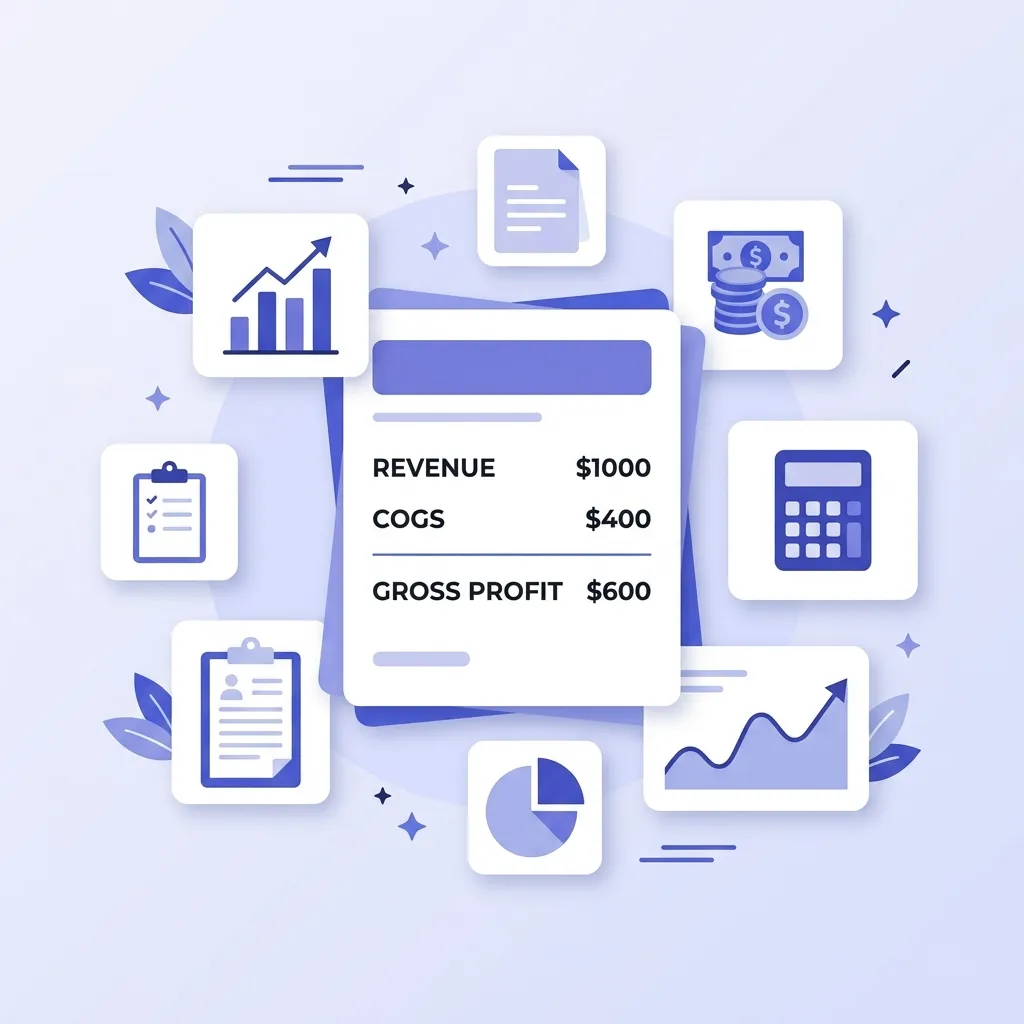
Gross Profit = Total Revenue – Cost of Goods Sold (COGS)
While the formula is simple, gathering the accurate data to plug into it is where most small business owners struggle. Let's break down the two components.
Step 1: Calculating Total Revenue
Total Revenue (sometimes called Net Sales) is the total amount of money brought in by your core business operations.
However, you cannot just look at the total deposits in your bank account. To get an accurate revenue figure, you must take your Gross Sales and subtract any money you had to give back.
Gross Sales: The total invoice value of all goods and services sold.
Minus Returns: Money refunded to customers for returned products.
Minus Allowances/Discounts: Reductions in price given to customers (e.g., a 20% off coupon).
Example: If you sold $50,000 worth of clothing, but processed $2,000 in returns and gave out $1,000 in discount codes, your Total Revenue is $47,000.
Step 2: Calculating Cost of Goods Sold (COGS)
Cost of Goods Sold (also known as Cost of Sales for service businesses) represents the direct, variable costs required to produce the goods you sold.
If a cost only occurs because you made a sale, it belongs in COGS. If a cost occurs regardless of whether you make a sale (like your monthly website hosting fee), it is an Operating Expense and should not be included in COGS.
What to INCLUDE in COGS:
Direct Materials: The raw materials used to manufacture a product (wood, steel, fabric).
Wholesale Purchases: The price paid to a manufacturer to buy finished goods for resale.
Direct Labor: The wages of the specific employees who build the product or directly deliver the service (e.g., factory line workers, a freelance graphic designer you hired for a specific client project).
Direct Shipping/Freight: The cost to ship raw materials to your factory, or the inbound freight to get wholesale products to your warehouse.
Packaging: The boxes and tape used to ship the final product.
What to EXCLUDE from COGS (These are Operating Expenses):
Rent for your office or retail storefront.
Salaries of administrative staff, HR, or marketing personnel.
Advertising and marketing costs (Facebook ads, billboards).
Let's look at how this math applies to different types of small businesses.
Example 1: The E-commerce Retailer
Sarah runs an e-commerce store selling custom mechanical keyboards. Over the course of a quarter, she needs to calculate her gross profit.
Gross Sales: $120,000
Returns & Discounts: $5,000
Total Revenue: $115,000
Now, she calculates her direct costs (COGS) for the keyboards that were actually sold:
Wholesale cost of keyboard parts: $40,000
Inbound shipping from the factory: $3,000
Custom packaging boxes: $2,000
Direct labor (hourly worker paid to assemble the keyboards): $10,000
Total COGS: $55,000
The Calculation:
Total Revenue ($115,000) - COGS ($55,000) = $60,000 Gross Profit
Sarah has $60,000 left over to pay her website fees, her marketing ads, her office rent, and her own salary.
Example 2: The Service-Based Agency
David runs a digital marketing agency. Calculating COGS for a service business can be tricky because there are no physical raw materials. Instead, COGS is primarily made up of direct labor.
Total Revenue (Retainers paid by clients): $80,000
David's direct costs to service those specific clients:
Freelance copywriter hired specifically for client campaigns: $15,000
Freelance web developer hired for a client website build: $10,000
Direct software costs charged back to the client (e.g., premium stock photos): $1,000
Total Cost of Sales: $26,000
(Note: David's own salary as the CEO, and his general office rent, are NOT included here).
The Calculation:
Total Revenue ($80,000) - Cost of Sales ($26,000) = $54,000 Gross Profit
Gross Profit vs. Gross Profit Margin
Knowing your raw gross profit in dollars (e.g., $60,000) is important, but it doesn't give you the full context of your business efficiency. To truly analyze your pricing strategy, you must convert that raw number into a percentage: The Gross Profit Margin.
The Formula:(Gross Profit / Total Revenue) × 100 = Gross Profit Margin %
This means that for every $1.00 Sarah generates in revenue, she retains 52 cents to cover her operating expenses and net profit. The other 48 cents is instantly eaten by the cost of creating the product.
Industry Benchmarks for Gross Margins
Is 52.1% a good margin? It depends entirely on the industry.
Software as a Service (SaaS): 70% to 90% (Very low direct costs to duplicate software).
Consulting & Professional Services: 50% to 80% (High margins, but very high overhead salaries).
Retail & E-commerce: 30% to 50% (Heavy costs tied up in physical inventory).
Restaurants: 60% to 70% (Food costs should be roughly 30% of the menu price).
Grocery Stores: 10% to 20% (Relies purely on massive sales volume to survive).
💰
Profit Margin Calculator
If you need to quickly calculate your margins, plug in your revenue and costs to instantly see your exact gross and net profit margins.
Why Your Small Business Gross Profit Might Be Too Low
If you calculate your gross profit margin and find that it is significantly lower than your industry average, your business is in jeopardy. A low gross profit usually stems from one of three structural problems:
1. You Are Not Charging Enough (Pricing Issues)
This is the most common issue for new small businesses. Fearful of losing customers, owners set their prices too low. If your COGS is $50 and you sell the item for $60, your gross margin is a dangerously low 16%. You do not have enough gross profit leftover to pay for marketing or rent. You must raise your prices.
2. Your Supply Chain is Bloated (COGS is Too High)
If your prices are aligned with the market, but your profit is low, you are paying too much to produce the product. You might be buying raw materials in quantities that are too small to receive volume discounts, or you are paying exorbitant inbound freight fees by using air shipping instead of ocean freight.
3. Inefficiency, Spoilage, or Theft
If you run a restaurant and your kitchen staff burns 10% of the food, or your bartenders over-pour drinks, your COGS will skyrocket because you are paying for materials that never turn into revenue. Similarly, in retail, inventory "shrinkage" (theft or damage) directly destroys gross profit.
Actionable Strategies to Improve Your Gross Profit
Improving your gross profit is the fastest way to inject cash into your small business. Here are immediate steps you can take:
Strategy
How to Implement It
Strategic Price Increases
Raise prices by 5% to 10% on your most popular, inelastic products. Often, a small price increase has zero impact on sales volume but significantly boosts gross profit.
Renegotiate with Suppliers
If you have been loyal to a supplier for years, ask for a 5% discount on raw materials, or ask them to cover inbound shipping costs.
Optimize Your Product Mix
Every business has "hero" products with 70% margins and "loss leaders" with 20% margins. Shift your marketing budget to exclusively advertise your high-margin items.
Reduce Direct Labor Costs
Improve the efficiency of your assembly line or service delivery. If a freelance web developer can finish a client site in 20 hours instead of 30 due to better templates, your Cost of Sales drops dramatically.
Buy in Bulk
Analyze your cash flow to see if you can afford to buy 6 months of inventory at once to secure a 15% wholesale discount, instantly lowering your COGS.
Final Thoughts on Small Business Profitability
Understanding how to calculate gross profit for your small business is not just an accounting exercise for tax season; it is the daily operational dashboard you need to make critical decisions.
If you do not know your gross profit, you do not know if you can afford to hire a new employee. You do not know if you can afford to run a 20% off Black Friday sale. You do not know if you can afford to lease a new office.
Make it a habit to calculate your gross profit margin at the end of every single month. Watch the trend lines. If your COGS is creeping up due to inflation, you must react quickly by adjusting your prices. By keeping a vigilant eye on your gross profit, you ensure your small business remains financially resilient, scalable, and genuinely profitable.
💰
Profit Margin Calculator
Run your revenue and COGS figures through our calculator to instantly see your gross and net profit margins.
Gross profit is the revenue a company earns after subtracting the direct costs associated with producing its goods or services (Cost of Goods Sold, or COGS).
How do you calculate gross profit?
The formula is simple: Total Revenue minus Cost of Goods Sold (COGS) equals Gross Profit.
What is the difference between gross profit and net profit?
Gross profit only deducts the direct costs of production (COGS). Net profit deducts all other business expenses as well, including rent, marketing, salaries, and taxes.
What is a good gross profit margin?
It depends heavily on the industry. Software and services often have gross margins above 70%, while retail and grocery stores typically operate with gross margins between 20% and 30%.
How can a business improve its gross profit?
A business can improve gross profit by increasing the selling price of its products, negotiating lower costs for raw materials, or improving production efficiency to reduce direct labor costs.
#how to calculate gross profit small business#gross profit margin#cost of goods sold#gross vs net profit#small business finance