Learn how to calculate markup percentage accurately. Understand the difference between markup and profit margin to price products and services profitably.
BT
Bizcalc Team
·May 14, 2026
Quick Answer & Key Summary
Quick Answer: Markup percentage defines the percentage added to a product's unit cost of goods sold to arrive at its final retail selling price, ensuring all overhead and target net profit margins are covered.
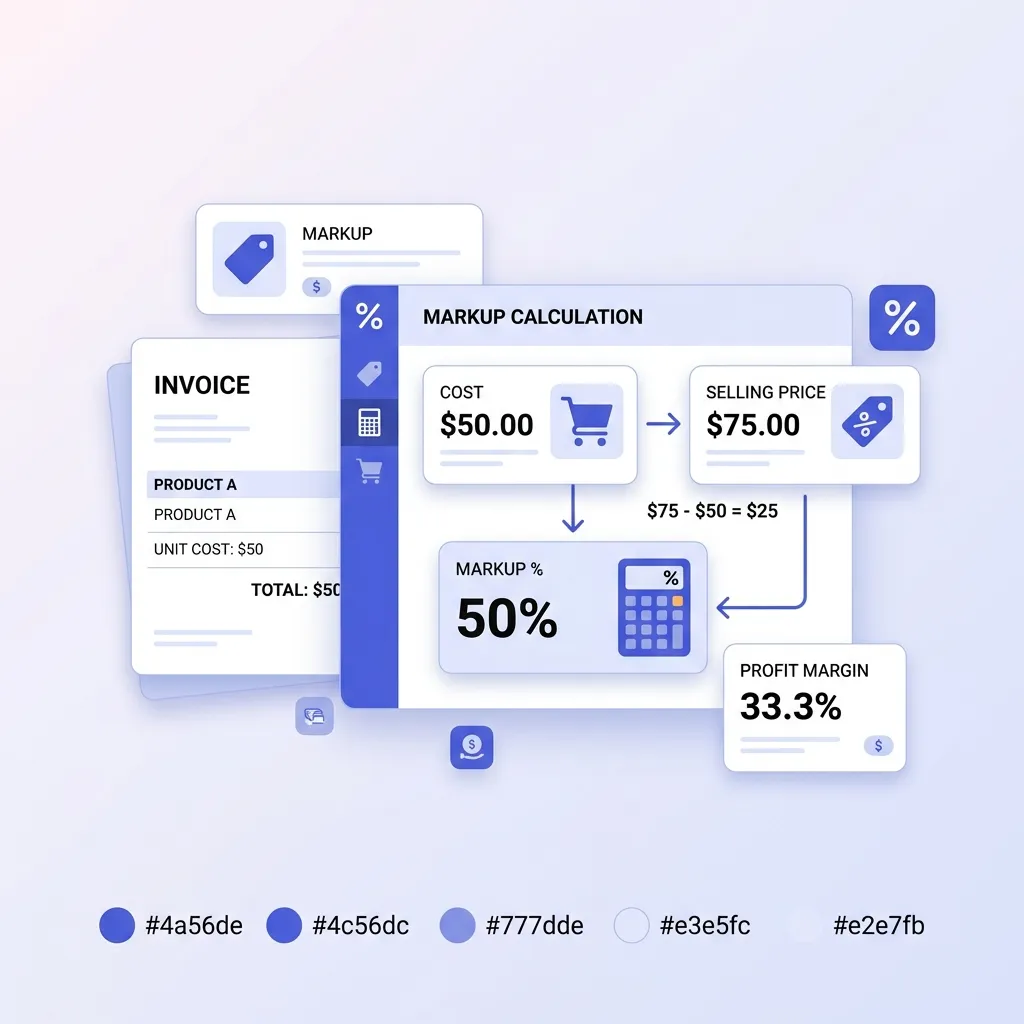
• Key Formula / Standard:Markup % = [(Selling Price − Cost) ÷ Cost] × 100 • Rule of Thumb / Benchmark: A 50% margin requires a 100% markup (known as 'keystone pricing', doubling your direct cost).
Pricing a physical product is one of the most critical decisions an entrepreneur will ever make. If you price your products too high, you will alienate your target market and your inventory will gather dust in a warehouse. If you price your products too low, you might generate massive sales volume, but you will slowly bleed cash until your business is forced to close its doors.
The secret to sustainable retail, wholesale, and e-commerce success is mathematical precision. You cannot guess a price based on what "feels right," and you cannot blindly copy your competitors without knowing their internal cost structures. You must understand exactly how to calculate markup percentage.
However, calculating markup is often the source of massive confusion for new business owners, primarily because it is constantly conflated with profit margin. While these two financial metrics are closely related, they are calculated differently and tell you completely different things about the health of your business. Mixing them up can lead to disastrous financial forecasting.
This comprehensive guide will teach you exactly how to calculate markup percentage, how to determine your true Cost of Goods Sold (COGS), the crucial differences between markup and margin, and how to apply standard pricing strategies to ensure your business remains profitable.
🏷️
Markup Calculator
Instantly calculate your markup percentage, selling price, or cost from any two known variables. No spreadsheets required.
In the simplest terms, markup is the amount by which the cost of a product is increased to determine its final selling price.
It is the premium you add to the raw cost of an item to cover your business's overhead expenses (like rent, employee salaries, and marketing) and to generate a net profit for yourself.
Markup is always expressed as a percentage of the cost.
If you buy a plain t-shirt from a supplier for $10 and you want to make $10 in profit, you must sell the t-shirt for $20.
The markup amount is $10. Because that $10 markup is equal to 100% of the original $10 cost, your markup percentage is 100%.
The Foundation: Calculating Cost of Goods Sold (COGS)
Before you can learn how to calculate markup percentage, you must have an incredibly accurate baseline number. This number is your Cost of Goods Sold (COGS).
A common mistake new e-commerce and retail owners make is assuming the COGS is simply the invoice price from the manufacturer. If you buy a wooden chair from a factory in Vietnam for $40, your COGS is not $40. You must account for the "landed cost"—the total price of getting that product from the factory floor into the hands of your customer.
To calculate your true COGS, you must add up the following elements:
Wholesale/Manufacturing Cost: The actual price paid to the supplier for the raw item.
Inbound Freight and Shipping: The cost of shipping the item via ocean freight or air from the supplier to your warehouse.
Customs Duties and Tariffs: The taxes paid to import the goods into your country.
Packaging Costs: The boxes, bubble wrap, poly mailers, and custom branded tape used to package the item.
Direct Labor (Optional but recommended): If you pay warehouse staff specifically to assemble or pick-and-pack this item, that labor cost can be factored into COGS.
A Quick COGS Example:
Wholesale price of a ceramic mug: $3.00
Shipping from factory to warehouse: $0.50 per mug
Import duties: $0.20 per mug
Custom branded box and packaging: $0.80 per mug
True COGS = $4.50
If you applied a 50% markup to the factory price of $3.00, your selling price would be $4.50. But because your true COGS is actually $4.50, you would be selling the mug at break-even, making exactly zero profit, and inevitably going out of business once you pay your website hosting fees.
Always base your markup on the True COGS.
The Master Formula: How to Calculate Markup Percentage
If you already know how much a product costs to produce, and you already know how much you are selling it for on your website, you can use the markup formula to determine your markup percentage.
This is highly useful for analyzing your current pricing structure or analyzing competitor pricing if you know their supplier costs.
You own a coffee shop. It costs you exactly $1.20 in coffee beans, milk, and a disposable cup to make a latte (This is your COGS). You sell the latte to customers for $4.50. What is your markup percentage?
Subtract Cost from Selling Price: $4.50 - $1.20 = $3.30 (This is the markup amount).
Divide the markup amount by the Cost: $3.30 / $1.20 = 2.75
Multiply by 100 to get the percentage: 2.75 × 100 = 275%
Your markup percentage on the latte is 275%.
Worked Example 2: The Boutique Clothing Store
You buy winter coats from a wholesale distributor for $60 each (Landed COGS). You retail them in your physical store for $150.
Subtract Cost from Selling Price: $150 - $60 = $90
Divide the markup amount by the Cost: $90 / $60 = 1.5
Multiply by 100 to get the percentage: 1.5 × 100 = 150%
Your markup percentage on the coats is 150%.
How to Calculate Selling Price from Cost and Target Markup
In many scenarios, you know your cost, and you know the markup percentage you want to achieve (perhaps to meet an industry standard), but you need to figure out what the final price tag should say.
You import wireless headphones. Your true landed COGS is $35 per unit. To cover your massive marketing budget and still turn a profit, your accountant tells you that you must apply a 120% markup to all electronics. What should the retail price be?
Convert the markup percentage to a decimal: 120% = 1.20
Multiply Cost by the decimal markup: $35 × 1.20 = $42 (This is the markup amount).
Add the markup amount to the original Cost: $35 + $42 = $77
You must price the headphones at $77 to achieve a 120% markup.
The Critical Difference Between Markup and Margin
This is the most dangerous trap in retail pricing. Markup and Profit Margin are not the same thing.
Markup is a percentage of the COST. It shows how much you added to the cost to get the price.
Profit Margin is a percentage of the SELLING PRICE. It shows how much of the final price you actually keep as profit.
Because they are based on different denominators, a 50% markup does not mean you have a 50% profit margin.
Let's look at the math using a product that costs $100 to make, and sells for $150.
If you go to a bank for a business loan and tell them you have a 50% margin, but you actually have a 50% markup, you are misrepresenting your financials by a massive amount.
Markup vs. Margin Conversion Table
To help you visualize how these two metrics interact, here is a quick conversion table for standard retail numbers:
Once you know how to calculate markup percentage, you must decide what percentage to actually use. This depends heavily on your industry, your brand positioning, and your sales volume.
1. Keystone Pricing (The 100% Markup)
Keystone pricing is arguably the most famous rule of thumb in the retail industry. It simply means applying a 100% markup to the wholesale cost of a product.
If you buy a pair of jeans wholesale for $40, you sell them for $80.
While keystone pricing is incredibly easy to calculate (you just double the cost), it is a blunt instrument. It doesn't account for products that are highly expensive to ship (like heavy furniture) or products that are highly competitive where a 100% markup prices you out of the market.
2. Volume Pricing (Low Markup, High Volume)
Grocery stores, big-box retailers (like Walmart), and electronics stores operate on very low markups—often between 10% and 20%.
If a grocery store buys a box of cereal for $3.00, they might sell it for $3.40 (a 13% markup). Because the profit per item is tiny, this strategy only works if you can sell a massive volume of products every single day. If you run a small boutique, attempting to compete on low markups will bankrupt you because you cannot generate the necessary volume.
Luxury brands, cosmetics companies, and high-end restaurants operate on astronomical markups.
A luxury perfume that costs $8 to manufacture might retail for $120—a markup of 1,400%. With premium pricing, the customer is not paying for the raw materials; they are paying for the brand prestige, the beautiful packaging, the exclusive retail experience, and the massive advertising campaigns required to sustain the brand image.
Industry Standards for Markup Percentages
To give you an idea of where your business fits in the broader economy, here are rough industry averages for markup percentages. Keep in mind that these are generalizations, and specific niches will vary wildly.
Grocery Stores: 10% to 20%
Automobiles (New): 8% to 15%
Consumer Electronics: 20% to 40%
Shoes and Apparel: 100% to 150% (Keystone or above)
Cosmetics and Skincare: 300% to 800%
Restaurants (Food): 200% to 300% (Food costs should generally be roughly 30% of the menu price)
Restaurants (Alcohol/Wine): 300% to 500%
How to Avoid Pricing Yourself Out of the Market
While it might be tempting to slap a 200% markup on all your products to ensure you make a healthy profit, pricing does not happen in a vacuum. Your customers have smartphones, and they will comparison shop.
When determining your markup strategy, you must balance your internal financial needs with external market forces:
Analyze Your Break-Even Point: Your markup must be high enough to cover your fixed costs (rent, salaries, software). If you only sell 100 items a month, a 10% markup won't pay the rent. Use a Break-Even Calculator to determine exactly how many units you must sell at your chosen markup to survive.
Monitor Competitor Pricing: If you are selling a commoditized product (e.g., a standard black phone case) and applying a 150% markup puts your price at $25, but Amazon is full of identical cases for $10, your product will not sell. You must either lower your markup or differentiate your brand so significantly that customers ignore the competitors.
Factor in Discounts and Promotions: If you plan to run "20% Off" Black Friday sales or offer free shipping over a certain order value, your initial markup must be high enough to absorb those discounts without dropping your net profit below zero.
Final Thoughts on Product Pricing
Learning how to calculate markup percentage is an essential rite of passage for any retail or e-commerce entrepreneur. It is the mathematical lever that controls the lifeblood of your business: cash flow.
Never guess your prices. Take the time to calculate your true landed Cost of Goods Sold down to the penny. Understand the crucial difference between markup and margin, and utilize automated tools like our Markup Calculator to remove the risk of human error from your spreadsheets.
By building a disciplined, math-based approach to your pricing strategy, you protect your business against unexpected expenses, ensure you generate enough capital to grow, and build a highly profitable, sustainable brand.
💰
Profit Margin Calculator
Once you have set your markup, verify that your resulting profit margin is healthy enough to sustain your business and cover your overheads.
Markup percentage is the amount added to the cost of a product to determine its selling price. It ensures you cover your costs and make a profit.
How do you calculate markup percentage?
Subtract the product's cost from its selling price to find the gross profit. Then, divide the gross profit by the cost, and multiply by 100 to get the markup percentage.
What is the difference between markup and profit margin?
Markup is based on the cost of the product, while profit margin is based on the final selling price. A 50% markup always equals a 33.3% profit margin.
How do I choose the right markup for my product?
The right markup depends on your industry norms, your overhead costs (like rent and marketing), and what your competitors are charging for similar products.
What does a 100% markup mean?
A 100% markup means you are doubling the cost of the product. This is commonly known as 'keystone pricing' and is standard in many retail industries.
#how to calculate markup percentage#markup vs margin#retail pricing strategy#cost of goods sold#keystone pricing