What Is EBITDA and How to Calculate It for Your Business
Learn how to calculate EBITDA with step-by-step formulas and examples. Measure core operating profitability and evaluate your business valuation.
BT
Bizcalc Team
·May 15, 2026
Quick Answer & Key Summary
Quick Answer: EBITDA measures a company's raw operating cash profitability by removing non-operating financing decisions (interest), statutory burdens (taxes), and non-cash accounting charges (depreciation and amortization).
• Key Formula / Standard:EBITDA = Net Income + Interest + Taxes + Depreciation + Amortization • Rule of Thumb / Benchmark: Small businesses typically command valuation transaction multiples ranging from 4x to 8x adjusted EBITDA.
If you ever plan to sell your business, apply for a major commercial loan, or pitch your startup to private equity investors, you will inevitably be asked one critical question: "What is your EBITDA?"
If you answer that question by quoting your total revenue, or even your net profit, you will immediately lose the respect of the person sitting across the table. For high-level corporate finance and business valuation, EBITDA is the undisputed king of profitability metrics.
However, for most small and medium-sized business owners, the term sounds like an overly complex accounting acronym designed to confuse people. It doesn't have to be.
Understanding how to calculate EBITDA is essential for determining the true, baseline operational health of your company.
In this comprehensive guide, we will demystify the acronym, break down the two primary formulas used to calculate it, walk through real-world examples, and explain why legendary investors like Warren Buffett actually hate this metric.
Table of Contents
What Does EBITDA Stand For?
EBITDA stands for Earnings Before Interest, Taxes, Depreciation, and Amortization.
It is a financial metric used to evaluate a company's operating performance. By stripping out the expenses related to debt financing (Interest), government regulations (Taxes), and accounting rules for asset degradation (Depreciation and Amortization), EBITDA reveals the raw cash-generating ability of the company's core operations.
📊
Free EBITDA Calculator
Want to instantly generate your number without doing the manual math? Plug your income statement data in to instantly see your EBITDA and margin.
If you look at the bottom line of an income statement, you will see the company's "Net Income" (or net profit). While Net Income is important, it can be highly deceptive when trying to compare two different companies, because Net Income is heavily skewed by the company's capital structure and tax environment.
Investors use EBITDA to level the playing field. Here is why stripping out those four specific expenses is so valuable:
1. Removing "Interest" Levels the Field on Debt
Company A and Company B both manufacture identical shoes and sell them for the exact same profit margin. However, Company A was entirely self-funded by a rich founder, while Company B had to take out a $5 million high-interest bank loan to start.
Because Company B is paying massive monthly interest payments, their Net Income will be significantly lower than Company A's. If you only look at Net Income, Company A looks like a much better business. But if you strip out the interest expense (looking at EBITDA), you realize both companies are operationally identical. If a private equity firm buys Company B and pays off the debt, Company B will instantly become just as profitable.
2. Removing "Taxes" Ignores Geography
A company based in high-tax California will have a lower Net Income than an operationally identical company based in zero-tax Texas. By removing taxes, buyers can evaluate the core business model regardless of where it happens to be headquartered.
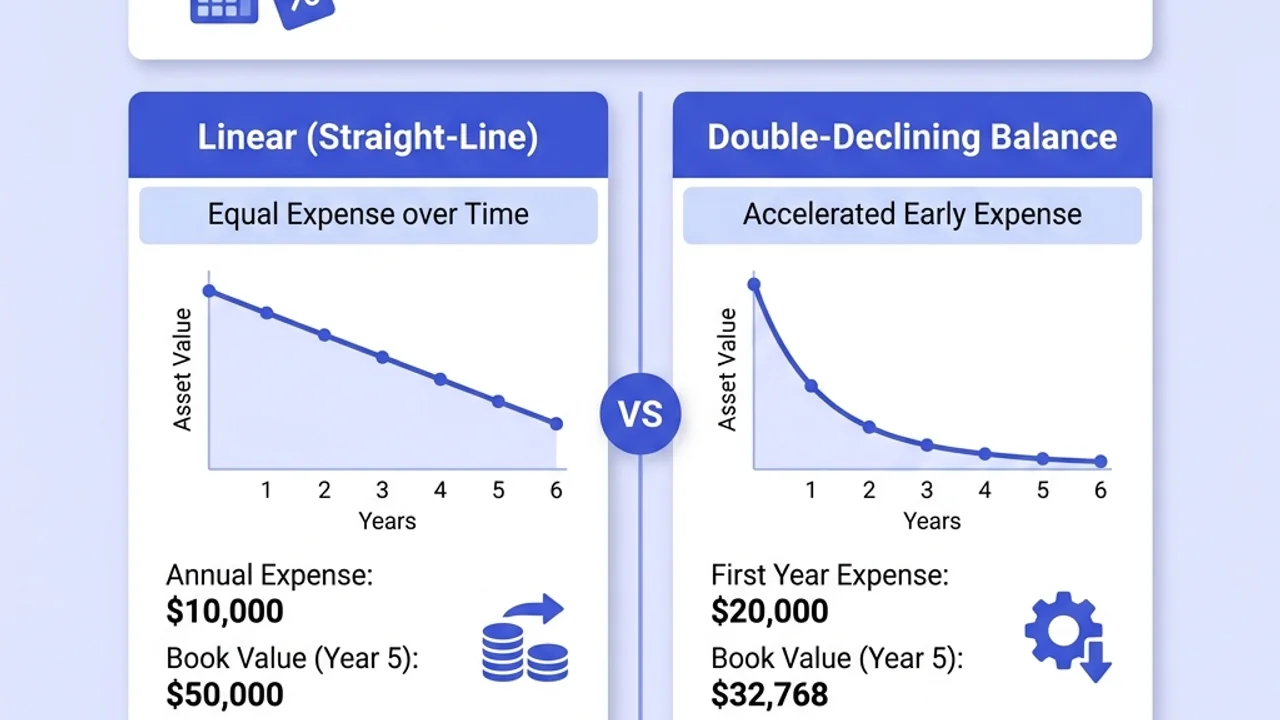
If a delivery company buys a fleet of trucks for $1,000,000, they don't expense that entire million dollars in year one. Accounting rules dictate they spread that cost over the 10-year lifespan of the trucks (this is called Depreciation).
Depreciation shows up as a massive expense on the income statement every year, dragging down Net Income. But the company isn't actually writing a check for that depreciation; the cash already left the building years ago. By adding Depreciation back into the equation, EBITDA provides a much clearer picture of how much actual cash the business is generating today.
How to Calculate EBITDA: The Two Formulas
There are two universally accepted methods for calculating EBITDA. Both methods will yield the exact same result; the one you choose simply depends on how your income statement is formatted.
Method 1: The Net Income Formula (Bottom-Up)
This is the most common method because it starts with the "bottom line" of your income statement and works its way backward, adding back the non-operational expenses.
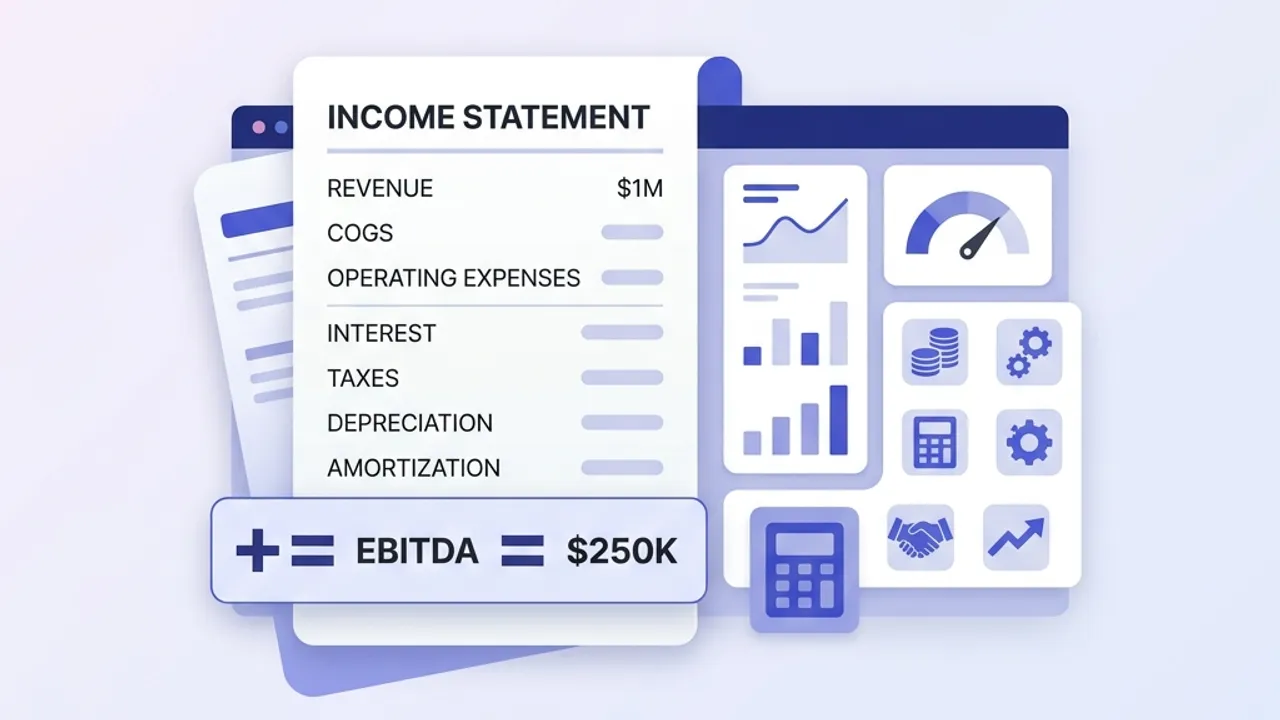
The Formula:EBITDA = Net Income + Interest + Taxes + Depreciation + Amortization
Where to find the numbers:
Net Income: The absolute bottom line of your income statement.
Interest: Found on the income statement under "Interest Expense."
Taxes: Found on the income statement under "Income Tax Expense."
Depreciation & Amortization (D&A): Usually found on the Cash Flow Statement or broken out as a line item in operating expenses on the income statement.
Method 2: The Operating Income Formula (Top-Down)
This method is slightly faster if your income statement already clearly separates your Operating Income (also known as EBIT—Earnings Before Interest and Taxes). Because Operating Income already excludes interest and taxes, you only have to add back the non-cash expenses.
The Formula:EBITDA = Operating Income + Depreciation + Amortization
A Step-by-Step Calculation Example
Let's look at how this math works for a fictional SaaS (Software as a Service) company called CloudWorks.
The CEO is preparing to pitch a venture capital firm and needs to know their EBITDA based on their year-end financial statements.
While the company only generated $1.2 million in final Net Income, their EBITDA is a much stronger $2 million. When the CEO pitches the venture capital firm, they will boast about their "$2M EBITDA business," because it proves the core software product is a cash-generating machine.
How to Calculate the EBITDA Margin
Knowing your raw EBITDA in dollars is useful, but it lacks the context required to compare your business against competitors. A $2M EBITDA sounds incredible, but if it took $100M in revenue to generate it, the business is actually highly inefficient.
To solve this, you must calculate your EBITDA Margin, which expresses EBITDA as a percentage of your total revenue.
The Formula:(EBITDA / Total Revenue) × 100 = EBITDA Margin %
A 40% EBITDA margin is considered elite. It means that for every dollar of revenue the company brings in, 40 cents is converted into pure, raw operating cash before debt, taxes, and accounting depreciation are factored in.
Industry Benchmarks for EBITDA Margins
SaaS and Tech: 20% to 40% (High margins due to low COGS).
Professional Services (Agencies): 15% to 25%.
Manufacturing: 10% to 20%.
Retail and E-commerce: 5% to 15%.
The Dark Side of EBITDA: Why Warren Buffett Hates It
While Wall Street bankers and private equity firms adore EBITDA, it has fierce critics. The most famous critic is legendary investor Charlie Munger (Warren Buffett's longtime business partner at Berkshire Hathaway), who famously referred to EBITDA as "bullshit earnings."
Why such harsh criticism? Because EBITDA ignores reality.
1. It Ignores Capital Expenditures (CapEx)
By adding back Depreciation, EBITDA pretends that the degradation of assets doesn't cost the company money. If you run a trucking company, your trucks will eventually break down and need to be replaced. Replacing those trucks requires massive amounts of real cash (Capital Expenditures). EBITDA completely ignores this reality, making capital-intensive businesses look artificially healthy.
2. It Ignores the Reality of Debt
EBITDA adds back interest payments, giving buyers a look at the "unleveraged" business. But if you are the current owner, you do have to pay that interest. If your EBITDA is highly positive, but your Net Income is negative because your interest payments are crushing you, your business can still go bankrupt. You cannot pay your employees with EBITDA; you can only pay them with cash.
3. It Can Be Heavily Manipulated
Because EBITDA is a "non-GAAP" metric (meaning it is not heavily regulated by standard accounting principles), companies frequently manipulate it. You will often see startups pitch their "Adjusted EBITDA," where they add back entirely standard expenses by claiming they were "one-time restructuring costs," making the business look vastly more profitable than it actually is.
EBITDA vs. Operating Income vs. Net Income Comparison
Financial Metric
Line Items Included
Line Items Excluded
Valuation Multiple Standard
Best Used For
EBITDA
Revenue minus COGS and Cash OpEx
Interest, Taxes, Depreciation, Amortization
4x – 12x EV/EBITDA
M&A, business sale valuation, private debt capacity
Operating Income (EBIT)
Core operating gross profit and overhead
Interest and Income Taxes only
6x – 15x EV/EBIT
Evaluating operational efficiency across asset-heavy firms
Learning how to calculate EBITDA is a mandatory rite of passage for any entrepreneur looking to scale, sell, or secure funding for their business. It is the language spoken by investors, banks, and buyers.
However, it must never be the only metric you monitor. Use EBITDA to understand your core operational efficiency, but use your Net Income and your Cash Flow Statement to ensure you have enough actual money in the bank to survive until next week.
📊
EBITDA Calculator
Plug your financial data in to instantly see your EBITDA and EBITDA margin, ready for investors or your next loan application.
EBITDA stands for Earnings Before Interest, Taxes, Depreciation, and Amortization.
Why is EBITDA important?
EBITDA provides a clear view of a company's core operating profitability by stripping out non-operating expenses like interest and taxes, as well as non-cash accounting expenses like depreciation.
How do you calculate EBITDA?
You can calculate it two ways: (1) Net Income + Interest + Taxes + Depreciation + Amortization, or (2) Operating Profit (EBIT) + Depreciation + Amortization.
Is EBITDA the same as cash flow?
No. While EBITDA is often used as a proxy for cash flow, it does not account for changes in working capital or capital expenditures (CapEx), which are critical components of true cash flow.
What is a good EBITDA margin?
A 'good' EBITDA margin varies widely by industry. Software companies often have margins over 30%, while retail or manufacturing might operate comfortably with margins between 10% and 15%.
#how to calculate EBITDA#EBITDA formula#operating income#net income vs EBITDA#business valuation