What Is Debt-to-Equity Ratio and What Should It Be?
The debt to equity ratio explained in plain English. Learn how to calculate your business leverage, analyze industry benchmarks, and manage your financial risk.
BT
Bizcalc Team
·May 15, 2026
Quick Answer & Key Summary
Quick Answer: The debt-to-equity (D/E) ratio compares a company's total debt obligations against its total shareholders' equity, revealing how aggressively a firm is financing its growth through borrowed leverage versus owner funds.
• Key Formula / Standard:Debt-to-Equity Ratio = Total Liabilities ÷ Total Shareholders' Equity • Rule of Thumb / Benchmark: A ratio between 1.0 and 1.5 is standard; values above 2.0 signal heavy financial leverage and elevated insolvency risk.
Building a business is ultimately a massive game of capital allocation. To grow your company, buy new equipment, or launch a new product line, you need money. But where does that money come from?
Every business in the world has exactly two primary ways to fund its growth: it can either borrow the money (Debt), or it can use its own money and the money of its investors (Equity).
The delicate balance between these two funding sources is the single greatest determinant of your company's financial risk profile. If you rely too heavily on equity, your growth will be painfully slow, and you will dilute your ownership. But if you rely too heavily on debt, you are building a house of cards that will instantly collapse the moment a recession hits and your revenue dips.
How do investors, banks, and smart CEOs measure this balance? They use the Debt-to-Equity Ratio (D/E).
In this comprehensive guide, you will find the debt to equity ratio explained from the ground up. We will break down the mathematical formula, provide real-world step-by-step examples, establish industry-specific benchmarks so you know what a "good" ratio actually is, and explore exactly how you can manipulate this metric to scale your business safely.
Table of Contents
1. What Is the Debt-to-Equity (D/E) Ratio?
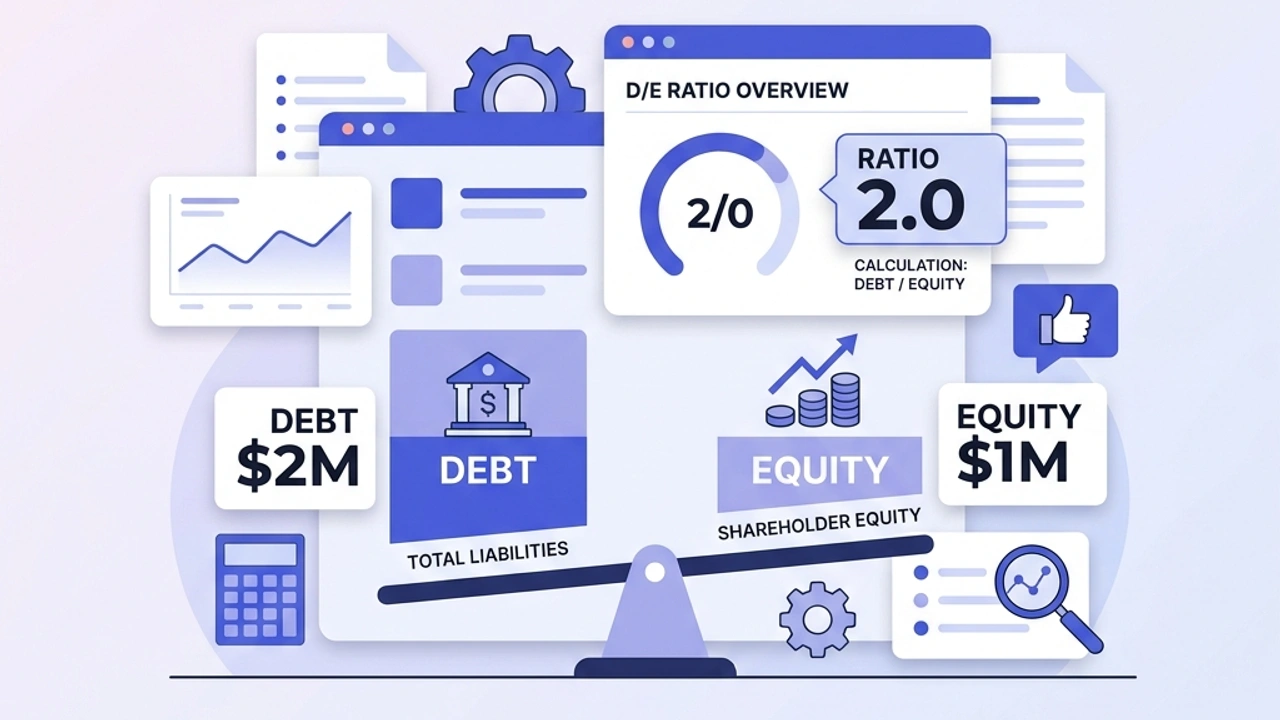
The Debt-to-Equity ratio is a fundamental financial liquidity and leverage metric. It calculates the exact proportion of a company's total debt relative to the total financial value owned by the shareholders.
In the simplest possible terms, the D/E ratio answers one terrifying question: "If this company went completely bankrupt today, and all the creditors demanded their money back immediately, would the business owners have enough equity to pay them off?"
The ratio is a measure of "leverage." Leverage simply means using borrowed money to multiply your potential returns.
If a real estate investor buys a $1,000,000 apartment building by putting down $200,000 of their own money (Equity) and borrowing $800,000 from the bank (Debt), they are highly leveraged. They control a massive asset using very little of their own cash.
The Debt-to-Equity ratio allows you to instantly quantify exactly how leveraged a business is. A high ratio indicates a company aggressively using debt to force growth, while a low ratio indicates a conservative company relying entirely on its own internal cash flow.
⚖️
Debt-to-Equity Calculator
Don't do the complex math by hand. Instantly run your leverage metrics and see how your business balances debt versus equity.
2. The Formula: The Debt-to-Equity Ratio Explained
To calculate your D/E ratio, you need to pull two massive figures from your company's balance sheet: Total Liabilities and Total Shareholders' Equity.
The Standard D/E Formula:Debt-to-Equity Ratio = Total Liabilities / Total Shareholders' Equity
Because the formula is so deceivingly simple, the secret to accurate calculation lies entirely in understanding exactly what belongs in the numerator (Liabilities) and the denominator (Equity). Let's break them down.
Understanding Total Liabilities
In corporate accounting, a liability is simply anything the company owes to an outside party. Total Liabilities is the absolute sum of every single debt the company holds, both short-term and long-term.
Current Liabilities (Short-Term): These are debts that must be paid within the next 12 months. This includes Accounts Payable (money owed to vendors), accrued wages owed to employees, short-term credit card debt, and the portion of any long-term loan that is due this year.
Long-Term Liabilities: These are obligations that are not due for over a year. This includes massive 10-year commercial mortgages, multi-year equipment leases, and long-term corporate bonds.
To find your Total Liabilities, you must add your Current Liabilities and Long-Term Liabilities together. You cannot exclude long-term debt just because it isn't due tomorrow; the bank still expects to be paid eventually.
Understanding Shareholders' Equity
Shareholders' Equity (also known as Owners' Equity in smaller businesses) represents the true "net worth" of the company. It is the amount of money that would theoretically be returned to the business owners if all the company's assets were liquidated and all of its debts were paid off.
The Basic Equity Formula: Total Assets - Total Liabilities = Shareholders' Equity.
What it includes: Equity includes the initial capital invested by the founders, money injected by venture capitalists or angel investors, and, most importantly, Retained Earnings. Retained Earnings is the historical accumulation of all the net profit the company has ever made that was kept inside the business rather than paid out as dividends to the owners.
3. A Step-by-Step Calculation Example
Let's look at how this math applies to a real-world scenario. Imagine two competing logistics companies: FastFreight Logistics and SafeHaul Trucking. Both companies generate exactly $10 Million a year in revenue, but they are run by very different CEOs.
Analyzing FastFreight Logistics (The Aggressive Approach)
The CEO of FastFreight wants to conquer the market rapidly, so he aggressively took out massive bank loans to buy hundreds of brand new semi-trucks.
Looking at FastFreight's balance sheet:
Total Liabilities (Bank loans, accounts payable, leases): $8,000,000
Total Shareholders' Equity (Initial investment + retained earnings): $2,000,000
The Calculation:
$8,000,000 / $2,000,000 = 4.0 D/E Ratio
For every $1 of equity the owners have in the business, FastFreight owes $4 to the bank. This company is massively leveraged and incredibly risky.
Analyzing SafeHaul Trucking (The Conservative Approach)
The CEO of SafeHaul is terrified of debt. She only buys new trucks when the company has saved enough cash to buy them outright.
Looking at SafeHaul's balance sheet:
Total Liabilities (Only minor accounts payable and a small credit line): $1,000,000
Total Shareholders' Equity (Massive retained earnings over 20 years): $9,000,000
The Calculation:
$1,000,000 / $9,000,000 = 0.11 D/E Ratio
For every $1 of equity, SafeHaul owes only 11 cents. This company is an absolute fortress. It is practically invincible to bankruptcy.
4. What Is a "Good" Debt-to-Equity Ratio?
After running the calculation, business owners always ask the same question: "Is my number good?"
The frustrating reality of corporate finance is that there is no universal "perfect" number. A ratio of 2.5 might be considered a terrifying disaster for a software company, but completely normal and healthy for an airline. A "good" ratio depends entirely on the capital intensity of the specific industry you operate in.
The General Rule of Thumb: 1.0 to 2.0
In a vacuum, most financial analysts consider a D/E ratio between 1.0 and 2.0 to be the optimal sweet spot for a standard business.
A ratio of 1.0 means your debt perfectly equals your equity.
A ratio of 2.0 means you have twice as much debt as equity.
Remaining in this zone means the company is aggressively using debt to grow, but the owners still retain enough equity to survive a mild economic downturn.
Industry-Specific Benchmarks
1. Capital Intensive Industries (Manufacturing, Airlines, Construction)
Typical D/E Ratio: 2.0 to 3.0+
Why: You cannot start a commercial airline or build a skyscraper using cash from your checking account. These businesses require hundreds of millions of dollars in upfront capital just to buy their baseline assets (planes, cranes, factories). Because these physical assets can be used as collateral to secure cheap bank loans, these industries are heavily debt-financed.
2. Banking and Finance
Typical D/E Ratio: 10.0 to 20.0+
Why: Banks operate under a completely different set of rules. A bank's entire business model is to borrow money (accept deposits from customers) and lend it out at a higher interest rate. If a bank has a D/E ratio of 15.0, it is not necessarily in distress; it is simply operating as a bank.
3. Technology and Software (SaaS)
Typical D/E Ratio: 0.1 to 0.5
Why: Software companies require very little physical capital. You don't need to build factories or buy delivery fleets; you just need laptops and cloud servers. Furthermore, banks hate lending money to software startups because if the startup fails, the bank can't repossess and sell "code" the way they can repossess a factory. Therefore, tech companies are almost entirely funded by equity (Venture Capital) and have practically zero debt.
5. The Danger of a High Debt-to-Equity Ratio
If your ratio is significantly higher than your industry average, you are operating in the danger zone. High leverage is a double-edged sword: it magnifies your returns during good times, but it guarantees your destruction during bad times.
A. The Threat of Immediate Bankruptcy
Debt requires fixed, monthly cash payments, regardless of what the economy is doing. If your D/E ratio is 4.0, and a global pandemic or a recession hits, your revenue might drop by 40%. However, your bank loan payments do not drop by 40%. They remain exactly the same. Because you lack the equity cushion to absorb the losses, your cash flow instantly turns negative, you miss a loan payment, the bank forecloses on your assets, and your company ceases to exist.
B. Increased Cost of Capital
If you have a massive D/E ratio, banks view you as a massive risk. If you try to take out another loan to survive, the bank will either flat-out reject you, or they will charge you predatory, double-digit interest rates. This high interest rate chokes your net income, making it even harder to pay off the debt, triggering a corporate death spiral.
C. Loss of Managerial Control
When a company becomes dangerously over-leveraged, the CEO effectively loses control of the business to the bank. Commercial loans come with strict legal clauses called "debt covenants." These covenants dictate exactly what the CEO is allowed to do. If the D/E ratio gets too high, the bank can legally forbid the company from hiring new employees, launching new products, or paying dividends to the founders until the debt is paid down.
6. The Danger of a Low Debt-to-Equity Ratio
If debt is so dangerous, you might assume that a D/E ratio of 0.0 is the ultimate goal. Why borrow money at all if you can just fund the business yourself?
Because while zero debt prevents bankruptcy, it also severely limits your potential wealth. This is the concept of "under-leveraging."
A. Slower Growth Trajectory
If you refuse to take on debt, you can only grow your business using the actual cash profits you generate each month (Retained Earnings). If you want to open a second retail location that costs $500,000, and your business only nets $50,000 a year, it will take you 10 agonizing years of saving before you can expand. Meanwhile, your competitor takes out a $500,000 bank loan, opens three new locations immediately, and completely dominates the local market while you are still saving your pennies.
B. Dilution of Ownership (The Equity Trap)
If you refuse to use debt to fund your growth, your only other option is to sell equity to venture capitalists or angel investors.
Debt is temporary; once you pay the bank back, they go away. Equity is permanent. If you sell 30% of your company to an investor for $1 Million to fund your expansion, you have permanently surrendered 30% of your future profits and 30% of your voting control. In the long run, selling equity is mathematically vastly more expensive than paying a 7% interest rate to a bank.
7. How the D/E Ratio Connects to Return on Equity (The DuPont Analysis)
To truly understand why elite CEOs intentionally take on debt, you must understand the "DuPont Analysis." This financial model proves that taking on debt directly increases the return the business owners make on their own money.
The Return on Equity (ROE) Formula:Net Income / Shareholders' Equity = ROE
Imagine you start a business with $100,000 of your own cash (Equity). The business generates $20,000 in net profit. Your ROE is 20%. ($20,000 / $100,000).
Now, imagine your competitor starts the exact same business. But they only use $50,000 of their own cash, and borrow $50,000 from the bank (D/E Ratio of 1.0). The business generates the same $20,000 in operating profit. After paying $3,000 in interest to the bank, their Net Income drops to $17,000.
At first glance, you made $20,000 and they only made $17,000. You win, right?
Wrong. Look at the Return on Equity.
Your competitor generated $17,000 in profit, but they only risked $50,000 of their own money to do it.
$17,000 / $50,000 = 34% ROE.
By strategically using a moderate amount of debt, your competitor vastly outperformed your 20% return, allowing them to compound their wealth much faster than you.
8. How to Improve a Bad Debt-to-Equity Ratio
If you calculate your metrics and realize your ratio is a terrifying 4.5, you must take immediate strategic action to deleverage your company before a market correction wipes you out.
📊
EBITDA Calculator
While D/E shows your leverage, EBITDA shows your cash-generation ability to pay that debt back. Calculate your operating profitability now.
You have three primary levers to fix a toxic D/E ratio:
A. Aggressive Debt Reduction (The Denominator Fix)
This is the most direct method. You must pause all aggressive expansion plans, halt any dividend payouts to the owners, and use every single dollar of free cash flow to aggressively pay down the principal on your highest-interest short-term debt. As Total Liabilities shrink, your ratio improves immediately.
B. Issue New Equity (The Numerator Fix)
If the debt load is too massive to pay down with cash flow, you must inject fresh cash into the equity side of the equation. You can achieve this by bringing on a new equity partner, pitching a private equity firm, or (if public) issuing new shares of stock. You then take this freshly raised cash and immediately use it to pay down the debt. You will dilute your ownership, but you will save the company from bankruptcy.
C. Supercharge Retained Earnings
Because Retained Earnings are a core component of Shareholders' Equity, increasing your profitability naturally improves your D/E ratio over time. You must aggressively optimize your profit margins. Raise your prices by 10%, fire your lowest-performing employees, and cut all non-essential software subscriptions. As your Net Income rises, those profits flow directly into Retained Earnings at the end of the year, expanding your equity base and lowering your ratio.
9. The Hidden Blind Spots of the D/E Ratio
While the D/E ratio is a mandatory metric for analyzing business risk, it is not a perfect crystal ball. It has several massive blind spots that you must be aware of:
It Ignores Cash Flow: The D/E ratio only looks at the balance sheet. It doesn't tell you if the company actually generates enough monthly cash to pay the interest on the debt. A company can have a great D/E ratio of 1.0 but still go bankrupt because all of its assets are tied up in unsold inventory and they have zero cash in the bank to make the loan payment.
It Ignores the Cost of Debt: The ratio treats a 3% government-backed SBA loan exactly the same as a predatory 25% merchant cash advance. The ratio only measures the volume of the debt, not how toxic the interest rates are.
The "Off-Balance-Sheet" Illusion: Many companies use aggressive accounting tactics to hide their debt. Instead of taking out a loan to buy a factory (which would spike their liabilities and ruin their D/E ratio), they sign a massive 20-year "operating lease" to rent the factory. The lease doesn't always show up as a traditional liability, making the D/E ratio look artificially safe, even though the company is still legally on the hook for millions of dollars in payments.
Debt-to-Equity (D/E) Ratio Benchmarks by Sector
Industry Sector
Average D/E Ratio
Healthy Range
High-Risk Threshold
Capital Structure Profile
SaaS & Technology
0.2 – 0.5
0.1 – 0.8
> 1.2
Asset-light; financed primarily through equity and cash flow
Professional Services
0.4 – 0.8
0.2 – 1.0
> 1.5
Low capital requirements; predictable operating cash flows
Retail & Wholesale
1.0 – 1.8
0.8 – 2.0
> 2.5
Working capital debt for seasonal inventory buildup
Manufacturing & Real Estate
1.5 – 2.8
1.2 – 3.0
> 3.5
Heavy equipment and property assets back long-term debt
Final Thoughts on Financial Leverage
Mastering the debt-to-equity ratio is the defining difference between a reckless gambler and a strategic operator.
Amateur business owners view debt as "evil" and avoid it entirely, stunting their growth and permanently limiting their wealth. Reckless founders view debt as "free money" and borrow to the absolute limit to fund their ego, guaranteeing their eventual destruction during the next recession.
The elite CEO operates in the middle. They understand the debt to equity ratio explained in this guide. They benchmark their company against their industry peers. They use debt as a precision tool to supercharge their returns (ROE), but they always maintain a thick enough equity cushion to absorb unexpected shocks.
📈
Free Debt-to-Equity Calculator
Stop guessing about your company's risk profile. Plug your balance sheet numbers into our interactive calculator to instantly visualize your leverage.
The D/E ratio compares a company's total liabilities to its shareholder equity. It shows how much of the company is financed by debt versus how much is owned by shareholders.
What is a good debt-to-equity ratio?
A 'good' ratio varies by industry, but a D/E ratio between 1.0 and 1.5 is generally considered healthy. Capital-intensive industries (like manufacturing) often operate safely with higher ratios.
What does a high debt-to-equity ratio indicate?
A high D/E ratio means a company relies heavily on borrowed money to fund its operations, which increases financial risk, especially during economic downturns or periods of high interest rates.
How is the debt-to-equity ratio calculated?
The formula is simply Total Liabilities divided by Total Shareholders' Equity. Both of these figures can be found on a company's balance sheet.
Why do investors look at the D/E ratio?
Investors use the D/E ratio to assess a company's financial leverage and risk. A heavily indebted company may struggle to pay dividends or survive if revenues temporarily drop.
#debt to equity ratio explained#financial leverage#total liabilities#shareholders equity#D/E ratio formula#business risk