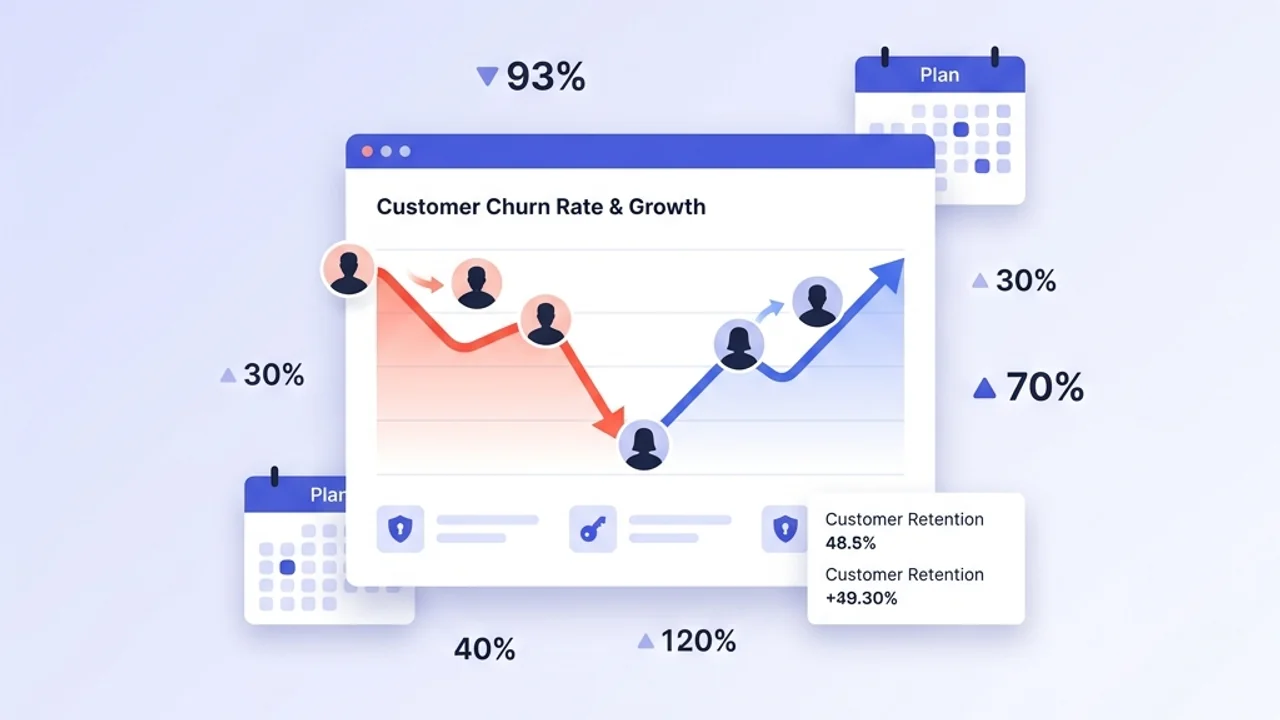
What Is Churn Rate and What's a Good Churn Rate for SaaS?
Understand SaaS churn rate. Learn the formulas for customer and revenue churn, discover benchmarks by market segment, and read practical retention strategies.
BT
Bizcalc Team
·June 16, 2026
Quick Answer & Key Summary
Quick Answer: Customer churn rate calculates the percentage of subscribers or recurring clients who cancel or fail to renew their contracts over a specific period, testing customer satisfaction and product retention.
• Key Formula / Standard:Customer Churn Rate = (Customers Lost During Period ÷ Customers at Start of Period) × 100 • Rule of Thumb / Benchmark: Target monthly customer churn under 3%–5% for SMB SaaS, and under 0.5%–1.0% per month for enterprise SaaS.
For any business built on a recurring revenue model, customer acquisition is only the first chapter of the story. The real engine of subscription growth is retention. You can have the most effective sales and marketing program in the world, but if your customers cancel their subscriptions as fast as you sign them up, your business will struggle to survive.
This is known as the "leaky bucket" problem, and its direct measurement is Churn Rate. Churn rate is the percentage of customers or revenue that a business loses over a given time frame. In the Software-as-a-Service (SaaS) industry, churn is regarded as the ultimate health indicator. A high churn rate indicates a lack of product-market fit, inefficient customer onboarding, or poor customer service.
Conversely, controlling and reducing churn is the most capital-efficient way to scale. This guide covers what churn rate is, the different formulas used to calculate it, typical SaaS benchmarks across different customer segments, and practical strategies to plug the leaks in your subscriber base.
📊
Churn Rate Calculator
Enter your starting customers and cancellations to instantly calculate your churn rate and see how your customer retention matches industry benchmarks.
Customer Churn Rate (often referred to as logo churn) is the rate at which customer accounts terminate their relationship with your business. It is a count-based metric that measures customer attrition over a set period, such as a month, a quarter, or a year.
In SaaS, churn occurs when a user cancels their subscription, allows their contract to expire without renewal, or cancels their account entirely. For transactional businesses (like e-commerce), churn is more subjective, usually defined as a customer who has not made a purchase within a specific timeframe (e.g., 90 or 180 days).
Why Churn Rate is the Silent Killer of SaaS
High churn rates destroy growth in three primary ways:
Erosion of Compound Growth: Subscription models scale because revenues compound. If you add $10,000 in new monthly recurring revenue (MRR) every month but lose 5% of your existing base, your growth will eventually plateau. The absolute revenue lost to churn scales with the size of your customer base, meaning the larger you get, the harder you have to run just to stand still.
Spiking Customer Acquisition Costs: Customer Acquisition Cost (CAC) is typically paid upfront. It often takes 6 to 18 months of subscription revenue just to recover the marketing cost of acquiring a single customer (the CAC Payback Period). If a customer churns before their payback period is complete, the business loses money on that relationship.
Depressed Customer Lifetime Value (LTV): As churn increases, the average customer lifespan shrinks. Since LTV is calculated by multiplying customer value by customer lifespan, a high churn rate directly drags down the value of every customer you acquire, lowering your optimal LTV:CAC ratio.
Customer Churn vs. Revenue Churn: The Two Essential Views
To understand the health of a subscription business, you must calculate both customer churn and revenue churn.
1. Customer Churn (Logo Churn)
Customer churn tracks the raw count of customer accounts lost.
Best Used For: Evaluating overall customer satisfaction, product adoption, and market fit.
The Limitation: It treats all customers equally. If you lose ten small accounts paying $10 per month and one enterprise account paying $5,000 per month, your customer churn rate is calculated based on eleven lost accounts, masking the true financial impact.
2. Revenue Churn (Gross Revenue Churn)
Revenue churn tracks the dollar or pound value of lost subscriptions.
Best Used For: Evaluating the financial health and cash flow sustainability of the business.
The Limitation: It can be masked by pricing changes or expansions.
Churn Rate Formulas
Here are the primary formulas used to calculate churn rate:
1. Customer Churn Rate Formula
This calculates the percentage of customer accounts lost during a period:
Customer Churn Rate = (Customers Lost during Period ÷ Total Customers at Start of Period) × 100
Important: Do not include new customers acquired during the period in your starting customer count, as this will artificially deflate your churn rate.
2. Gross Revenue Churn Rate Formula
This measures the recurring revenue lost due to cancellations and downgrades, relative to the starting revenue:
Gross Revenue Churn Rate = (MRR Lost from Cancellations & Downgrades ÷ Total MRR at Start of Month) × 100
Gross revenue churn focuses strictly on lost revenue, ignoring any new expansion revenue.
3. Net Revenue Churn Rate Formula
This measures the net change in recurring revenue, accounting for both lost revenue and expansion revenue (upgrades, add-ons, or extra seats purchased by existing customers):
Net Revenue Churn Rate = [(MRR Lost from Cancellations & Downgrades − MRR Gained from Existing Customer Expansions) ÷ Total MRR at Start of Month] × 100
If your existing customers expand their accounts by more than you lose to churn, your Net Revenue Churn Rate becomes a negative percentage. This is known as Negative Churn—the ultimate goal for SaaS companies, as it means the business can grow its recurring revenue base even without acquiring any new customers.
Step-by-Step Guide: How to Calculate Customer Churn Rate
To perform a customer churn rate calculation for a given month, follow these five steps:
Step 1: Identify Your Starting Customer Count
Count the total number of active, paying subscribers at the very start of the month (e.g., June 1st).
Active Subscribers on June 1st: 1,200 customers
Step 2: Track Cancellations During the Month
Count the number of those starting customers who cancelled their subscription or let their contract expire during the month (June 1st to June 30th).
Note: Exclude any new customers who signed up after June 1st and subsequently cancelled in the same month. We want to isolate the starting cohort.
Cancellations from Starting Cohort: 36 customers
Step 3: Run the Customer Churn Calculation
Divide the lost customers by your starting customer count, and multiply by 100.
Customer Churn Rate = (36 ÷ 1,200) × 100 = 3.0%
Step 4: Calculate Gross Revenue Churn
Locate your starting Monthly Recurring Revenue (MRR) and track the MRR lost from those 36 cancellations plus any account downgrades.
For the month of June, your SaaS business experienced a 3.0% Customer Churn Rate, a 3.5% Gross Revenue Churn Rate, and a 2.0% Net Revenue Churn Rate. These metrics suggest that while you are losing accounts, you are partially offsetting those financial losses by expanding existing accounts.
📊
Churn Rate Calculator
Plug in your customer and revenue numbers to check your monthly churn metrics and evaluate your business's customer retention health.
Analysis: An annual customer churn rate of 4.0% (0.33% monthly) is exceptional. Because enterprise contracts require deep integrations, switching costs are high, resulting in very low customer churn.
Example 2: B2C Consumer App (Low Cost, High Volume)
B2C mobile apps or consumer services have low prices, monthly rolling contracts, and highly transactional user relationships.
Analysis: A monthly churn rate of 7.0% is common in the consumer space. Since there are no long-term contracts and switching costs are negligible, B2C apps require constant, high-volume marketing to replace lost users.
Example 3: SMB-Focused B2B SaaS (Mid-Tier Pricing)
Companies serving small and medium-sized businesses operate in a middle ground, with self-serve onboarding but some business integration.
Analysis: A 4.0% monthly churn rate is standard for SMB SaaS. Small businesses churn more frequently than enterprise accounts due to tighter cash flows, higher business failure rates, and less complex software usage.
What Is a "Good" Churn Rate for SaaS? Benchmarks
To evaluate your churn rate, you must compare it to benchmarks for your target market. Customer segments dictate churn expectations:
Target Market
Annual Contract Value (ACV)
Typical Monthly Churn
Typical Annual Churn
Target Net Revenue Retention (NRR)
Enterprise B2B
$50,000+
0.5% – 1.0%
6% – 12%
110% – 120%+ (Net Negative Churn)
Mid-Market B2B
$5,000 – $50,000
1.0% – 2.0%
12% – 24%
100% – 110%
SMB B2B
Under $5,000
3.0% – 5.0%
30% – 45%
90% – 100%
B2C Consumer
Under $500
5.0% – 8.0%
45% – 60%+
80% – 90%
Key Takeaways from Benchmarks
The Scale Influence: Larger companies with bigger budgets churn less because they invest more time in choosing, onboarding, and training teams on software.
Net Revenue Retention (NRR) is Key: If your NRR is above 100%, your business is expanding its revenue from existing cohorts, which can absorb higher customer churn.
Churn vs. Employee Turnover
While customer churn measures lost subscribers, employee turnover (often called employee churn) measures staff departures. It is calculated similarly but belongs to human resource management.
The Formula:Employee Turnover = (Staff Departures ÷ Average Headcount) × 100.
To reduce your churn rate, you must focus on customer success, onboarding efficiency, and contract structures.
1. Optimize the First 30 Days (Onboarding)
Most customer churn occurs early in the lifecycle because the user fails to realize the product’s value.
Self-Serve Walkthroughs: Design interactive, step-by-step product tours that guide users to their first "Aha!" moment (e.g., sending their first invoice or building their first report).
Onboarding Emails: Send automated tips based on user behavior. If a user signs up but hasn't set up their account after 3 days, send a helpful tutorial.
2. Monitor Account Activity and Health Scores
Identify "silent churners"—customers who are paying but have stopped logging in.
Track Usage Metrics: Monitor key indicators like login frequency, feature usage, and API integrations. If a customer's usage drops by 50% in a week, trigger a proactive outreach campaign from your customer success team.
Net Promoter Score (NPS): Periodically survey customers to identify unsatisfied accounts before they cancel.
Up to 30% of SaaS churn is involuntary, caused by expired credit cards, failed bank transfers, or billing errors.
Automated Retries: Implement smart payment retries that attempt charges on optimal days of the week.
In-App Alerts: Display clear, friendly billing reminders inside the application when a card is nearing expiration.
4. Adjust Pricing and Contract Durations
Promote Annual Billing: Offer a discount (e.g., 2 months free) for users who choose annual billing. Annual contracts guarantee 12 months of retention, giving you more time to integrate the customer and prove your value.
Set Up Inactivity Alerts: Create automated alerts to identify accounts that have not logged in for over 14 days.
Final Thoughts
Churn rate is the ultimate measure of product value and customer satisfaction. While winning new customers is exciting, retaining your existing subscriber base is what builds long-term, profitable growth.
Calculate your customer and revenue churn regularly, compare your performance to industry benchmarks, and focus on onboarding and success to keep your customer bucket full.
📈
LTV Calculator
Use your churn rate to calculate customer lifespan, and determine your customer lifetime value to guide acquisition budgets.
In SaaS, churn rate is the percentage of subscribers or monthly recurring revenue (MRR) that a business loses over a specific period. It is a critical measure of product-market fit and customer retention, as high churn rates require a business to constantly acquire new users just to maintain flat revenue.
How is customer churn rate calculated?
The formula for customer churn rate is Customer Churn Rate = (Customers Lost during Period ÷ Total Customers at Start of Period) × 100. For accuracy, new customers acquired during that specific period should be excluded from the starting count.
What is the difference between logo churn and revenue churn?
Logo churn (customer churn) measures the percentage of individual customer accounts that cancel their service. Revenue churn measures the percentage of Monthly Recurring Revenue (MRR) lost due to cancellations and downgrades. A business can have high logo churn but low revenue churn if it primarily loses low-paying, small accounts.
What is a good churn rate for a SaaS business?
A good churn rate depends on your target customer segment. For B2B enterprise SaaS, a monthly churn rate under 1% (or under 10% annually) is considered excellent. For SMB-focused SaaS, a monthly churn rate of 3% to 5% is typical, while B2C consumer subscription apps often see monthly churn rates of 5% to 8% due to lower switching costs.
What is negative churn?
Negative churn occurs when the expansion revenue generated from existing customers (through upgrades, add-ons, or seat expansions) exceeds the revenue lost from customers who churned or downgraded. It represents the gold standard of SaaS growth, as it allows a company to grow its revenue without acquiring any new customer logos.