Invoice Discounting Explained: What It Is and How to Calculate It
Learn how invoice discounting works. Find costs, advance rates, calculation formulas, and comparative guides to optimize your working capital.
BT
Bizcalc Team
·June 17, 2026
Quick Answer & Key Summary
Quick Answer: Invoice discounting is an invoice financing facility where businesses borrow cash against unpaid client receivables, unlocking immediate operating capital while retaining customer billing and collections control.
• Key Formula / Standard:Advance Cash = Invoice Value × Advance Rate % (typically 80%–90%) − Discounting Fee (1.5%–3.5%) • Rule of Thumb / Benchmark: Discounting fees typically cost 1.5% to 3.0% of the invoice value per 30-day financing cycle.
Managing cash flow is a constant operational challenge for businesses that sell to commercial clients. When offering credit terms of 30, 60, or 90 days, a large portion of working capital remains locked up in accounts receivable. This credit delay creates a cash gap: while sales revenue appears on the profit and loss statement, the physical cash is unavailable to cover payroll, purchase raw materials, or fund expansion.
To resolve this liquidity gap, many enterprises turn to receivables finance. By accessing the value of unpaid invoices early, companies can bypass standard payment cycles and maintain smooth operations. Among the options available, invoice discounting represents a popular choice for businesses that want to maintain control over their billing relationships while unlocking capital.
Having invoice discounting explained clearly is the first step in determining whether this financing method is suitable for your capital requirements. By understanding the underlying mechanics, fee structures, and calculation formulas, finance managers can evaluate the true cost of funding and make informed decisions for their cash positions.
📊
Invoice Discount Calculator
Input your invoice value, advance rate, and fee structure to calculate your immediate funding availability and final costs.
When looking at invoice discounting explained in simple terms, it is a form of asset-based finance where a company uses its unpaid sales invoices as collateral to secure a revolving line of credit from a commercial lender. The lender advances a significant portion of the invoice value immediately, providing the business with instant cash.
The Standard Lifecycle of a Discounted Invoice
The process follows a structured sequence:
Billing: The business delivers goods or services to a customer and issues an invoice with credit terms (e.g., Net 60 days).
Funding Request: The business sends a copy of the invoice to the invoice finance provider.
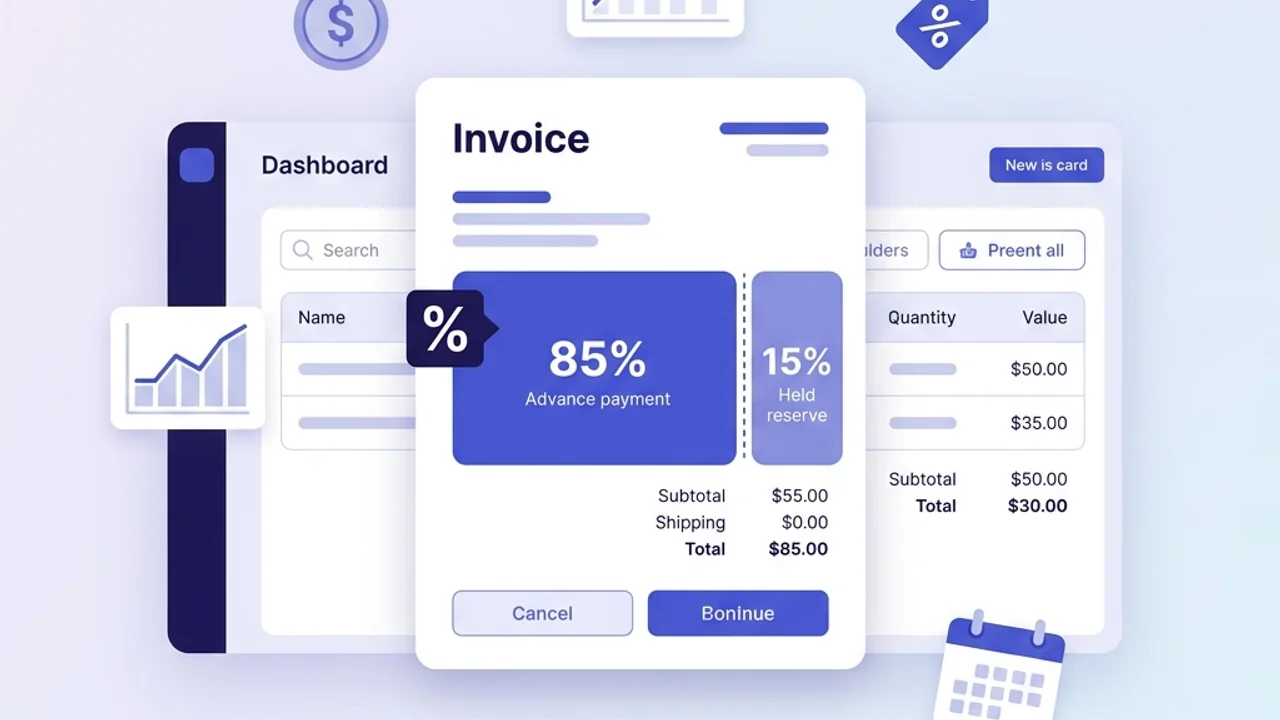
The Advance: The lender reviews the invoice and advances a set percentage (the advance rate, usually 80%) to the business's bank account within 24 to 48 hours.
Collections: The business manages customer relations and collects the outstanding payment when the invoice falls due.
Settlement: The customer pays the invoice amount into a control bank account set up by the lender.
The Rebate: The lender receives the payment, subtracts the advanced amount plus fees (service and interest fees), and returns the remaining balance (the rebate, usually 20% minus fees) to the business.
Invoice Discounting vs. Invoice Factoring
While both mechanisms fall under the invoice finance umbrella, they differ in operations and customer relations:
Ledger Control: In invoice discounting, the business retains control of its sales ledger and manages its own credit control and collection processes. In invoice factoring, the lender takes over the collections process, meaning they contact your clients directly to collect outstanding payments.
Confidentiality: Invoice discounting is typically confidential. Because you manage collections, your customers do not know that you are using a finance facility. Factoring is disclosed, meaning your customers pay the lender directly and are aware of the arrangement.
Business Size: Lenders generally restrict invoice discounting to established firms with robust internal accounting systems, as they must trust the business to manage collections effectively. Factoring is more widely available to smaller or early-stage businesses.
To evaluate how much working capital is currently tied up in your operations, check the Working Capital Calculator to assess your general liquidity needs.
Types of Invoice Discounting
Invoice discounting arrangements are structured in several ways to meet different business needs:
1. Confidential vs. Disclosed Discounting
Confidential Invoice Discounting: The most common form. The arrangement remains secret, allowing you to maintain your brand image and customer relationships without suggesting cash flow constraints.
Disclosed Invoice Discounting: The lender notifies your customers of the arrangement, and payments are sent to a designated bank account in the lender's name. This option is often used by businesses that do not qualify for confidential facilities due to credit history.
2. Whole Ledger vs. Selective (Single) Discounting
Whole Ledger Discounting: The business discounts its entire sales ledger. The lender provides a revolving credit line based on the total value of all eligible outstanding invoices. This offers a steady source of cash but carries higher ongoing costs.
Selective Invoice Discounting: The business selects specific invoices or specific client accounts to discount. This offers flexibility, allowing you to secure funding only when you face large projects or seasonal cash shortages.
The Cost Structure and Key Metrics
To evaluate an invoice finance agreement, you must understand the individual cost components. Providers do not charge a single interest rate; instead, they split fees into two categories:
1. The Advance Rate
This is the percentage of the invoice value that the lender pays upfront. Standard rates range from 70% to 90%. The remaining 10% to 30% is held in reserve as a security buffer and is returned (minus fees) after the customer pays.
2. The Service Fee (Administration Fee)
This charge covers the cost of managing the facility. It is calculated as a flat percentage of the total invoice face value, typically ranging from 0.5% to 3.0%. The fee is charged whether you draw down the advanced funds or not.
3. The Finance Fee (Discount Rate / Interest Rate)
This is the interest rate charged on the advanced funds. It behaves like a standard bank overdraft rate, calculated daily on the outstanding advance balance. Rates are typically pegged to a central bank base rate (such as the Bank of England Base Rate, SOFR, or EURIBOR) plus a margin (e.g., base rate + 3.0%).
The Mathematical Formulas for Invoice Discounting
Calculating the cost and cash flow impact of invoice discounting requires using three primary formulas.
1. The Advance Amount
To find the cash available immediately when you upload an invoice:
Advance Amount = Invoice Value * Advance Rate
2. The Service Fee
To calculate the administrative cost of the transaction:
Service Fee = Invoice Value * Service Fee Rate
3. The Finance Fee (Daily Interest Cost)
Interest is only charged on the funds you borrow, for the exact number of days they are outstanding. First, calculate the daily interest rate:
Daily Interest Rate = Annual Interest Rate / 365
Then, compute the total interest cost based on the payment period:
Step-by-Step Guide to Calculating Invoice Discounting Costs
Use this step-by-step process to model the cash availability and financing costs of an invoice.
Step 1: Identify the Invoice Value and Payment Terms
Determine the face value of the invoice (including VAT/GST) and estimate the days to payment. If your client's contract states Net 60 terms, use 65 days as a realistic collection period to account for administrative delays.
Step 2: Calculate the Initial Cash Advance
Multiply the invoice value by the advance rate agreed with your lender. This is the immediate cash injection that improves your working capital position.
Step 3: Compute the Flat Service Fee
Multiply the invoice value by the service fee percentage. This amount is fixed and will be deducted from the final rebate when the invoice settles.
Step 4: Calculate the Finance Fee (Interest)
Determine the interest charge on the advanced cash. Multiply the advance amount by the daily interest rate, then multiply by the estimated days outstanding.
Step 5: Calculate the Settlement Position
Add the service fee and the finance fee to find the total financing cost. Subtract this total from your invoice value to determine the net cash your business receives across the entire cycle.
Practical Invoicing Examples (Case Studies)
To see the math of invoice finance in action, let's review two common business funding scenarios.
Case Study A: Selective Invoice Discounting
A business issues a single invoice worth $100,000 to a corporate customer on Net 60 terms. The business uses a selective discounting facility with the following terms:
Advance Rate: 85%
Service Fee: 1.5% of invoice value
Annual Interest Rate: 8.0%
Actual Collection Time: 60 days
selective Discounting Cost Model
Step
Metric Description
Calculation Method
Calculation Result
1
Invoice Value
Stated Face Value
$100,000.00
2
Advance Rate
Agreed Facility Rate
85.00%
3
Immediate Cash Advance
$100,000.00 * 85%
$85,000.00
4
Reserve Held
$100,000.00 - $85,000.00
$15,000.00
5
Service Fee
$100,000.00 * 1.50%
$1,500.00
6
Daily Interest Rate
8.00% / 365
0.021918% (per day)
7
Days Outstanding
Actual Customer Collection Time
60 days
8
Finance Fee (Interest)
$85,000.00 * 0.021918% * 60
$1,117.81
9
Total Financing Cost
$1,500.00 + $1,117.81
$2,617.81
10
Final Rebate Received
$15,000.00 - $2,617.81
$12,382.19
11
Net Cash Received
$85,000.00 + $12,382.19
$97,382.19
In this scenario, the business secures $85,000 in cash immediately. When the customer pays on day 60, the business receives the final rebate of $12,382.19. The total cost to access the cash 60 days early was $2,617.81, representing an effective financing cost of 2.62% of the invoice value.
Case Study B: Whole Ledger Discounting (Annualized Costs)
A larger company maintains a constant outstanding accounts receivable balance of $500,000. The company discounts its entire ledger to support ongoing working capital needs:
Advance Rate: 80%
Annual Ledger Turnover: $3,000,000.00
Service Fee: 0.75% of total sales volume
Annual Interest Rate: 7.5% (applied to average drawn funds)
Average Days Outstanding: 45 days
Whole Ledger Annualized Cost Model
Step
Metric Description
Calculation Method
Calculation Result
1
Average Ledger Balance
Outstanding Accounts Receivable
$500,000.00
2
Maximum Advance Available
$500,000.00 * 80%
$400,000.00
3
Average Drawn Funds
Estimated Draw (75% of max)
$300,000.00
4
Annual Service Fee
$3,000,000.00 * 0.75%
$22,500.00
5
Annual Finance Fee (Interest)
$300,000.00 * 7.50%
$22,500.00
6
Total Annual Financing Cost
$22,500.00 + $22,500.00
$45,000.00
7
Effective Annual Rate
$45,000.00 / $3,000,000.00
1.50%
This case shows that whole-ledger facilities offer a lower percentage service fee (0.75% compared to 1.5% for selective discounting) due to the higher volume of transactions. The company pays $45,000 annually to maintain a constant $300,000 cash injection in its bank account, helping to support growth and manage operational expenses.
Pros and Cons of Invoice Discounting
Before establishing an invoice finance facility, you must weigh the benefits against the operational requirements and costs.
The Benefits
Improved Liquidity: Unlocks cash from your sales ledger immediately, allowing you to meet payroll, pay suppliers, and invest in growth.
Confidentiality: Because you manage collections, customers are unaware that you are using a finance provider, protecting your reputation.
Scalability: The credit limit grows automatically alongside your sales volume. As you issue more invoices, more funding becomes available.
Sales Ledger Control: Retaining control of collections allows you to maintain direct customer relationships.
The Risks and Drawbacks
Cost Accumulation: The combination of service fees and interest charges makes invoice finance more expensive than traditional bank loans or overdrafts.
Operational Requirements: Lenders require detailed monthly reconciliation reports, audits of your sales ledger, and proof of robust internal credit control processes.
Concentration Limits: If a large portion of your revenue comes from a single customer, the lender may restrict the advance rate on those invoices to manage their credit risk.
Default Risk (Recourse): If a customer fails to pay, your business must repay the advanced funds, which can trigger sudden cash shortages.
If you are concerned about how invoice discounting costs impact your bottom line, use the Profit Margin Calculator to verify that your operating margins can support these financing expenses.
Invoice Discounting Readiness Checklist
Use this checklist to evaluate if your business is prepared to implement an invoice discounting facility:
Reconcile your accounts receivable ledger weekly to ensure invoice records are accurate.
Calculate your average collection period (Days Sales Outstanding) to estimate interest costs.
Verify that your primary customers have strong credit ratings (lenders will audit your key debtors).
Ensure your annual revenue meets the lender's minimum threshold (typically $100,000 to $500,000 for confidential discounting).
Draft a standard credit control procedure document illustrating how your business tracks and collects outstanding invoices.
Model the impact of service and interest fees on your net profit margins.
Establish if you require a recourse (lower cost, higher risk) or non-recourse (higher cost, lower risk) facility.
Accessing the value of your invoices is a practical way to manage working capital. With invoice discounting explained, you can review your accounts receivable, calculate your financing costs, and determine if this solution is right for your cash flow needs.
📊
Invoice Discount Calculator
Input your outstanding invoice details to find the exact advance cash and total financing fees for your business.
Invoice discounting is an invoice finance mechanism where a lender advances a large percentage of unpaid customer invoices (usually 70% to 90%) to a business, charging service and interest fees. The business maintains control of its sales ledger and collections, paying back the advance when the customer settles the invoice.
How does invoice discounting differ from invoice factoring?
The primary difference is control over collections and customer awareness. In invoice discounting, the transaction is confidential, and the business manages its own collections. In factoring, the lender purchases the invoices outright, takes over the collections process, and contacts customers directly for payment.
What is a standard advance rate for invoice discounting?
Lenders typically offer advance rates between 70% and 90% of the eligible invoice's face value. The specific rate is determined by the lender's audit of your credit history, your customers' creditworthiness, and your industry's average collection terms.
What are the main costs associated with invoice discounting?
The cost structure consists of a service fee (administration charge, typically 0.5% to 3.0% of the invoice value) and a finance fee (interest rate charged on the advanced funds, calculated daily based on the number of days the funds are outstanding).
What happens if a customer defaults on a discounted invoice?
Under a recourse agreement, the business must repay the advanced funds to the lender if the customer fails to pay. Under a non-recourse agreement, the lender assumes the credit risk of customer default, though this option carries significantly higher service fees and strict credit limits.