How to Calculate the True Cost of an Employee (Beyond Salary)
Calculate the true cost of an employee beyond base salary. Account for payroll taxes, benefits, equipment, and overhead before making your next hire.
BT
Bizcalc Team
·May 24, 2026
Quick Answer & Key Summary
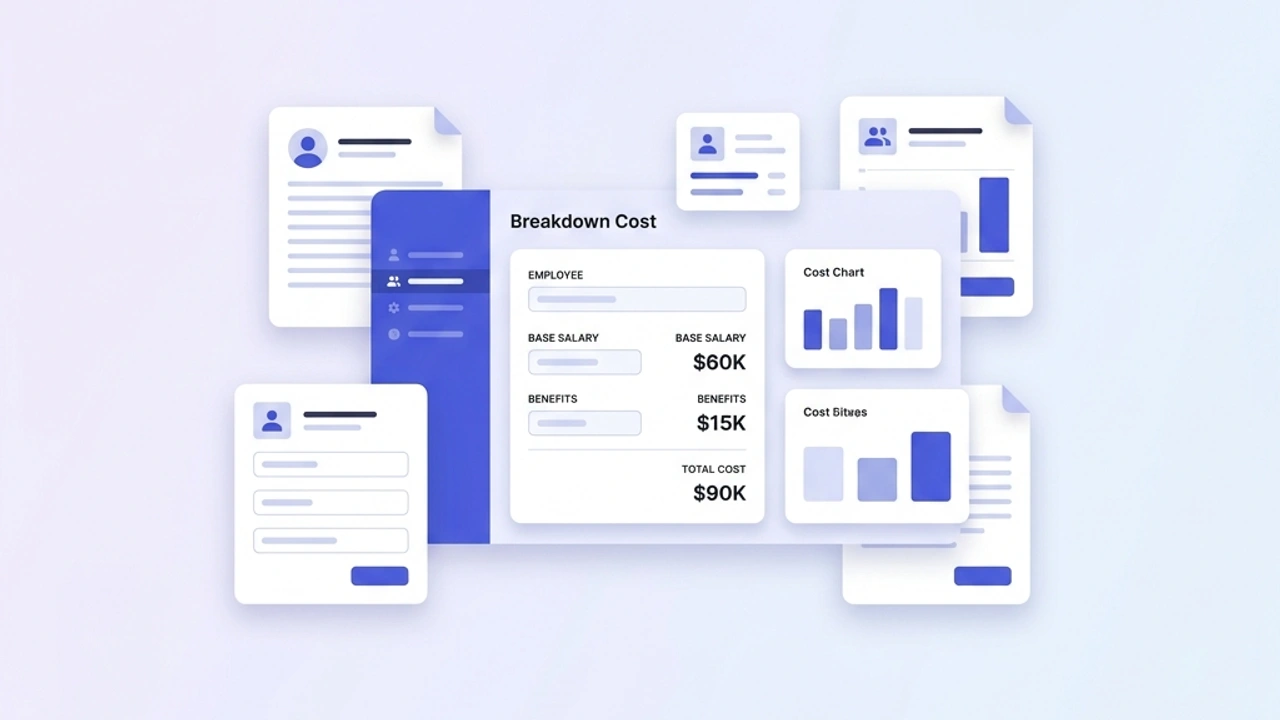
Quick Answer: The true cost of an employee goes far beyond their gross base salary, factoring in employer payroll taxes (FICA/unemployment), health benefits, retirement matching, paid leave, and workspace equipment.
• Key Formula / Standard:True Cost of Employee = Gross Salary × (1.25 to 1.40) to account for 25%–40% statutory overhead burden • Rule of Thumb / Benchmark: A $60,000 salaried employee actually costs the business between $75,000 and $84,000 per year in total cash expenses.
You have just found the perfect candidate. They accepted your offer of a $65,000 annual salary, and you are thrilled. You do the quick mental math and figure the hire will cost your business roughly $65,000 per year — a number your budget can absorb.
Six months later, you look at your actual financials and the number is nothing close to $65,000.
This is one of the most expensive mistakes business owners make, and it happens constantly. The salary printed on an employment contract is simply the tip of the iceberg. Below the waterline lies a massive, often invisible collection of mandatory employer contributions, statutory benefits, workplace overhead, and productivity costs that can push the true cost of a single employee to 1.25 to 1.4 times their base salary — or higher.
Understanding the true cost of an employee is not just useful accounting trivia. It is the fundamental information you need to make sound hiring decisions, price your services correctly, evaluate whether to hire a full-time employee or outsource to a contractor, and protect the long-term profitability of your business.
This guide will walk you through every layer of the employee cost stack, provide real calculation examples, and show you exactly how to model your total labor costs before you ever make an offer.
Table of Contents
1. Why the Salary Figure Alone Is Dangerously Misleading
When most managers think about hiring, they think about the salary line in their budget spreadsheet. This is understandable — salary is the single largest component of employee cost, and it is the number candidates negotiate over. But it creates a deeply misleading picture of what employment actually costs.
Here is a simplified view of where the gap between "quoted salary" and "true cost" comes from:
Cost Layer
Visibility
Estimated Impact
Gross Salary
Obvious
100% of base
Employer Payroll Taxes
Mandatory but often forgotten
+6% to 15%
Health & Insurance Benefits
Semi-visible
+5% to 12%
Paid Time Off
Hidden labor cost
+4% to 8%
Recruitment & Onboarding
One-time but significant
+10% to 20% of annual salary
Equipment & Software
Often overlooked
+$2,000 to $10,000 per hire
Workspace Overhead
Rarely calculated
+$5,000 to $20,000 per year
Training & Development
Ongoing
+1% to 3%
Management Overhead
Almost never counted
+10% to 15%
Taken together, these layers consistently push total employee cost to between 1.25× and 1.45× of the base salary for a typical full-time hire. For senior roles with premium benefits and expensive office space, the multiplier can reach 1.8× or higher.
👤
Employee Cost Calculator
Don't want to piece this together manually? Get a complete, itemized true cost breakdown in seconds to see what an employee really costs.
The first cost layer beyond salary is one that surprises nearly every first-time employer: the government's mandatory payroll tax requirements. These are employer-side contributions that are completely separate from what the employee pays — they come entirely out of your business's pocket.
While the specific tax rates vary significantly by country and jurisdiction, the categories are broadly consistent across most developed economies:
Social Security / National Insurance Contributions
In the United States, employers pay 6.2% of each employee's wages toward Social Security (up to the annual wage base limit, which adjusts each year). In the UK, employers pay National Insurance Contributions (NICs) at 13.8% above a certain earnings threshold. In Australia, this takes the form of Superannuation contributions (currently 11%). The label differs, but every major economy has an equivalent mandatory pension/retirement contribution system.
Medicare / Healthcare Levy
US employers pay 1.45% of all employee wages toward Medicare, with no wage cap. Other countries fold equivalent costs into broader social insurance schemes.
Unemployment Insurance
Employers fund unemployment insurance systems through payroll taxes. In the US, this is the Federal Unemployment Tax (FUTA) at 6% on the first $7,000 of wages (though credits typically reduce the effective rate to around 0.6%), plus State Unemployment Tax (SUTA) which varies widely by state and industry.
Workers' Compensation Insurance
Nearly every jurisdiction requires employers to carry workers' compensation insurance to cover employees in the event of a work-related injury. Rates vary dramatically based on the industry's risk profile — a software developer might cost 0.3% of payroll, while a construction worker might cost 8% or more.
Practical Example — US Employer:
An employee earning $65,000 per year triggers approximately:
Social Security: $65,000 × 6.2% = $4,030
Medicare: $65,000 × 1.45% = $943
FUTA (effective rate): $7,000 × 0.6% = $42
SUTA (example: 2.7% on first $7,000): $189
Workers' Comp (office role, ~0.5%): $325
Total mandatory payroll taxes: ~$5,529 (8.5% of salary)
3. Layer 2 — Employee Benefits
Benefits are increasingly viewed as a baseline expectation of employment rather than a perk, particularly in competitive hiring markets. Depending on your industry, location, and the seniority of the role, benefits can add between 5% and 30% to your total employment cost.
Health Insurance
In countries without universal employer-sponsored healthcare (most notably the United States), employer-provided health insurance is often the single largest benefit cost. Average employer contributions in the US run approximately $7,000 to $8,000 per year for individual coverage and $20,000+ for family coverage. In countries with national health systems (UK, Canada, Germany, Australia), this cost is absorbed through the tax system, reducing the direct employer obligation significantly — though employer contributions to supplementary private health cover are still common for senior roles.
Retirement / Pension Contributions
Beyond mandatory contributions, most competitive employers offer additional matched pension contributions. A typical match of "up to 4% of salary" on a $65,000 salary adds $2,600 to annual employer cost.
Paid Time Off (PTO)
This is one of the most frequently overlooked costs in employee cost analysis. When an employee takes a day off, you continue paying their salary, but you receive zero productive output. That lost productivity has a real dollar value.
PTO Cost Formula:Daily Salary Rate = Annual Salary / 260 working daysPTO Cost = Daily Rate × PTO Days Granted
For our $65,000 employee receiving 20 days of PTO:
Daily rate: $65,000 / 260 = $250/day
PTO cost: $250 × 20 days = $5,000 per year
This figure is the "ghost cost" of PTO — the salary you are paying for time the employee is not generating revenue.
Additional Benefits
Life and disability insurance: $500 to $2,000/year
Dental and vision coverage: $500 to $1,500/year
Employee Assistance Programs (EAPs): $100 to $400/year
Commuter benefits / transport allowances: Varies by location
4. Layer 3 — Recruitment and Onboarding Costs
Before your new hire generates a single dollar of value for the business, you will have already spent a substantial sum just to find and prepare them. These costs are typically one-time per hire, but they are large enough that they must be factored into your true cost analysis.
Recruitment Costs
Job board advertising: $500 to $3,000 per role (LinkedIn, Indeed, specialized boards)
Recruiter / staffing agency fees: 15% to 25% of first-year salary for professional roles. On a $65,000 hire, this alone can reach $9,750 to $16,250.
Internal recruiting time: If your HR manager spends 40 hours screening and interviewing candidates, and earns $80,000/year, that is approximately $1,538 of internal labor cost for that single hire.
Background checks and assessments: $50 to $500
Onboarding and Training Costs
Onboarding time (HR, IT setup, paperwork): 4 to 8 hours of staff time
Training and ramp-up period: During the first 1 to 3 months, new employees typically operate at 25% to 75% of full productivity while learning. You are paying full salary for reduced output.
Formal training programs: $500 to $5,000+ depending on the role
The Society for Human Resource Management (SHRM) estimates the average cost per hire in the US at around $4,700 for direct costs, while total costs including lost productivity during the ramp-up period can reach 50% to 200% of the annual salary for specialized professional roles.
5. Layer 4 — Equipment, Software, and Workspace
Every new employee requires physical and digital tools to do their job. These costs are completely separate from their salary and are frequently treated as separate line items in IT or facilities budgets — meaning hiring managers often don't associate them with the true cost of their headcount decision.
Hardware and Equipment
Laptop/computer: $1,000 to $3,500 (amortized over 3 years: $333 to $1,167/year)
Monitor, keyboard, peripherals: $300 to $800
Phone (if applicable): $500 to $1,200
Software Licenses
Every seat of your core business software has a per-user cost that scales directly with headcount:
Microsoft 365 or Google Workspace: $100 to $300/year per user
CRM software (Salesforce, HubSpot): $1,200 to $4,800/year per user
Project management tools: $100 to $500/year per user
Industry-specific software: Highly variable
A typical software stack for a single knowledge worker can easily total $2,000 to $8,000 per year in additional license costs.
Workspace Overhead
If the employee works from your physical office, every desk they occupy has a cost attached to it. You can calculate this by dividing your total monthly rent, utilities, and facilities management costs by the number of desks in the office.
For a company paying $15,000/month for office space with 50 desks, the cost per desk is $300/month ($3,600/year). Add cleaning, internet, office supplies, and common area costs, and the true workspace overhead per employee can easily reach $5,000 to $15,000 per year in major cities.
6. The Full True Cost Calculation: A Complete Example
Let's pull all of these layers together for a single, complete example. We are hiring a mid-level marketing manager in the US with a $65,000 salary.
Cost Category
Annual Amount
Base Salary
$65,000
Social Security (6.2%)
$4,030
Medicare (1.45%)
$943
Unemployment Insurance
$231
Workers' Compensation (0.5%)
$325
Health Insurance (employer share)
$7,500
Retirement Match (4%)
$2,600
Paid Time Off (20 days)
$5,000
Life & Disability Insurance
$800
Recruitment (amortized year 1)
$5,000
Equipment (amortized 3 yrs)
$1,500
Software Licenses
$3,500
Workspace Overhead
$6,000
Training & Development
$1,500
Total True Annual Cost
$104,929
Multiplier vs. Base Salary
1.61×
That $65,000 salary hire actually costs your business $104,929 per year — 61% more than the headline number. If you were planning for $65,000 and the true cost is nearly $105,000, you have a gap of $40,000 that will directly erode your profitability.
💰
Run Your Custom Hiring Scenario
Use our calculator to run this math for your specific situation, adjusting for your country's payroll tax rates, benefits, and actual overhead costs.
7. The Employee Cost Multiplier: A Quick Estimation Tool
When you need a fast estimate rather than a full breakdown, financial analysts use a simple cost multiplier to approximate the true cost of an employee. While less precise than a full itemized calculation, it provides a useful planning figure.
Guideline Multipliers by Role Type:
Role Type
Typical Multiplier
Example: $70K Salary
Entry-level / junior
1.25× to 1.35×
$87,500 to $94,500
Mid-level professional
1.35× to 1.50×
$94,500 to $105,000
Senior / specialist
1.50× to 1.70×
$105,000 to $119,000
Executive / C-suite
1.70× to 2.50×+
$119,000 to $175,000+
These multipliers are driven upward by more generous executive benefits packages, higher-value office space, larger travel and entertainment budgets, and the greater cost of recruiting senior talent.
8. Employee vs. Contractor: The Total Cost Comparison
Understanding the true cost of an employee also reframes the classic "hire vs. contract" decision. Contractors typically charge significantly higher hourly or day rates than what an equivalent salaried employee would earn per hour. However, when you factor in the full employer cost stack, the comparison often shifts dramatically.
Scenario: You need a full-time web developer.
Salaried Employee: $80,000/year → True total cost at 1.45× = $116,000/year
On the surface, the contractor looks more expensive. But consider what you are not paying for with a contractor:
No payroll taxes (they handle their own)
No health insurance
No paid time off
No equipment (typically their own)
No workspace overhead (remote)
No recruitment or onboarding costs
No long-term severance liability
Full flexibility to end the engagement
In many cases — especially for project-based, specialized, or part-time needs — contracting is actually the more cost-effective option once all employer costs are correctly modeled.
9. How Employee Cost Affects Your Pricing Strategy
The final and perhaps most commercially critical reason to understand your true employee cost is its direct connection to how you price your services.
If your business sells professional services (consulting, creative work, software development, legal services), your employees are your core "product." Underestimating how much they cost means you will systematically underprice your services, fail to cover your true overhead, and generate far less profit than your revenue numbers suggest.
For our $104,929/year marketing manager who works 2,000 hours per year but only bills 1,400 of them (allowing for internal meetings, admin, and unbillable time):
Break-even rate: $104,929 / 1,400 = $74.95/hour
At a 30% profit margin target: $74.95 / (1 - 0.30) = $107/hour minimum billing rate
If you are charging $70/hour for their time, you are actively losing money on every client engagement — even though the employee only costs you $65,000 in salary.
Final Thoughts on Hiring Economics
The single most important shift you can make as a business owner is to stop thinking about payroll in terms of salaries and start thinking about it in terms of total employment cost.
Every hiring decision you make should be treated as a multi-year capital investment, analyzed with the same rigor as buying equipment or launching a product. Before you extend any offer, ask: What is the true total cost of this hire? How long will it take for this person to generate enough revenue or cost savings to justify that investment? What would it cost to outsource the same work?
These are the questions that separate businesses that scale profitably from those that grow headcount and shrink margins at the same time.
📊
Free Employee Cost Calculator
Ready to stress-test your hiring budget? Build out your full employee cost model—it handles payroll taxes, benefits, and overhead automatically.
The true cost of an employee is their base salary plus all mandatory taxes, benefits, overhead (like office space and equipment), and administrative costs.
How much more than their salary does an employee cost?
As a general rule of thumb, an employee typically costs 1.25 to 1.4 times their base salary. So, an employee making $50,000 may actually cost the company $62,500 to $70,000.
What are payroll taxes?
In the US, employers must pay their portion of payroll taxes, which includes Social Security (6.2%), Medicare (1.45%), and federal and state unemployment taxes (FUTA/SUTA).
Do benefits significantly increase employee cost?
Yes. Health insurance, retirement plan matching (like a 401k), and paid time off are major expenses that can easily add 20% to 30% to an employee's base compensation.
Why is it important to calculate the true cost of an employee?
If you only price your services or products based on an employee's hourly wage, you will severely underprice your offerings and likely lose money due to hidden overhead costs.
#true cost of an employee calculator#employee cost breakdown#cost of hiring#payroll taxes#employee benefits cost#labor cost analysis