How to Value a Small Business: Methods and Formulas
Learn how to value a small business using SDE, EBITDA multiples, asset-based, and DCF methods. Includes valuation formulas and worked examples.
BT
Bizcalc Team
·June 15, 2026
Quick Answer & Key Summary
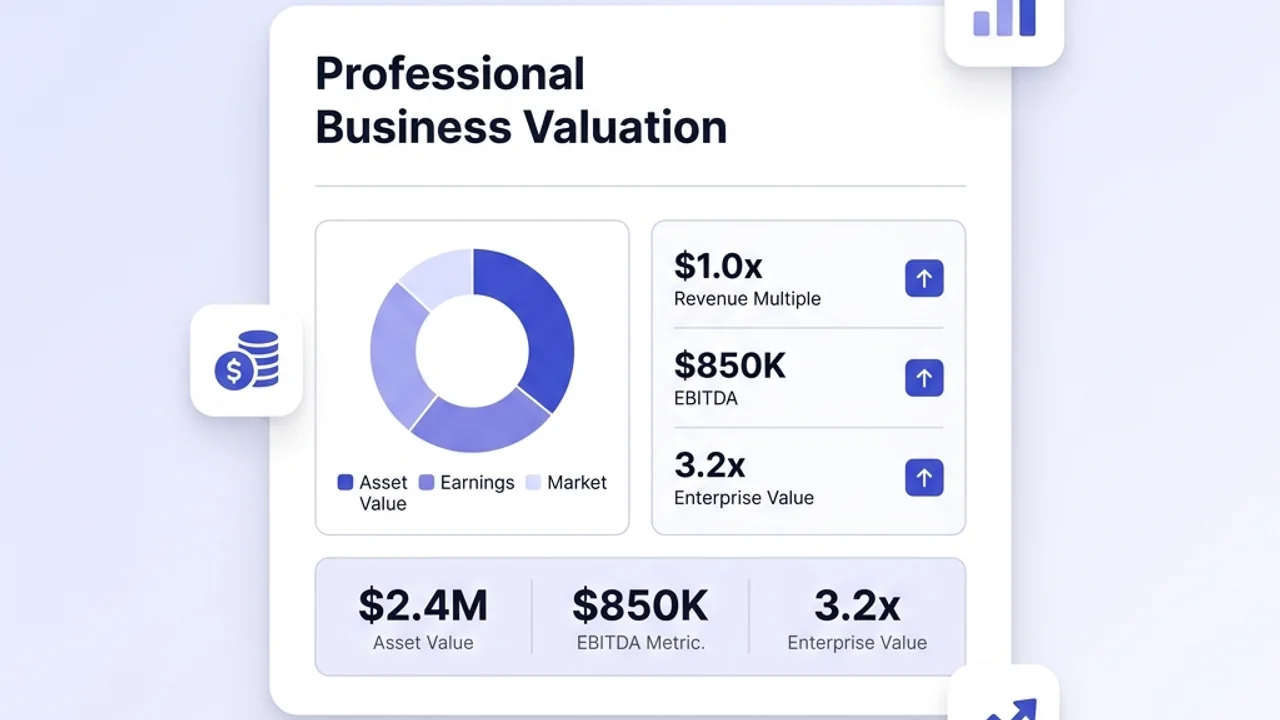
Quick Answer: Valuing a small business estimates its fair market worth using Seller's Discretionary Earnings (SDE), EBITDA multiples, asset-based appraisals, or discounted cash flow (DCF) models for acquisitions and sales.
• Key Formula / Standard:Business Value = SDE × SDE Multiple (typically 2.0x to 3.5x for owner-operated small businesses) • Rule of Thumb / Benchmark: Businesses under $1M profit trade at 2x–3x SDE; businesses exceeding $2M EBITDA trade at 5x–8x+ EBITDA.
Knowing what your business is worth is one of the most strategically important insights an owner can have — yet it is also one of the most consistently neglected. Whether you are preparing to sell, bringing on a business partner, applying for financing, planning your estate, or simply making better long-term decisions, having a credible business valuation changes how you see every major choice you make.
The challenge is that business valuation is not a single formula. It is a framework of multiple methodologies, each suited to different business types, purposes, and stages of growth. Understanding which method applies to your situation — and how to apply it correctly — can mean the difference between leaving money on the table and commanding the full premium your business deserves.
This guide walks through the main valuation methods used for small businesses, explains the formulas behind each one, provides worked examples in USD, and gives you a practical checklist to prepare for your own valuation.
🏢
Business Valuation Calculator
Plug in your annual revenue, earnings, and industry multiple to instantly estimate your business's market value using multiple methods.
Business valuation is not only for sellers. There are numerous scenarios where understanding your business's worth is critical:
Selling the business: An accurate valuation helps you set a realistic asking price and negotiate confidently with buyers.
Bringing in investors or partners: Equity deals require an agreed valuation to determine ownership percentages.
Securing business loans: Lenders use asset values and earnings capacity to assess collateral and repayment risk.
Management buyouts (MBOs): A departing owner or retiring partner needs a fair value to exit cleanly.
Estate planning and succession: Business interests must be accurately valued for inheritance, gifting, and estate tax purposes.
Divorce proceedings: Business interests are typically treated as marital assets requiring independent valuation.
Strategic benchmarking: Understanding your value trajectory over time reveals whether operational improvements are actually growing enterprise worth.
The Three Core Approaches to Business Valuation
All mainstream valuation methods fall into one of three broad categories: asset-based, income-based, and market-based. Each starts from a different premise about where value comes from, and each produces a different type of answer.
1. Asset-Based Approach
Core idea: The business is worth what it owns minus what it owes.
This approach values a business by calculating the net fair market value of all its assets after subtracting all liabilities. It comes in two variants:
Book Value Method: Uses the values recorded on the balance sheet. Simple but often misleading because balance sheets reflect historical cost, not current market value.
Adjusted Net Asset Method (Liquidation / Going Concern): Restates all assets and liabilities at their current fair market value. This is the more accurate and commonly used variant.
Formula:
Business Value = Fair Market Value of Total Assets − Total Liabilities
Best suited for: Asset-heavy businesses (manufacturing, real estate, equipment rental, trucking), holding companies, businesses being wound down, or as a valuation floor when other methods produce lower figures.
Limitation: It does not capture future earnings potential or goodwill. A profitable service business may be worth far more than its net assets.
2. Income-Based Approach
Core idea: The business is worth the present value of the income it is expected to generate in the future.
This is the most commonly used approach for operational businesses because buyers are fundamentally paying for future cash flows. There are two primary methods within this category:
A. Earnings Multiple / SDE Multiple
The most practical method for small business sales. It takes the business's normalized annual earnings and multiplies by an industry-specific factor.
The key earnings figure used varies:
Earnings Metric
Definition
Typical Users
SDE (Seller's Discretionary Earnings)
Net profit + owner's salary + add-backs (depreciation, personal expenses, one-time costs)
Businesses with revenue under $5M; owner-operated
EBITDA
Earnings Before Interest, Taxes, Depreciation, and Amortization
Mid-market businesses; private equity buyers
Net Income
Bottom-line profit after all expenses
Simple or informal valuations
Formula:
Business Value = Normalized Earnings × Industry Multiple
Typical SDE multiples for small businesses range from 1.5x to 4x, while EBITDA multiples for slightly larger businesses typically range from 3x to 8x or higher, depending on growth, industry, and quality of earnings.
B. Discounted Cash Flow (DCF)
DCF is the gold standard of finance theory. It projects the business's future free cash flows over a defined period (usually 5–10 years) and discounts them back to today's value using a discount rate that reflects the risk of receiving those cash flows.
Formula:
Business Value = Σ [CFₜ ÷ (1 + r)ᵗ] + Terminal Value
Where:
CFₜ = Free cash flow in year t
r = Discount rate (weighted average cost of capital or required rate of return)
t = Year number
Terminal Value = Estimated value of all cash flows beyond the projection period
DCF is powerful but highly sensitive to assumptions. Small changes in the growth rate or discount rate can produce dramatically different valuations. It is most reliable when a business has a stable, predictable cash flow history and when the assumptions are conservatively grounded in historical performance.
3. Market-Based Approach
Core idea: The business is worth what similar businesses have sold for.
Just as residential real estate is valued using comparable sales, businesses can be valued by comparing them to recently sold businesses of similar size, industry, and financial profile.
A. Comparable Transactions (Comps)
Search databases of completed business sales (such as BizBuySell, DealStats, or PeerComps) for businesses in the same industry with similar revenue and earnings. Identify the median sale price-to-revenue or sale price-to-EBITDA multiple and apply it to your business.
B. Revenue Multiple
For businesses where earnings are not yet stable or meaningful, a revenue multiple provides a simple market-based benchmark.
Formula:
Business Value = Annual Revenue × Revenue Multiple
Revenue multiples for small businesses typically range from 0.3x to 1.5x annual revenue, though high-growth technology or SaaS businesses can attract multiples of 3x to 10x or more based on recurring revenue quality and growth trajectory.
Step-by-Step: Calculating Your Business Value
Here is a practical five-step process you can follow to estimate your own business value using the earnings multiple method — the most practical approach for most small business owners.
Step 1: Gather Three Years of Financial Statements
Collect your profit and loss statements (income statements) for the last three full fiscal years. Using multiple years smooths out anomalies and gives buyers a more reliable picture of earning power.
Step 2: Normalize Your Earnings
"Normalize" means adjusting your reported earnings to reflect the true, recurring profitability of the business. Add back:
Your own salary (and any family members' salaries that exceed market rates)
Personal expenses run through the business (vehicle, phone, travel)
Non-cash charges (depreciation, amortization)
Interest expenses (capital structure is buyer's choice, not business value)
The result is your Seller's Discretionary Earnings (SDE) or adjusted EBITDA.
Step 3: Select the Appropriate Earnings Figure
Use SDE if you are a hands-on owner-operator with revenue under $5M. Use EBITDA if your business has a management team in place and revenue over $2M, or if you are preparing for a sale to a private equity or institutional buyer.
Step 4: Determine Your Industry Multiple
Research comparable transactions in your industry. Common SDE multiple ranges by sector:
Industry
Typical SDE Multiple
Professional Services (accounting, law, consulting)
1.5x – 3.0x
Retail (brick-and-mortar)
1.5x – 2.5x
E-commerce
2.0x – 4.0x
Food and Beverage / Restaurants
1.5x – 2.5x
Construction and Trades
2.0x – 3.5x
Technology / SaaS (small)
3.0x – 6.0x
Healthcare (clinics, dental, optometry)
2.5x – 4.5x
Manufacturing
2.5x – 4.0x
Distribution / Wholesale
2.0x – 3.5x
These ranges are indicative. Your specific multiple will be influenced by factors such as customer concentration, contract quality, competitive defensibility, and owner dependency.
Step 5: Apply the Formula and Triangulate
Multiply your normalized earnings by your chosen multiple. Then cross-check using at least one other method (asset-based or revenue multiple) to ensure the result is reasonable.
🏢
Business Valuation Calculator
Enter your financials and instantly see your estimated business value across multiple valuation methods — no spreadsheet required.
Additionally, the business holds $45,000 in inventory at cost, which a buyer would likely pay separately as an asset add-on, bringing the total transaction value to approximately $675,000.
Example 3: DCF Valuation for a Stable Service Business
Business: A commercial cleaning company with long-term contracts generating stable cash flows.
Projected Free Cash Flows:
Year
Projected FCF
Discount Factor (15%)
Present Value
Year 1
$120,000
0.870
$104,400
Year 2
$130,000
0.756
$98,280
Year 3
$140,000
0.658
$92,120
Year 4
$148,000
0.572
$84,656
Year 5
$156,000
0.497
$77,532
Terminal Value
$780,000
0.497
$387,660
Total Business Value
$844,648
Terminal value assumes a 5x multiple on Year 5 FCF, discounted back at 15%. The 15% discount rate reflects the elevated risk typical of a small privately-held business.
Factors That Increase or Decrease Your Valuation Multiple
Understanding what drives multiples gives you a roadmap for building a more valuable business before you sell.
Value Drivers (Increase Multiple)
Recurring revenue: Subscription contracts, retainer agreements, and long-term service contracts all increase revenue predictability and command premium multiples.
Low owner dependency: A business that runs effectively without the owner's daily involvement is far more transferable and valuable.
Diversified customer base: No single customer representing more than 10–15% of revenue reduces concentration risk.
Documented systems and processes: Standard operating procedures (SOPs), trained staff, and documented workflows increase buyer confidence.
Strong profit margins: Margins above the industry average signal competitive advantage and pricing power.
Consistent growth: A 3–5 year track record of steady revenue and earnings growth justifies higher multiples.
Proprietary IP or brand: Trademarks, patents, exclusive supplier agreements, or strong brand recognition add defensible value.
Value Destroyers (Decrease Multiple)
Heavy owner dependency: Buyers heavily discount businesses where all key relationships, expertise, or decisions sit with one person.
Customer concentration: If one client represents 40% of revenue, that client's departure could devastate the business.
Declining revenue trends: Even one or two years of declining revenue raises questions about business health.
Inconsistent or undocumented financials: Poor bookkeeping increases perceived risk and makes due diligence painful.
Deferred maintenance or capex: Aging equipment or infrastructure that will require near-term replacement increases the buyer's true cost.
Industry headwinds: Businesses in structurally declining industries (certain retail formats, print media) face compressed multiples regardless of current performance.
What Is Goodwill and How Is It Calculated?
In business transactions, goodwill is the portion of the purchase price that exceeds the fair market value of the net tangible assets. It represents the intangible premium a buyer pays for the business's reputation, customer relationships, trained workforce, location advantages, and know-how.
Goodwill Formula:
Goodwill = Purchase Price − Fair Market Value of Net Identifiable Assets
Example:
Agreed purchase price: $600,000
Fair market value of equipment: $80,000
Inventory: $35,000
Accounts receivable: $25,000
Total identifiable assets: $140,000
Liabilities assumed: $30,000
Net identifiable assets: $110,000
Goodwill = $600,000 − $110,000 = $490,000
In this example, the buyer is paying $490,000 for the intangible value of the business — its brand, relationships, and earnings potential — and $110,000 for its tangible net assets.
For service businesses, professional practices, and software companies, goodwill often represents 70–90% of the total transaction value.
Preparing Your Business for Valuation: A Checklist
Whether you are planning a formal sale or simply want a credible internal estimate, preparing clean, organized documentation makes the process faster and produces a more reliable result.
Gather 3 years of financial statements — profit and loss, balance sheet, and cash flow statements, preferably prepared or reviewed by an accountant.
Prepare a list of all add-backs — document every non-recurring expense, personal expense, and non-cash charge with supporting evidence.
Compile a complete asset list — all equipment, vehicles, inventory, intellectual property, and real estate with current market values.
List all liabilities — loans, lines of credit, deferred revenue, contingent liabilities, and lease obligations.
Document recurring revenue — contracts, subscriptions, and retainer agreements with remaining terms.
Prepare a customer concentration analysis — show revenue breakdown by top 10 customers and their tenure.
Review your legal structure — confirm whether the sale would be structured as an asset sale or share/stock sale, as this affects both valuation and tax treatment.
Identify key person dependencies — document which roles are owner-held and create transition plans to show transferability.
Benchmark against industry comps — research recent comparable sales in your sector using business broker databases or industry associations.
Engage professional advisors — for formal transactions over $500,000, engage a business broker, M&A advisor, or certified valuator.
To model the full cost impact of your workforce — including salaries, payroll taxes, and benefits — before or after a business sale or acquisition, the Employee Cost Calculator can give you a clear picture of true labor obligations.
Choosing the Right Valuation Method for Your Business
No single method is right for every situation. Here is a quick reference guide to help you select the most appropriate approach:
Situation
Recommended Method
Profitable, owner-operated business under $5M revenue
SDE Multiple
Profitable business with management team, $2M–$20M revenue
EBITDA Multiple
Early-stage or pre-profit business with strong revenue
Revenue Multiple
Asset-heavy business (manufacturing, fleet, equipment)
Adjusted Net Asset + Earnings Multiple
Stable business with predictable long-term contracts
DCF + Earnings Multiple
Formal sale, financing, or legal proceeding
Professional appraisal (all methods triangulated)
Quick strategic estimate
Revenue Multiple as a starting benchmark
The most defensible valuations use two or three methods and present a justified range rather than a single point estimate. Buyers and sellers rarely agree on every assumption, but triangulating from multiple approaches helps both parties find fair common ground.
Final Thoughts
Valuing a small business is part science and part art. The formulas provide a rigorous structure, but the judgment calls — which multiple to apply, how to treat a one-time expense, what growth rate is realistic — require experience and an honest assessment of the business's strengths and weaknesses.
For most small business owners, the single most important step is simply to start. Running the numbers — even with a basic earnings multiple — gives you an invaluable baseline for strategic planning, and understanding the key value drivers gives you a clear roadmap for growing enterprise worth long before a transaction is on the horizon.
📊
Profit Margin Calculator
See exactly how your revenue, costs, and margins feed into your business valuation — plug in your numbers and instantly understand your profitability profile.
What is the most common method to value a small business?
The most widely used method for small businesses is the earnings multiple (or EBITDA multiple) approach, which multiplies the business's annual earnings or EBITDA by an industry-specific factor. It is popular because it directly reflects the business's ability to generate profit, which is what most buyers are paying for.
What is a typical valuation multiple for a small business?
Most small businesses sell for 2x to 5x their annual EBITDA or seller's discretionary earnings (SDE). The exact multiple depends on the industry, growth rate, customer concentration, competitive position, and how dependent the business is on the owner. Higher-quality, more systemized businesses attract higher multiples.
How do you value a small business with no profit?
For businesses with no profit or negative earnings, valuation shifts to revenue multiples or asset-based methods. A revenue multiple (typically 0.3x to 1.5x annual revenue) is applied for businesses with strong top-line growth. Asset-based valuation is used for businesses whose primary value lies in their tangible assets, such as equipment, inventory, or real estate.
Does goodwill count toward a small business valuation?
Yes. Goodwill represents the intangible value of a business beyond its net assets — including brand reputation, customer relationships, proprietary processes, and trained staff. It is calculated as the difference between the agreed purchase price and the fair market value of the net tangible assets. For service and knowledge businesses, goodwill often represents the largest component of value.
Should I hire a professional to value my business?
For informal purposes such as strategic planning or a preliminary sales estimate, self-directed methods and online calculators are sufficient. For formal events — such as a legal sale, partnership buyout, divorce proceedings, or financing applications — a Certified Business Valuator (CBV), Chartered Business Valuator, or licensed appraiser should be engaged to produce a defensible, credentialed valuation report.
#how to value a small business#business valuation methods#small business valuation#business valuation formula#valuing a business