How to Calculate Overtime Pay (Rules, Formulas, Examples)
A comprehensive guide on how to calculate overtime pay for employers and employees. Learn standard formulas, regional rules, and see detailed payroll examples.
BT
Bizcalc Team
·June 15, 2026
Quick Answer & Key Summary
Quick Answer: Overtime pay compensates non-exempt employees for hours worked beyond 40 within a single statutory 7-day workweek, mandated at 1.5 times the employee's regular hourly rate under federal FLSA regulations.
• Key Formula / Standard:Overtime Pay = (Regular Hourly Rate × 1.5) × Overtime Hours Worked (> 40 hrs) • Rule of Thumb / Benchmark: Overtime premium is 1.5x for standard weekly overtime; California additionally mandates 2.0x for work over 12 hours/day.
Managing payroll requires absolute precision, and one of the most critical aspects of this process is calculating overtime pay. For business owners, HR professionals, and employees alike, understanding the rules, formulas, and legal frameworks surrounding overtime is essential. Getting it wrong can lead to costly compliance penalties, legal disputes, underpaid employees, or misallocated business budgets.
While the concept of overtime is straightforward—paying employees more for working extra hours—the implementation involves a complex mix of local labor laws, standard multipliers, specific regular rate calculations, and contract variations. Different countries, states, and industries have their own rules regarding when overtime triggers, who is eligible, and how much must be paid.
This guide provides a comprehensive, step-by-step breakdown of how to calculate overtime pay. We will cover the core formulas, discuss eligibility categories, look at international rules, and review real-world calculations for both hourly and salaried staff.
⏰
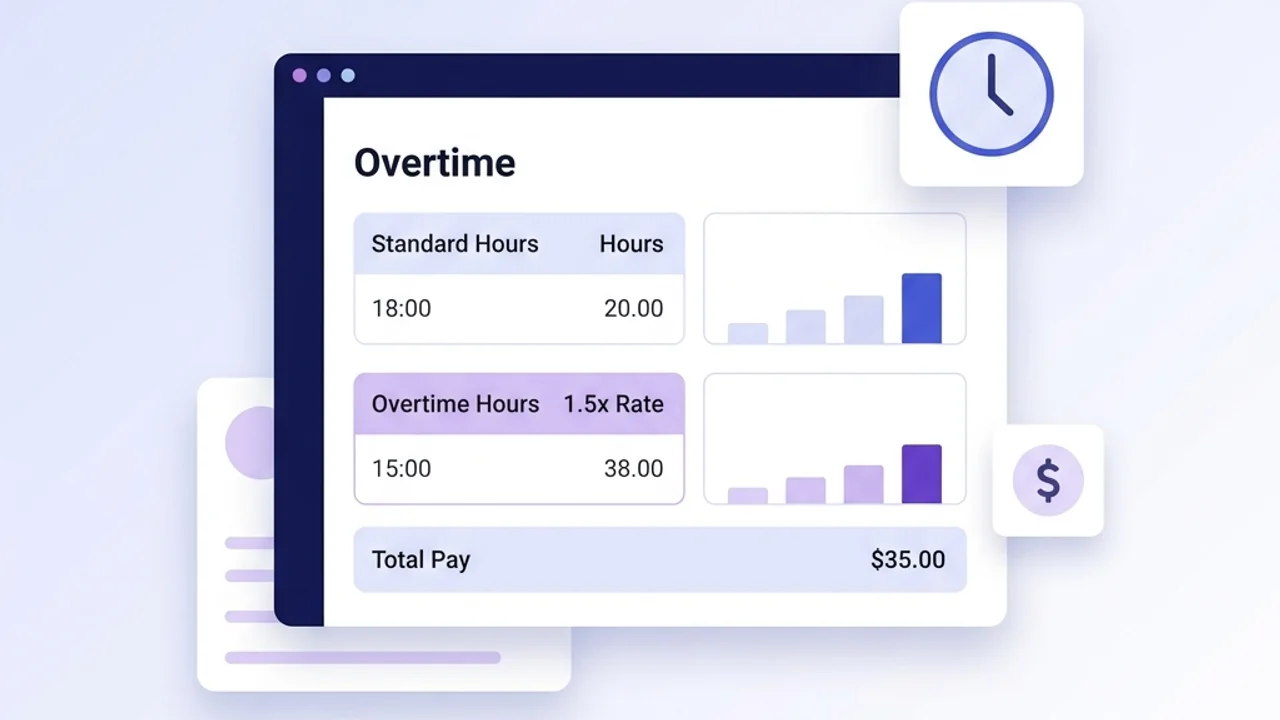
Overtime Pay Calculator
Plug in your hourly rate, standard hours, and overtime hours to instantly see your total compensation and rate breakdown.
Overtime pay is the additional compensation paid to employees for hours worked beyond their standard working hours. The standard workweek varies by region and industry, but it typically ranges between 35 and 40 hours. Hours worked past this threshold are compensated at a premium rate, which is legally mandated in most industrial nations to prevent worker exploitation and incentivize hiring.
Historically, overtime regulations were established to encourage companies to hire more staff rather than overworking their existing workforce. By making extra hours more expensive, governments created a financial incentive for employers to distribute labor across more individuals. Today, overtime serves as both a statutory right for employees and a key operational metric for businesses.
Regular Rate of Pay vs. Base Hourly Rate
Before diving into formulas, it is crucial to understand the difference between an employee's "base hourly rate" and their "regular rate of pay."
Base Hourly Rate: The standard rate an employee is contracted to earn per hour of regular work (e.g., $20 per hour).
Regular Rate of Pay: The actual rate used to calculate overtime. This includes not only the base hourly rate but also other forms of compensation like non-discretionary bonuses, commissions, shift differentials, and production incentives.
If an employee receives bonuses or commissions, their regular rate of pay will be higher than their base rate. Under most labor standards, employers must calculate overtime based on this comprehensive regular rate, not just the base rate.
Who Qualifies for Overtime Pay?
Not everyone who works extra hours is legally entitled to overtime compensation. Eligibility depends on job classifications, salary levels, and local legislation.
Exempt vs. Non-Exempt Employees
In jurisdictions like the United States and Canada, workers are broadly categorized into two groups:
Non-Exempt Employees: These employees are entitled to overtime pay. They are typically paid hourly, but they can also be salaried. By law, employers must pay them overtime rates for any extra hours worked.
Exempt Employees: These employees are excluded from overtime protections. To be classified as exempt, workers must usually meet specific criteria, which often include:
Earning above a legally defined salary threshold.
Performing specific job duties, such as executive, administrative, professional, or outside sales roles.
Hourly vs. Salaried Employees
It is a common misconception that all salaried employees are exempt from overtime. In reality, a salaried employee who performs non-exempt duties (such as customer service, administrative support, or manual labor) and earns below the statutory salary threshold is still entitled to overtime. Their salary must be converted to an equivalent hourly rate to calculate the overtime owed.
Conversely, contract workers, freelancers, and independent contractors are generally responsible for setting their own rates and are not covered by statutory overtime laws. Instead, any premium pay for extra hours must be negotiated directly within their service contracts.
The Core Overtime Formulas
The calculation of overtime pay depends on the multiplier required by law or contract. The two most common multipliers are "time-and-a-half" and "double time."
1. Time-and-a-Half (1.5x) Formula
This is the standard rate for overtime in most parts of the world. It requires paying employees 1.5 times their regular hourly rate for any hours worked beyond the regular threshold.
Overtime Rate = Regular Hourly Rate × 1.5
Overtime Pay = Overtime Rate × Overtime Hours Worked
Total Pay = (Regular Hours Worked × Regular Hourly Rate) + Overtime Pay
2. Double Time (2.0x) Formula
Double time is paid under specific circumstances, such as working on public holidays, Sundays, or after working a certain number of overtime hours in a single day or week (e.g., working more than 12 hours in a single day in some regions).
Double Time Rate = Regular Hourly Rate × 2.0
Double Time Pay = Double Time Rate × Double Time Hours Worked
Summary of Common Multipliers
Multiplier Name
Factor
When Typically Applied
Formula
Regular Time
1.0x
Within standard daily/weekly hours
Rate × Hours
Time-and-a-Half
1.5x
Standard overtime hours (e.g., >40 hours/week)
Rate × 1.5 × Hours
Double Time
2.0x
Holidays, Sundays, or extreme overtime (e.g., >12 hours/day)
Rate × 2.0 × Hours
Step-by-Step Guide: How to Calculate Overtime Pay
To ensure compliance and accuracy, follow these steps when calculating overtime for any pay period:
Step 1: Identify Standard and Overtime Hours Worked
Review the employee's timesheet for the pay period. Separate the hours worked into regular hours (up to the daily or weekly threshold) and overtime hours.
Note: In weekly systems, only hours actually worked count toward the threshold. Paid time off (PTO), sick leave, and holidays typically do not count as hours worked when determining if an employee has exceeded their standard weekly hours.
Step 2: Establish the Regular Hourly Rate of Pay
For hourly workers with no extra compensation, this is their base hourly rate. For salaried workers, calculate the regular hourly rate by dividing their weekly salary equivalent by their standard hours. For employees with bonuses or commissions, add these earnings to their base pay for the week and divide by the total hours worked.
Step 3: Determine the Overtime Multiplier
Check the local employment laws or collective bargaining agreements to identify the correct multiplier (usually 1.5x, but sometimes 2.0x for holidays or consecutive days of work).
Step 4: Compute the Overtime Rate
Multiply the regular hourly rate by the overtime multiplier.
Step 5: Calculate Overtime Earnings
Multiply the overtime hours worked by the overtime rate.
Step 6: Calculate Total Gross Pay
Add the regular earnings to the overtime earnings.
⏰
Overtime Pay Calculator
Model different overtime scenarios and regular wage structures to quickly calculate exact payroll additions for any period.
In some regions (like California, British Columbia, or parts of Australia), overtime is calculated on a daily basis. Let's assume a daily threshold of 8 hours, after which overtime is paid at 1.5x, and a daily threshold of 12 hours, after which double time (2x) is paid.
Total Pay = $836.00 + $198.00 + $44.00 = $1,078.00
Note: In daily overtime systems, weekly thresholds still apply. If an employee's total regular hours for the week exceed 40, any additional standard hours must also be paid at the overtime rate, though hours already paid as daily overtime are not counted twice.
Example 3: Non-Exempt Salaried Employee
An administrative assistant earns a fixed salary of $800.00 per week for a scheduled 40-hour workweek. They work 45 hours in a busy week. Because their job duties do not meet the criteria for an exemption, they are entitled to overtime.
Calculate the Regular Hourly Rate:
Hourly Rate = Weekly Salary ÷ Scheduled Hours
Hourly Rate = $800.00 ÷ 40 = $20.00/hour
Separate the Hours:
Regular Hours = 40
Overtime Hours = 5
Calculate the Overtime Rate:
Overtime Rate = $20.00 × 1.5 = $30.00/hour
Calculate Overtime Pay:
Overtime Pay = 5 hours × $30.00/hour = $150.00
Calculate Total Pay:
Total Pay = $800.00 (Salary) + $150.00 (Overtime) = $950.00
Example 4: Weighted Average (Blended) Overtime
When an employee works two or more different jobs for the same employer at different rates of pay, the employer cannot simply calculate overtime based on the highest or lowest rate. Instead, they must use a "weighted average" of the rates to determine the regular rate of pay for overtime purposes.
An employee works 30 hours as a Customer Service Agent at $15.00/hour, and 15 hours as a Shift Supervisor at $20.00/hour. Total hours worked = 45. The weekly threshold is 40 hours.
Calculate Total Regular Earnings (at straight-time rates):
Job 1 Earnings = 30 hours × $15.00/hour = $450.00
Job 2 Earnings = 15 hours × $20.00/hour = $300.00
Total Straight-Time Earnings = $450.00 + $300.00 = $750.00
Calculate the Weighted Average Hourly Rate:
Weighted Rate = Total Straight-Time Earnings ÷ Total Hours Worked
Weighted Rate = $750.00 ÷ 45 hours = $16.67/hour
Determine the Overtime Premium Rate:
Because the straight-time rate has already been paid for all 45 hours in step 1, we only need to add the remaining half-time premium (0.5x) for the 5 overtime hours.
Total Pay = Total Straight-Time Earnings + Overtime Premium Pay
Total Pay = $750.00 + $41.70 = $791.70
International Overtime Rules and Regulations
Overtime laws are highly dependent on geography. It is vital for companies with remote teams or international operations to understand these regional differences.
United States (FLSA Rules)
Under the Fair Labor Standards Act (FLSA), non-exempt employees must receive overtime pay for hours worked over 40 per workweek at a rate of at least 1.5 times their regular rate of pay. There is no federal limit on the number of hours an employee can work in a workday, nor is daily overtime required. However, individual states (such as California, Alaska, and Nevada) enforce stricter daily overtime laws.
Canada (Provincial Rules)
Canada's overtime regulations are determined at the provincial and territorial levels, except for federally regulated industries (like banking and telecommunications, which follow the Canada Labour Code's 8-hour daily and 40-hour weekly thresholds).
Ontario: Overtime starts after 44 hours per week at 1.5x regular pay.
British Columbia & Alberta: Overtime starts after 8 hours per day or 44 hours per week (BC is 40 hours) at 1.5x. Double time (2x) applies after 12 hours in a day.
Quebec: Overtime starts after 40 hours per week at 1.5x.
United Kingdom (Working Time Regulations)
In the UK, there is no statutory legal right to receive overtime pay. However, employers must ensure that the employee's average pay for the hours they work does not fall below the National Minimum Wage. Additionally, the Working Time Regulations state that employees cannot work more than 48 hours per week on average, unless they sign an "opt-out" agreement. Any overtime rates must be agreed upon in the employment contract.
European Union (Working Time Directive)
EU law protects workers through the Working Time Directive, which requires member states to guarantee:
A limit to weekly working time, which must not exceed 48 hours on average, including overtime.
A minimum daily rest period of 11 consecutive hours.
At least 24 hours of uninterrupted weekly rest.
Actual overtime payment rates are governed by national laws and collective agreements within each specific country (e.g., France's 35-hour workweek rules).
Australia (Modern Awards and NES)
Australia operates under a system of National Employment Standards (NES) and industry-specific "Modern Awards." The standard full-time workweek is 38 hours. Any hours worked beyond 38 hours must be "reasonable." Overtime rates, including penalty rates for weekends and public holidays, are heavily detailed within the specific Modern Award that applies to the employee's role and industry.
Best Practices for Managing Overtime
For businesses, overtime can be a valuable tool for handling seasonal demand, unexpected staffing shortages, or sudden projects. However, unmanaged overtime can quickly erode profit margins and lead to employee burnout.
1. Maintain Clear Written Policies
Establish a clear overtime policy in the employee handbook. The policy should define:
What constitutes standard hours vs. overtime.
The process for obtaining authorization to work overtime.
How overtime hours must be recorded and submitted.
The consequences of working unauthorized overtime (while unauthorized overtime must still be paid by law, employers can address the policy violation through standard disciplinary procedures).
2. Implement Reliable Time-Tracking Software
Manual tracking using paper timesheets or spreadsheets is prone to errors, rounding disputes, and deliberate time card fraud. Utilizing digital time clocks, geofenced mobile apps, or integrated scheduling software ensures that actual hours are tracked down to the minute.
3. Establish a Pre-Approval Process
Require manager approval for any work hours expected to exceed the standard daily or weekly thresholds. This helps supervisors adjust schedules, reallocate tasks, or bring in temporary help before expensive overtime costs are incurred.
4. Conduct Regular Payroll Audits
Review timesheets and calculations regularly to catch mistakes early. Ensure that shift differentials, bonuses, and commissions are correctly integrated into the "regular rate of pay" calculations. Comparing scheduled hours against actual hours can help identify chronic understaffing issues.
If you are an employer looking to budget for new hires, it is helpful to calculate your total labor costs. Check out the Employee Cost Calculator to model payroll taxes, pension contributions, and insurance obligations alongside base wages.
Common Overtime Pitfalls to Avoid
Failing to calculate overtime correctly can lead to investigations by labor departments, back-pay audits, and substantial fines. Avoid these common mistakes:
Pitfall 1: Misclassifying Non-Exempt Workers as Exempt
Many employers assume that putting an employee on a salary or giving them a "manager" title automatically makes them exempt from overtime. Job duties and salary levels are the only legal metrics that determine exemption status. Always verify that an employee meets the strict legal criteria before classifying them as exempt.
Pitfall 2: Excluding Bonuses and Commissions from the Overtime Calculation
When calculating the overtime rate, you must divide all straight-time earnings (base pay + non-discretionary bonuses + commissions) by the total hours worked in that week to establish the regular rate of pay. Excluding these additional earnings results in underpaying overtime.
Pitfall 3: Offering "Comp Time" Instead of Overtime Pay
In many jurisdictions, private sector employers cannot offer "compensatory time off" (comp time) in lieu of overtime pay. If a non-exempt employee works 45 hours, they must be paid for 40 regular hours and 5 overtime hours. You cannot simply give them 7.5 hours of paid time off in a future week unless you are a public sector employer or operate under specific legal allowances.
Pitfall 4: Failing to Pay for "Off-the-Clock" Work
If an employee is performing work-related tasks, they must be paid. This includes checking emails from home, attending pre-shift meetings, cleaning workstations after clocking out, or traveling between job sites. If these activities push their hours over the threshold, overtime rates apply.
Checklist for Compliance
Whether you are an employer processing payroll or an employee verifying your payslip, use this checklist to ensure overtime calculations are correct:
Establish standard working hours: Confirm the daily and weekly hour limits for the specific jurisdiction and contract.
Identify non-exempt status: Verify the employee's classification based on their actual job duties and salary.
Track all actual hours worked: Ensure all time spent performing job duties, including minor pre/post-shift tasks, is logged.
Determine the correct rate: Check if there are bonuses, commissions, or shift differentials that must be added to the regular rate of pay.
Apply correct multipliers: Use the appropriate factor (1.5x, 2.0x) based on the day of the week, total hours, or public holiday rules.
Exclude non-work hours: Verify that paid leaves (sick time, vacation, holidays) are excluded from the overtime hours calculation.
Process timely payments: Ensure overtime earnings are paid in the pay period they were worked, or within the legally allowed processing window.
By following these principles and utilizing tools like our Hourly to Salary Calculator, you can maintain compliance, protect profit margins, and ensure fair compensation across your organization.
💰
Hourly to Salary Calculator
Convert your hourly rate (including standard and overtime estimates) into a regular annual salary structure in seconds.
In many countries, the standard overtime rate is 1.5 times the employee's regular hourly rate, often called time-and-a-half. Some jurisdictions or contracts also specify double time (2.0 times the regular rate) for work on holidays or consecutive rest days.
Who is eligible for overtime pay?
Generally, non-exempt hourly employees are legally entitled to overtime pay once they exceed standard daily or weekly hour limits. Salaried employees may also qualify depending on local employment laws, their job duties, and salary thresholds.
How is overtime calculated for salaried employees?
To calculate salaried overtime, first determine the employee's regular hourly rate by dividing their weekly salary equivalent by their contracted hours. Then apply the applicable overtime multiplier (typically 1.5) to any hours worked beyond the standard limit.
Does sick leave or holiday time count toward overtime hours?
In most jurisdictions, only actual hours worked count toward the overtime threshold. Paid leave, sick days, or holidays do not count as hours worked for calculating overtime unless specified otherwise by company policy or a collective bargaining agreement.
How do daily and weekly overtime thresholds differ?
Daily overtime requires paying overtime rates for any hours worked beyond a daily limit (e.g., 8 hours in California or parts of Canada). Weekly overtime calculates overtime based on hours exceeding a weekly limit (typically 38 or 40 hours) regardless of daily patterns.