CPM vs CPC vs CPL: Which Metric Should You Optimize For?
Understand CPM vs CPC vs CPL. Learn the formulas, see how they connect, read worked examples, and discover which bidding metric to optimize for your campaigns.
BT
Bizcalc Team
·June 16, 2026
Quick Answer & Key Summary
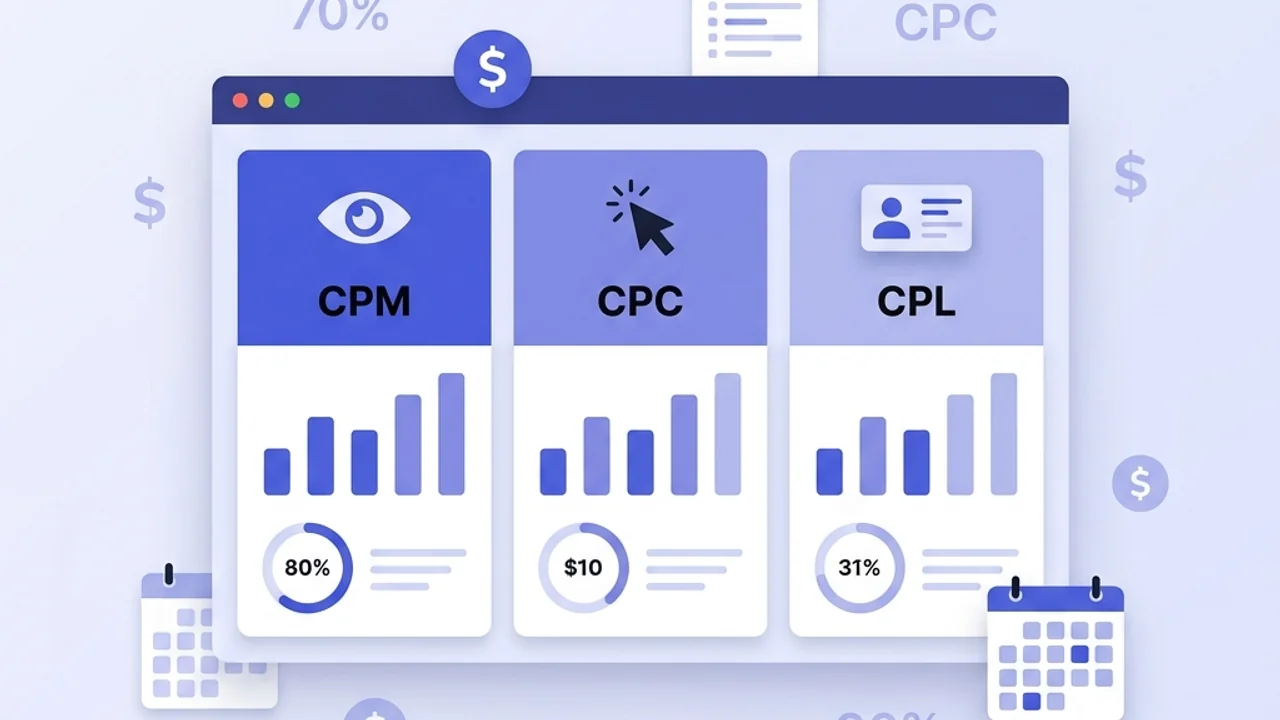
Quick Answer: CPM (Cost Per Mille) prices advertising per 1,000 impressions, CPC (Cost Per Click) charges only when prospects click, and CPL (Cost Per Lead) bills upon verified contact info submission, mapping to different funnel stages.
• Key Formula / Standard:CPM = (Ad Spend ÷ Impressions) × 1,000 | CPC = Ad Spend ÷ Clicks | CPL = Ad Spend ÷ Leads • Rule of Thumb / Benchmark: Target CPMs under $15 for top-of-funnel brand awareness; target CPCs under $2.50 for mid-funnel search intent.
Digital advertising platforms like Google, Meta, TikTok, and LinkedIn offer marketers an incredible amount of control. You can target users down to their exact interests, schedule ads for specific hours of the day, and allocate budgets of any size. But along with this control comes a flood of metrics. When setting up a campaign, you are immediately asked to choose a bidding strategy: do you want to pay for impressions (CPM), clicks (CPC), or conversions (CPL/CPA)?
Choosing the wrong optimization target is one of the most common ways businesses burn their marketing budgets. Bidding for impressions when you need leads can result in massive exposure but zero sales. Conversely, bidding for leads on a brand-new account with no tracking data can cause your campaigns to stall entirely.
To build a profitable marketing engine, you must understand the mathematical relationships between CPM, CPC, and CPL. This guide covers each metric in detail, explains how they connect, walks through step-by-step calculations, and provides a framework to help you choose the right metric to optimize for your campaigns.
📊
CPM CPC CPL Calculator
Enter your campaign spend, impressions, clicks, and leads to instantly calculate and compare your advertising costs across all three key metrics.
CPM stands for Cost Per Mille (mille is the Latin word for thousand), representing the cost an advertiser pays for 1,000 views or impressions of their advertisement. An "impression" is recorded every time an ad is displayed on a user's screen, regardless of whether they click on it or even look at it.
CPM is the oldest and most fundamental digital advertising metric. Traditional media buying (television, print, and billboards) operates on a similar concept of reach and frequency.
The CPM Formula
To calculate CPM, divide your total ad spend by the total number of impressions, and multiply by 1,000:
CPM = (Total Ad Spend ÷ Total Impressions) × 1,000
For example, if you spend $600 running display banners on a local news site and receive 80,000 impressions, the calculation is:
CPM = ($600 ÷ 80,000) × 1,000 = $7.50
You paid $7.50 for every 1,000 times your ad appeared on a screen.
When to Optimize for CPM
Brand Awareness Campaigns: When your goal is to get your logo, product name, or message in front of as many people as possible.
Video Reach: When launching a new product video or brand film where you want maximum views.
High Click-Through Rates (CTR): If you have a highly engaging ad that earns clicks at a rate well above average, buying impressions on a CPM model can be cheaper than paying for each click. This is known as CTR arbitrage.
What Is CPC (Cost Per Click)?
CPC stands for Cost Per Click, representing the actual price you pay each time a user clicks on one of your digital advertisements, directing them to your website or landing page.
In a CPC model, you do not pay for impressions. If your ad is displayed 10,000 times but receives zero clicks, you pay nothing. This shifts the risk of ad performance from the advertiser to the platform, making CPC a highly popular model for businesses targeting immediate website traffic.
The CPC Formula
To calculate CPC, divide the total ad spend by the total number of clicks received:
CPC = Total Ad Spend ÷ Total Clicks
Using the same example, if your $600 campaign generated 400 clicks, the calculation is:
CPC = $600 ÷ 400 = $1.50
Every visitor who arrived on your site from that ad campaign cost you $1.50.
When to Optimize for CPC
Driving Website Traffic: When your goal is to get qualified prospects to read a blog post, visit a product page, or view a portfolio.
Direct Response with Low Budgets: When you have limited budget and cannot afford to pay for impressions that do not lead to site visits.
Paid Search Advertising: Search engines (like Google or Bing) operate almost exclusively on a pay-per-click (PPC) model because users are actively searching for information.
What Is CPL (Cost Per Lead)?
CPL stands for Cost Per Lead, representing the cost an advertiser incurs for every user who completes a lead form, signs up for a newsletter, registers for a webinar, or takes an action that provides their contact details to the business.
CPL is a bottom-funnel direct-response metric. It ignores impressions and clicks entirely, focusing strictly on customer acquisition efficiency.
The CPL Formula
To calculate CPL, divide the total ad spend by the total number of leads generated:
CPL = Total Ad Spend ÷ Total Leads
Continuing our example, if those 400 website visitors resulted in 40 users submitting a contact form to request a quote, the calculation is:
CPL = $600 ÷ 40 = $15.00
It cost you $15.00 in direct advertising spend to acquire each business lead.
When to Optimize for CPL
B2B Lead Generation: When your sales team relies on a steady stream of email addresses, phone numbers, or company details to close deals.
Newsletter Signups / Email List Building: When building an email database for newsletters or product launches.
High-Intent Offers: When promoting free trials, product demos, quote requests, or download resources.
The Mathematical Interconnection: How the Metrics Relate
Many marketers treat CPM, CPC, and CPL as separate silos. In reality, they are deeply connected by two baseline conversion metrics: Click-Through Rate (CTR) and Visitor-to-Lead Conversion Rate (CR).
The Bridge Metrics
Click-Through Rate (CTR): The percentage of people who saw the ad and clicked on it.
CTR = (Total Clicks ÷ Total Impressions) × 100
Conversion Rate (CR): The percentage of website visitors who filled out the lead form.
Conversion Rate = (Total Leads ÷ Total Clicks) × 100(Note: Track conversion rates for your pages using the Conversion Rate Calculator.)
The Connective Formulas
If you know your CPM, CTR, and Conversion Rate, you can calculate your effective CPC and CPL:
To find effective CPC from CPM and CTR:
Effective CPC = (CPM ÷ 1,000) ÷ CTR(Where CTR is expressed as a decimal, e.g., 2% = 0.02)
To find CPL from CPC and Conversion Rate:
Effective CPL = CPC ÷ Conversion Rate(Where Conversion Rate is expressed as a decimal)
The Interconnection in Action
Let's see how these formulas function together. Imagine you are running a campaign with a $10.00 CPM, a 2.0% CTR (0.02), and a 10% Conversion Rate (0.10):
By improving your ad creative to double your CTR, you automatically cut your Cost Per Click and Cost Per Lead in half, without changing your budget or bidding model.
Step-by-Step Guide: How to Calculate All Three Metrics
To perform a comprehensive advertising audit, follow these five steps using data from your last campaign.
Step 1: Collect Campaign Data
Gather your raw totals from your ad platform (e.g., Google Ads dashboard) and CRM:
Total Spend: $2,400
Total Impressions: 300,000
Total Clicks: 6,000
Total Leads: 300
Step 2: Calculate CPM
Divide spend by impressions and multiply by 1,000.
CPM = ($2,400 ÷ 300,000) × 1,000 = $8.00
Step 3: Calculate CPC
Divide spend by clicks.
CPC = $2,400 ÷ 6,000 = $0.40
Step 4: Calculate CPL
Divide spend by leads.
CPL = $2,400 ÷ 300 = $8.00
Step 5: Calculate CTR and Conversion Rate (for context)
CTR = (6,000 ÷ 300,000) × 100 = 2.0%
Conversion Rate = (300 ÷ 6,000) × 100 = 5.0%
Analysis
Your campaign operates at an $8.00 CPM, a $0.40 CPC, and an $8.00 CPL. If you know your maximum acceptable Cost Per Lead is $10.00, this campaign is performing well. You can use these metrics as baselines to compare future ad designs or test different audience targeting options.
📊
CPM CPC CPL Calculator
Plug in your own campaign metrics to instantly run this audit and compare your channel costs.
Analysis: The company successfully reached 625,000 screens at an $8.00 CPM. While the cost per click is relatively high ($1.60) due to the low CTR, the primary goal was brand exposure and video views, making the CPM model the correct choice.
Example 2: B2B Consultancy Traffic Campaign (CPC)
A consulting firm writes an in-depth guide on tax planning. They want to drive corporate managers to their website to read the article.
Bidding Model: CPC Bidding (Optimizing for clicks)
Analysis: Because the target audience is highly specific (corporate managers), the CPM is very high ($37.50). However, because they bid on a CPC model, they only paid when a user actually clicked, keeping their cost per click at a predictable $2.50.
Example 3: SaaS Lead Generation (CPL)
A project management software provider runs Facebook Ads offering a free guide on productivity in exchange for an email address.
Bidding Model: Conversion Bidding (Optimizing for leads/CPL)
Analysis: The campaign generated leads at a CPL of $25.00. While the cost per click ($4.00) and CPM ($40.00) are high, the platform's algorithm prioritized showing ads only to users who matched the profile of historical lead submissions, maximizing the bottom-funnel conversion rate.
CPM vs. CPC vs. CPL Comparison Table
This comparison table summarizes how the three metrics match up across different campaign objectives:
Feature
CPM (Cost Per Mille)
CPC (Cost Per Click)
CPL (Cost Per Lead)
Primary Goal
Brand awareness, reach, visibility
Website traffic, content engagement
Contact acquisition, trial signups
Funnel Stage
Top of Funnel (Awareness)
Middle of Funnel (Consideration)
Bottom of Funnel (Action)
Budget Predictability
High (Cost per view is fixed)
Medium (Dependent on search volume)
Low (Dependent on conversion rates)
Risk Allocation
High risk for advertiser (paying for views only)
Balanced risk (paying for visits only)
Low risk for advertiser (paying for results only)
Typical Platform Bidding
Google Display, Facebook reach campaigns
Google Search, LinkedIn traffic ads
Meta Lead Gen, Google conversion campaigns
How to Choose: Which Metric Should You Optimize For?
To choose the correct optimization metric, align your bidding strategy with your campaign goals and account history.
1. The Funnel-Alignment Framework
Optimize for CPM if you want to launch a brand video, announce a merger, or build general awareness in a broad geographic region.
Optimize for CPC if you want to promote a detailed case study, drive traffic to a product directory, or run search campaigns where click intent is high.
Optimize for CPL if you have a clear lead-capture form and want to build your email list, book demos, or generate sales-ready calls.
2. The Account Maturity Framework (Crucial for SaaS/B2B)
Modern ad platforms use machine learning to optimize for conversions. If you select CPL/Conversion bidding, the platform needs data to understand what a "lead" looks like.
Phase 1 (New Accounts): Start with CPC or CPM bidding to drive initial traffic to your website. This feeds conversion data to the platform's tracking pixel.
Phase 2 (Mature Accounts): Once your pixel records at least 30 to 50 conversions per week, switch to CPL / Conversion bidding. The algorithm now has enough data to find similar users and optimize your budget.
3. The CTR Arbitrage Trick
If you are an experienced advertiser with an ad creative that gets an exceptionally high click-through rate (CTR), test bidding on a CPM model rather than CPC.
The Math: Imagine a competitor pays a $2.00 CPC on search. You run a highly engaging display ad with a $10.00 CPM and a 1.0% CTR (0.01).
By buying impressions instead of clicks, you effectively cut your traffic acquisition cost in half. Always test both models to see which delivers the lower real-world cost per visitor.
Practical Optimization Strategies for Each Metric
If your advertising audit reveals costs that are too high, use these strategies to optimize your metrics.
1. How to Lower Your CPM
Improve Ad Relevancy: Platforms charge higher CPMs for ads that users report, hide, or ignore. Make ad creatives highly relevant to the target audience.
Broaden Your Targeting: Highly narrow, niche targeting (e.g., "SaaS CEOs in Munich") increases competition, driving up your CPM. Broadening your audience constraints reduces costs.
2. How to Lower Your CPC
Increase Click-Through Rate (CTR): Test compelling headlines, clear buttons, and bold images.
Related Tool: Run structured split tests on your ad copy and creatives, verifying results with the AB Test Calculator.
Use Negative Keywords (For Search Ads): Exclude searches that aren't relevant to your business (e.g., adding "free" as a negative keyword if you sell premium software).
3. How to Lower Your CPL
Optimize Landing Page Conversions: Ensure your landing page loads fast, features reviews, and has a clear call to action.
Shorten Lead Forms: Remove fields that aren't critical for sales follow-up. Moving from a 7-field form to a 3-field form can double conversions, cutting your CPL in half.
Campaign Audit Checklist
Use this checklist to audit your campaign performance and verify your optimization choices:
Confirm Pixel Integration: Check that your conversion tracking pixels are recording views, clicks, and leads accurately.
Calculate Monthly Baselines: Use the CPM CPC CPL Calculator to record metrics for all active campaigns.
Define Funnel Targets: Set maximum acceptable costs for each metric based on your product margins.
Check Account Data Volume: Confirm your pixel records at least 30 conversions a week before switching to CPL/Conversion bidding.
Segment by Device: Check if CPM or CPC is significantly higher on mobile vs. desktop, and adjust bids accordingly.
Run Creative Tests: Test at least two ad designs simultaneously to improve CTR and lower effective CPC.
Perform a CTR Arbitrage Test: For high-CTR ads, test running a CPM-bidding campaign alongside a CPC-bidding campaign to compare effective traffic costs.
Shorten Low-Performing Forms: Audit landing pages with high click volume but low conversion rates.
Align Bidding with Goals: Verify that awareness campaigns are using CPM bidding and lead campaigns are optimizing for conversions.
Final Thoughts
CPM, CPC, and CPL are not competing metrics; they are different views of the same marketing funnel. By understanding how they connect through CTR and conversion rates, you can locate inefficiencies in your campaigns and choose the bidding strategies that maximize your budget.
Run your calculations regularly, align your bidding models with your funnel goals, and optimize your creative assets to build a highly efficient marketing engine.
📈
Conversion Rate Calculator
Calculate your website's conversion rate to see how landing page improvements will directly lower your cost per lead (CPL).
CPM stands for Cost Per Mille (Cost Per Thousand impressions). CPC stands for Cost Per Click. CPL stands for Cost Per Lead. These are the three primary buying and optimization models used in digital advertising platforms.
How are CPM, CPC, and CPL calculated?
The calculations are: CPM = (Total Spend ÷ Total Impressions) × 1,000. CPC = Total Spend ÷ Total Clicks. CPL = Total Spend ÷ Total Leads. They are mathematically connected by your click-through rate (CTR) and conversion rate.
When should I optimize for CPM?
Optimize for CPM when your primary goal is brand awareness, reach, or video views. It is also highly effective if your ad creatives have exceptionally high click-through rates (CTR), as buying impressions and letting users click naturally can often result in a lower effective CPC than bidding directly on clicks.
When should I optimize for CPC vs CPL?
Optimize for CPC when you want to drive high-volume, targeted traffic to a website or content hub where you have strong mid-funnel tracking. Optimize for CPL when running direct-response campaigns (such as newsletter signups, quote requests, or B2B trial registrations) where you want the ad platform's algorithm to prioritize users who are highly likely to submit their contact details.
How does click-through rate (CTR) link CPM and CPC?
Click-through rate (CTR) is the bridge between impressions and clicks. The mathematical relationship is Effective CPC = (CPM ÷ 1,000) ÷ CTR. If you increase your CTR while keeping your CPM flat, your cost per click will automatically decrease.
#CPM vs CPC vs CPL comparison#cpm cpc cpl calculator#digital advertising metrics#marketing cost analysis#ad bidding optimization