Understanding Profit Margins: Gross vs. Net vs. Operating
Learn the difference between gross margin, operating margin, and net margin — and why each one matters for your business health, pricing strategy, and investor reporting.
BT
Bizcalc Team
·March 5, 2025
Quick Answer & Key Summary
Quick Answer: Profit margin measures the percentage of sales revenue a company retains after deducting costs across production, operations, and capital structure tiers.
• Three Core Formulas: Gross Margin = [(Revenue − COGS) ÷ Revenue] × 100; Operating Margin = (EBIT ÷ Revenue) × 100; Net Margin = (Net Income ÷ Revenue) × 100. • Typical Benchmarks: Healthy net margins average 8%–15%+ (industry dependent), while gross margins typically range from 30% to 70%+.
"What's your margin?" It is one of the first questions investors, lenders, and experienced operators ask when evaluating a business. But the answer depends entirely on which margin you are talking about — because gross margin, operating margin, and net profit margin each tell a completely different story about your business, and confusing them is one of the most common and costly mistakes in small business finance.
A business can have a 70% gross margin and still be losing money. A business with a 5% net margin might be running a leaner, healthier operation than a competitor with a 15% net margin and three times the debt. Understanding all three profit margins — how they are calculated, what they reveal, and what industry benchmarks look like — is essential for making smart pricing decisions, managing costs, attracting investment, and building a sustainable business.
This guide explains every profit margin metric in depth, with worked examples, industry benchmarks, common mistakes, and strategies for improvement.
Table of Contents
What Is a Profit Margin?
A profit margin is a ratio that expresses profit as a percentage of revenue. It answers a deceptively simple question: of every pound or dollar of revenue your business generates, how much remains as profit after various categories of costs are deducted?
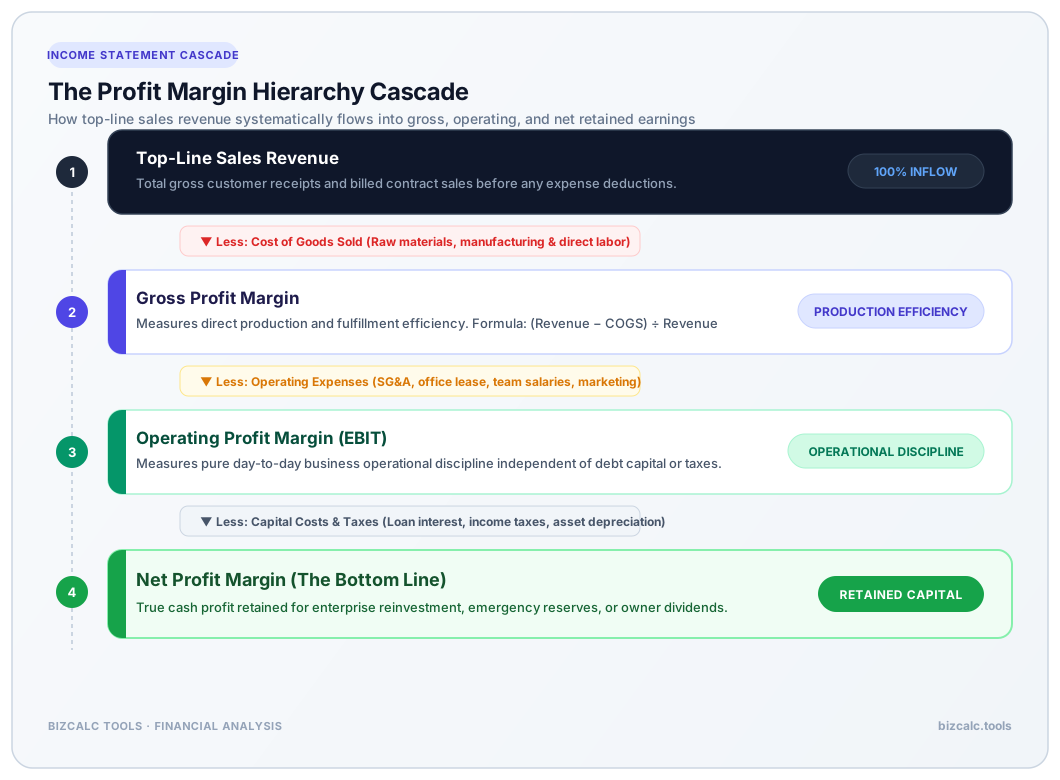
The reason there are multiple profit margin metrics — rather than just one — is that different categories of costs reveal different things about business performance. Stripping out costs layer by layer, from the most direct to the most comprehensive, gives you a multi-dimensional view of where your money is going and which part of your cost structure is creating or destroying value.
The three standard profit margins, in order from most to least direct:
Gross profit margin — revenue minus the direct cost of producing your product or service
Operating profit margin — revenue minus direct costs and all operating expenses
Net profit margin — revenue minus all costs, including tax and interest
Each successive margin includes more costs and therefore tells a more complete — but also more complex — story about profitability.
Gross Profit Margin
Gross profit margin is the foundational profitability metric. It measures what percentage of your revenue remains after accounting for the direct costs of producing your goods or delivering your services — before any overhead, sales costs, or administrative expenses are considered.
where Gross Profit = Revenue − Cost of Goods Sold (COGS)
What Is Included in Cost of Goods Sold?
Cost of Goods Sold (COGS) — sometimes called Cost of Sales or Cost of Revenue — includes only the direct costs attributable to producing the goods or services sold. The exact components vary by business type, but the principle is consistent: COGS captures the variable and semi-variable costs that scale directly with your output.
For a product business:
Raw materials and components
Direct manufacturing labour (factory floor workers, not management)
Manufacturing overhead directly tied to production (machine depreciation, factory utilities)
Packaging and direct distribution costs
Freight and import duties on raw materials purchased
For a service business:
Direct labour of the people delivering the service (salaries, freelancer costs)
Software licences or tools used specifically for client delivery
Subcontractor costs for client work
Direct client-related travel and expenses
What is NOT included in COGS:
Office rent and utilities
Marketing and advertising costs
Sales team salaries
Administrative staff costs
Interest on debt
Income taxes
This distinction matters enormously. Many small business owners — especially in services — inadvertently treat all their costs as COGS, which produces an artificially low gross margin and obscures the true operational efficiency picture.
Gross Margin Worked Example
A software business (SaaS) generates $120,000 per month in subscription revenue. Its direct costs — server hosting, payment processing fees, and two customer support staff entirely dedicated to service delivery — total $18,000 per month.
Gross Profit = $120,000 − $18,000 = $102,000
Gross Margin = $102,000 ÷ $120,000 × 100 = 85%
This means 85 pence of every pound of revenue remains after covering the cost of delivering the service — a strong gross margin for a SaaS business.
Now consider a retail clothing business with $80,000 monthly revenue and $44,000 in COGS (stock purchase cost plus fulfilment):
Same revenue tier, drastically different gross margin — because the nature of the product business requires significant direct cost.
What Is a Good Gross Profit Margin?
Gross margins vary widely by industry. Comparing your gross margin against your industry average tells you whether your pricing and production cost structure is competitive:
Industry
Typical Gross Margin
SaaS / Software
70–90%
Professional Services
55–75%
eCommerce / Retail
30–55%
Manufacturing
25–45%
Food & Beverage Manufacturing
20–40%
Grocery / Food Retail
20–35%
Restaurants
25–40%
Construction
15–30%
If your gross margin is significantly below your industry benchmark, there are two likely causes: your production or delivery costs are too high, or your prices are too low. Either way, this is the first problem to diagnose and fix — because a poor gross margin cannot be compensated for by efficiency improvements downstream.
💰
Profit Margin Calculator
Calculate your gross margin from revenue and cost figures instantly. See if your pricing and production costs are competitive.
Operating profit margin takes the analysis one level deeper by incorporating all operating expenses — not just the direct costs of production, but also the overhead expenses required to run the business: rent, marketing, non-production salaries, software, professional fees, and administrative costs.
This means 35p of every pound earned is left after covering all the day-to-day costs of running the business — before paying taxes or debt service.
What Does Operating Margin Reveal?
Operating margin is the most useful metric for assessing the operational efficiency and scalability of a business. It answers: "How well does this business manage its overhead relative to the revenue it generates?"
A key pattern to watch is the relationship between gross margin and operating margin:
Large gap between gross margin and operating margin = high overhead structure. The business has strong pricing power and low direct costs, but is spending heavily on running costs. This is the signature of a fast-growing startup: high gross margin, heavy spending on sales, marketing, and headcount, creating a lower operating margin.
Narrow gap between gross margin and operating margin = lean overhead structure. The business runs efficiently, with operating costs well-controlled relative to revenue. This is the hallmark of a mature, profitable operation.
As a business scales, operating margin should improve over time — because fixed overhead costs like rent, management salaries, and core software are spread across a growing revenue base. If operating margin is not improving as revenue grows, it is a signal that costs are scaling proportionally with revenue, which implies either pricing pressure or operational inefficiency.
Industry Operating Margin Benchmarks
Industry
Typical Operating Margin
SaaS / Software
15–35%
Professional Services
15–30%
eCommerce
5–15%
Retail
3–10%
Manufacturing
8–18%
Restaurants
3–9%
Construction
3–8%
Net Profit Margin
Net profit margin is the final measure of profitability — what remains after literally every cost has been deducted from revenue: production costs, operating expenses, interest payments on debt, and income taxes.
Net Profit Margin Formula:
Net Margin (%) = Net Income ÷ Revenue × 100
where: Net Income = Operating Profit − Interest Expense − Tax
Net Margin Worked Example
Our SaaS business has $42,000 operating profit. It carries a business loan with $1,500/month interest payments and has a corporation tax liability of $8,500 for the month.
Net Income = $42,000 − $1,500 − $8,500 = $32,000
Net Margin = $32,000 ÷ $120,000 × 100 = 26.7%
This $32,000 per month, or $384,000 annually, is the actual profit available to reinvest in the business, distribute to shareholders, or retain as capital reserves.
What Is a Good Net Profit Margin?
Net margins vary significantly by industry, capital structure, and tax position:
Industry
Typical Net Margin
SaaS / Software
15–30%
Professional Services
10–20%
eCommerce
2–8%
Retail
2–6%
Manufacturing
5–12%
Restaurants
3–9%
Construction
4–8%
A well-run retail business with 5% net margin might be a more efficient operator than a service firm with 12% net margin if you factor in capital intensity, working capital requirements, and risk profile. Context always matters.
Net Margin as an Investment Metric
Net profit margin is the metric most scrutinised by investors and acquirers because it represents the actual return generated from the revenue base. Two businesses with identical revenue and different net margins will command very different valuations:
Business A: $2M revenue, 20% net margin = $400K profit
Business B: $2M revenue, 5% net margin = $100K profit
If both are valued at 10× earnings (a common multiple for small business acquisitions), Business A is worth $4M and Business B is worth $1M — despite identical revenue. This is why improving net margin is one of the highest-leverage activities a business owner can undertake before seeking investment or preparing for sale.
Margin vs. Markup: A Critical Distinction
Margin and markup are two of the most frequently conflated terms in business finance. They measure related but different things, and confusing them leads to systematic pricing errors.
Markup is calculated as a percentage of cost:
Markup (%) = (Selling Price − Cost) ÷ Cost × 100
Margin is calculated as a percentage of selling price:
Margin (%) = (Selling Price − Cost) ÷ Selling Price × 100
The same price point produces different percentages under each method:
Cost
Selling Price
Markup %
Gross Margin %
$10
$12.50
25%
20%
$10
$15.00
50%
33%
$10
$20.00
100%
50%
$10
$25.00
150%
60%
A 50% markup does not produce a 50% gross margin — it produces a 33% margin. A business targeting a 50% gross margin needs to apply a 100% markup to its costs.
This distinction matters enormously for retail businesses that set prices using markup percentages. If your buying team uses a "50% markup" rule and your finance team is targeting a "50% margin", there is a systematic 17-percentage-point gap in your pricing — one that compounds across every product you sell.
🏷️
Markup vs Margin Calculator
Use our calculator to convert between markup and margin instantly and ensure every pricing decision uses the correct metric.
How the Three Margins Work Together: The Profitability Waterfall
The three profit margins form a "waterfall" — each successive metric subtracts another layer of costs:
P&L Statement Line Item
Financial Amount
Proportion of Sales
Margin Classification
Gross Invoiced Revenue
$120,000
100.0%
Baseline Top-Line Revenue
Less: Cost of Goods Sold (COGS)
−$18,000
15.0%
Direct Unit Production Costs
Gross Profit
$102,000
85.0%
Gross Profit Margin
Less: Operating Overhead (OpEx)
−$60,000
50.0%
Fixed SG&A, Payroll, Facilities
Operating Profit (EBIT)
$42,000
35.0%
Operating Profit Margin
Less: Debt Financing & Income Taxes
−$10,000
8.3%
Interest Expense & Corporate Taxes
Net Income (Bottom Line)
$32,000
26.7%
Net Profit Margin
Reading down this waterfall reveals exactly where value erodes between revenue and profit. A business with a high gross margin but low operating margin has an overhead problem. A business with a good operating margin but poor net margin has a debt or tax efficiency problem. The waterfall makes these problems immediately visible.
Which Margin to Focus On — and When
Focus on Gross Margin When:
Evaluating whether your pricing covers your production costs
Comparing the profitability of different products or service lines
Negotiating with suppliers on raw material costs
Assessing whether a new product launch is viable
Gross margin is the first line of defence. If it is low, no amount of operational efficiency or financial engineering will save the business.
Focus on Operating Margin When:
Assessing how efficiently the business is being run day-to-day
Making hiring or overhead investment decisions
Benchmarking against competitors at scale
Evaluating whether fixed costs are growing faster than revenue
Operating margin is the metric that improves (or worsens) as the business scales. Watching it over time tells you whether your business model is actually becoming more efficient.
Focus on Net Margin When:
Reporting to investors or preparing for fundraising
Comparing overall profitability against industry peers
Evaluating the after-tax return the business is generating for its owners
Preparing for a business sale or valuation exercise
Net margin is the definitive measure of what the business actually earns — the number that drives valuation, investment decisions, and owner wealth.
Strategies for Improving Each Profit Margin
Improving Gross Margin
Raise prices. This is the highest-leverage action available. Even a 5% price increase flows almost entirely to gross profit — it does not increase COGS. Test with a single product or client segment before rolling out broadly.
Reduce direct input costs. Renegotiate supplier contracts, consolidate purchasing to increase leverage, explore alternative materials or components. Be careful not to compromise the quality that underpins your pricing.
Eliminate low-margin products. If one product line has a 15% gross margin and another has a 55% gross margin, your blended gross margin is being dragged down by the first. Consider discontinuing, repricing, or restructuring the underperforming line.
Improve production efficiency. Reduce waste, improve yield rates, and eliminate steps in your production process that add cost without adding value.
Improving Operating Margin
Audit and rationalise overhead. A regular audit of operating expenses — particularly software subscriptions, professional services, and administrative headcount — typically reveals 10–20% of costs that are either redundant or delivering insufficient value.
Scale revenue without scaling costs proportionally. This is the essence of operational leverage. If you can grow revenue 20% while holding operating expenses flat, your operating margin expands significantly.
Automate repetitive processes. Marketing automation, accounts payable automation, reporting automation — every hour of management time redirected from repetitive tasks to high-value activity is an improvement in operational efficiency.
Improve sales productivity. More revenue per salesperson, per marketing pound, or per customer acquired directly improves operating margin without requiring cost cuts.
Improving Net Margin
Refinance expensive debt. High-interest loans significantly erode net margin. Refinancing at lower rates, or paying down the highest-cost debt first, improves net margin without touching the operating model.
Tax efficiency planning. Working with a qualified accountant or tax advisor to ensure your business is structured tax-efficiently — using all available reliefs, allowances, and deferral mechanisms — can meaningfully improve net margin.
Improve operating margin. Every improvement in operating margin flows directly to net margin. The most sustainable path to improving net margin is through the operational improvements described above.
Frequently Asked Questions
What is the difference between profit margin and profit?
Profit is an absolute number ($32,000 per month). Profit margin is that number expressed as a percentage of revenue (32,000 ÷ 120,000 = 27%). Margins enable comparison across businesses of different sizes — a $32,000 profit at $120,000 revenue (27% margin) is a much stronger performance than a $32,000 profit at $500,000 revenue (6.4% margin).
Why can a business have high gross margin but negative net margin?
Because gross margin only subtracts direct production costs. A business can have excellent pricing power and low production costs (high gross margin) while spending heavily on marketing, headcount, and infrastructure (high operating expenses), resulting in an operating loss. Many early-stage technology companies have this profile: 75%+ gross margins with net losses, because they are investing heavily in growth.
How often should I calculate my profit margins?
Monthly, as part of your regular financial review. Margins are most useful as trend data — a single month's margin tells you where you stand; six months of margin data tells you whether you are improving or deteriorating. Build a simple tracking sheet (or use your accounting software's built-in reporting) to watch gross, operating, and net margin month over month.
Can profit margins be too high?
Extremely high margins — particularly gross margins above 90% — can attract competitive entry, as they signal that prices significantly exceed costs. In sustainably competitive markets, high margins tend to attract competitors who undercut pricing. However, high margins backed by genuine differentiation, switching costs, or network effects are durable and desirable. The goal is not to minimise margins, but to maintain them at a level that reflects genuine competitive advantage.
What is EBITDA and how does it relate to operating margin?
EBITDA stands for Earnings Before Interest, Tax, Depreciation, and Amortisation. It is similar to operating profit but also adds back depreciation and amortisation — non-cash charges that reduce reported earnings but do not represent cash outflows in the period. EBITDA is widely used as a proxy for cash generation and is a common valuation basis for small business acquisitions (e.g. "the business sold for 6× EBITDA").
📊
Complete Profitability Picture
Use our EBITDA Calculator alongside the profit margin calculator for a complete profitability and cash generation picture.
Without changing prices, margin improvement comes from cost reduction: lower COGS through supplier negotiations or production efficiency, lower operating expenses through overhead audits and process automation, lower interest costs through debt refinancing, and lower tax through professional tax planning. In practice, the most powerful combination is modest price increases plus selected cost reductions, which compound in their effect on profit margins.
Calculate Your Profit Margins Now
Understanding your gross, operating, and net profit margins is not optional for a sustainable business — it is the minimum financial literacy required to make pricing decisions, manage costs, attract investment, and build a business that creates lasting value.
💰
Profit Margin Calculator
Calculate all three margins from your revenue and cost figures in seconds.
The numbers are already in your business. You just need the right tools to read them clearly.
Frequently Asked Questions
What is a profit margin?
Profit margin is a ratio that measures how much profit a business keeps from its total revenue. It shows the financial health and efficiency of the company.
What are the three types of profit margins?
The three main types are Gross Profit Margin (revenue minus direct costs), Operating Profit Margin (revenue minus direct costs and operating expenses), and Net Profit Margin (revenue minus all expenses, including taxes).
How is profit margin different from markup?
Markup is a percentage added to the cost of a product to determine its selling price. Profit margin is the percentage of the selling price that is profit.
What is a 'good' net profit margin?
It depends on the industry. A 5% margin is considered low (typical for grocery stores), a 10% margin is average, and a 20% margin is considered excellent.
How can I increase my profit margin?
You can increase profit margins by raising your selling prices, negotiating better rates with suppliers to lower your cost of goods sold, or reducing your operating expenses.
#profit margins#gross margin#net margin#operating margin#financial analysis#small business finance