Master the marketing ROI formula to evaluate campaign performance. Calculate simple and customer-lifetime ROI with benchmarks and worked examples.
BT
Bizcalc Team
·March 16, 2026
Quick Answer & Key Summary
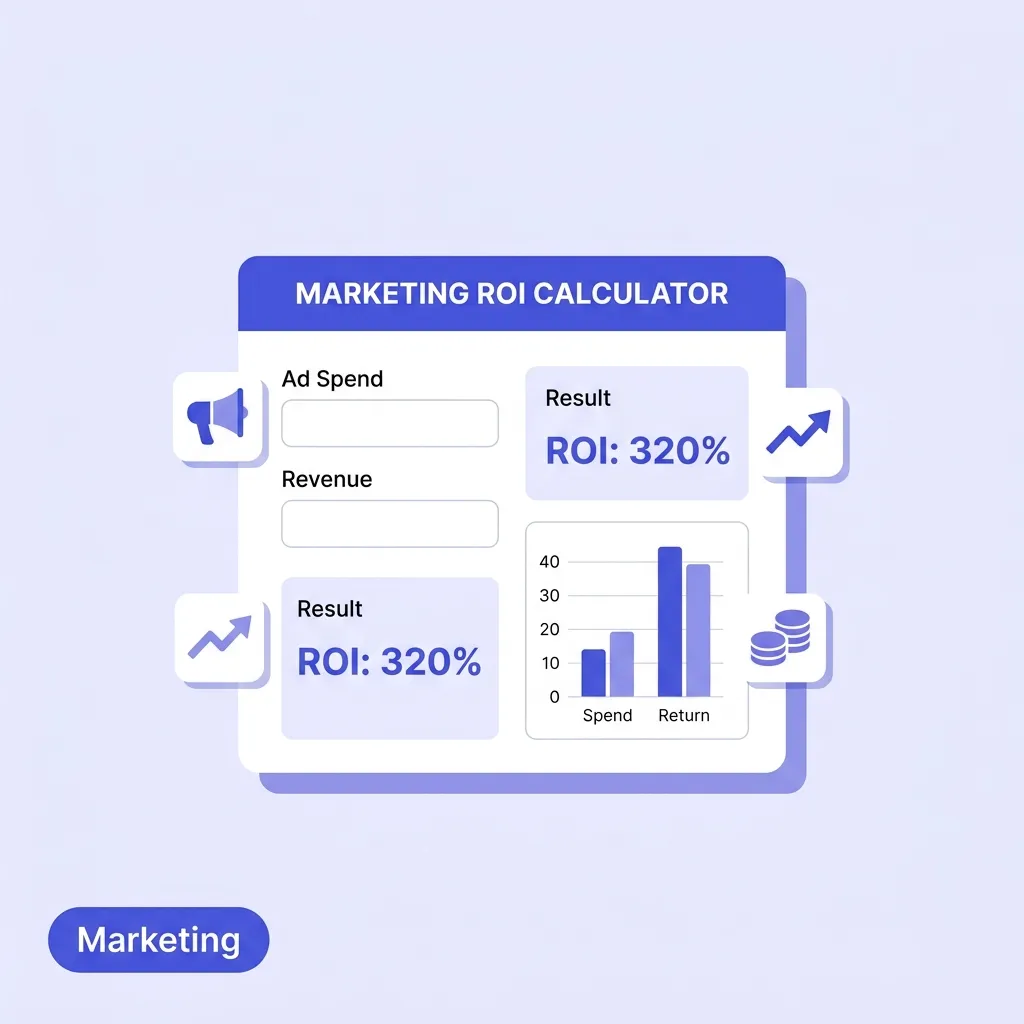
Quick Answer: Marketing Return on Investment (ROI) evaluates campaign profitability by calculating the net revenue gains generated directly by marketing programs relative to the total capital invested in them.
• Key Formula / Standard:Marketing ROI = [(Incremental Sales Revenue − Marketing Campaign Costs) ÷ Marketing Campaign Costs] × 100 • Rule of Thumb / Benchmark: A 5:1 revenue-to-cost ratio (representing a 400% simple marketing ROI) is considered strong across most industries.
"Half the money I spend on advertising is wasted; the trouble is I don't know which half."
John Wanamaker said this over a century ago. In the era of television, print, and radio — where tracking was impossible — it was a profound and honest admission. But in the digital age, where every click, session, conversion, and purchase can be attributed with remarkable precision, there is no longer any excuse for not knowing which half of your marketing spend is working.
Marketing ROI — Return on Investment — is the metric that answers this question definitively. It tells you whether the money you are spending on campaigns, channels, and content is generating more value than it costs. When calculated correctly and consistently, it is the most powerful tool available for allocating your marketing budget, justifying spend to stakeholders, and building a growth engine that compounds over time.
This guide covers everything: the correct marketing ROI formula, the difference between ROI and ROAS, how to define "return" for different types of campaigns, the challenges of measurement, attribution models, channel-level benchmarks, and the strategies that consistently produce the highest returns.
💰
ROI Calculator
Calculate the true return on any marketing campaign. Input all cost components and get your fully loaded ROI instantly.
Marketing ROI is the financial return generated by marketing activities relative to the cost of those activities. At its core, it measures whether your marketing investment is profitable — whether the revenue and profit it generates exceeds what you spent to produce that output.
A positive marketing ROI means your campaigns are generating more value than they cost. A negative marketing ROI means your marketing spend is destroying capital — you would be better off not running the campaign at all.
Why Marketing ROI Is More Complex Than Standard ROI
The standard Return on Investment formula is straightforward:
Marketing ROI follows the same logic, but with two important complications:
1. Defining "net profit" is non-trivial. In marketing, the return from a campaign is often revenue, not profit directly. To calculate true ROI, you need to apply your gross margin to that revenue to get gross profit — then subtract the marketing investment to get net return.
2. Attributing revenue to a specific campaign is difficult. A customer may have interacted with your brand through a blog post, a social ad, a retargeting campaign, and a branded search before converting. Which campaign gets the credit for the ROI? This attribution challenge is addressed later in this guide.
The Marketing ROI Formula
There are two versions of the marketing ROI formula. Which one you use depends on whether you are working from revenue data or gross profit data.
Version 1: Gross Profit-Based Marketing ROI (Recommended)
Marketing ROI (%) = (Gross Profit from Campaign − Total Marketing Cost) ÷ Total Marketing Cost × 100
Total Marketing Cost = all costs attributable to the campaign (see "What to Include" below)
This is the correct formula for measuring whether a campaign is genuinely profitable, because it accounts for the cost of the goods or services sold — not just the revenue generated.
Version 2: Revenue-Based Marketing ROI
Marketing ROI (%) = (Campaign Revenue − Total Marketing Cost) ÷ Total Marketing Cost × 100
This version uses revenue rather than gross profit. It is simpler but produces inflated ROI figures that do not reflect true profitability — because they do not account for the cost of delivering what was sold. A campaign with a 300% revenue-based ROI might have a negative gross-profit-based ROI if your margins are very low.
Use the gross profit version for internal decision-making. Use the revenue version only when comparing against industry benchmarks that also use revenue-based calculations (most published marketing ROI benchmarks use revenue).
What to Include in Total Marketing Cost
To calculate meaningful marketing ROI, your cost figure must be fully loaded — not just ad spend:
Paid media spend — Google Ads, Meta, LinkedIn, TikTok, programmatic, etc.
Agency and freelancer fees — creative, copywriting, media buying, strategy
Marketing software — your marketing automation, analytics, email platform, and landing page tools, prorated by campaign
Content production costs — photography, videography, graphic design fees
Marketing team time — the salary cost of the internal team hours spent on the campaign
Influencer and partnership fees — flat fees, commission, gifted products at cost
PR and earned media costs — fees for PR agencies or in-house PR staff time
💰
ROI Calculator
Enter all your campaign cost components and revenue to get your fully loaded marketing ROI percentage in seconds.
Let us walk through a complete, realistic campaign calculation.
Scenario: You run a 90-day content marketing and paid search campaign to promote a software product.
Campaign Costs:
Cost Item
Amount
Google Ads spend
$8,500
Content writing (10 articles)
$3,000
SEO agency fee (3 months)
$4,500
Graphic design for ads
$800
Marketing team time (est.)
$2,200
Total Campaign Cost
$19,000
Campaign Results:
New customers acquired: 42
Average first-year contract value: $1,200
Total revenue attributed: 42 × $1,200 = $50,400
Gross margin: 72%
Gross Profit = $50,400 × 72% = $36,288
Marketing ROI Calculation:
ROI = ($36,288 − $19,000) ÷ $19,000 × 100
ROI = $17,288 ÷ $19,000 × 100 = 91%
This campaign generated a 91% return — for every $1 invested, the business generated $1.91 back in gross profit. A solid positive result that clearly justifies the investment.
Now consider what happens if you only counted ad spend as the "cost": $36,288 − $8,500 = $27,788; $27,788 ÷ $8,500 = 327% ROI. This inflated figure might feel satisfying but would lead to incorrect budget allocation decisions — because it ignores $10,500 of real costs.
Marketing ROI vs ROAS — Understanding the Difference
Return on Ad Spend (ROAS) is frequently confused with marketing ROI. They measure related but fundamentally different things, and using them interchangeably leads to poor decisions.
Marketing ROI
ROAS
Measures
Net profitability of campaign
Revenue efficiency of ad spend
Includes COGS?
Yes (via gross margin)
No
Includes all marketing costs?
Yes
No — ad spend only
Expressed as
Percentage (%)
Ratio (e.g. 4:1) or multiple (4×)
Best used for
Strategic budget decisions, board reporting
Optimising bids within an ad platform
Formula
(Gross Profit − Total Cost) ÷ Total Cost
Revenue ÷ Ad Spend
ROAS Example
Using the same campaign above:
Revenue: $50,400
Google Ads spend: $8,500
ROAS = $50,400 ÷ $8,500 = 5.93 (or 593%)
This tells you that for every $1 spent on Google Ads specifically, you generated $5.93 in revenue. Use this to compare the efficiency of individual ad channels against each other — but never use it to conclude whether the campaign is actually profitable.
The practical rule: Use ROAS — via our ROAS Calculator — to optimise within channels. Use Marketing ROI to decide which channels to fund and how to report overall marketing performance.
What Is a Good Marketing ROI?
The widely cited industry benchmark for marketing ROI is 5:1 — meaning $5 of revenue returned for every $1 spent on marketing. That translates to a 400% revenue-based ROI (or roughly 100–200% gross-profit-based ROI depending on your margins).
However, benchmarks vary significantly by channel, industry, and campaign type:
Channel / Campaign Type
Typical ROI Range
Email marketing
3,600%+ (revenue-based)
SEO and content marketing
200–500% (long-term, 12–24 month view)
Paid search (Google Ads)
100–400% (revenue-based)
Social media advertising
50–250% (revenue-based)
Display advertising
50–180% (revenue-based)
Influencer marketing
100–600% (highly variable)
Trade shows and events
30–150% (revenue-based)
TV / traditional media
30–100% (very variable)
Email marketing's extraordinary benchmark reflects its near-zero marginal cost per send for established lists. SEO's benchmarks require a longer measurement window — search traffic compounds over 12–24 months and initial ROI calculations undercount the long-tail value.
Defining "Return" for Different Campaign Types
The most intellectually honest challenge in marketing ROI is defining what "return" means for campaigns that are not designed for immediate direct-response conversion.
Direct Response Campaigns
The clearest case. Campaigns designed to generate immediate conversions — purchases, sign-ups, bookings. Google Search ads, ecommerce retargeting, and direct mail with unique phone numbers all fall here. Measure revenue and gross profit directly attributed to the campaign within a defined conversion window (typically 7–30 days).
Lead Generation Campaigns
B2B campaigns that generate leads rather than immediate customers. The "return" measurement requires tracking leads through the sales pipeline: lead → qualified lead → opportunity → closed deal. This may take 3–12 months. Measure ROI as the gross profit from deals closed that were sourced by the campaign, divided by the campaign cost.
Brand Awareness Campaigns
Campaigns designed to build recognition, trust, and top-of-mind presence rather than immediate conversion. PR campaigns, podcast sponsorships, brand-focused social content, and out-of-home advertising fall here. Measuring their ROI requires indirect methods:
Brand search volume — does branded search term volume increase post-campaign?
Aided/unaided brand recall — survey-based measurement in the target audience
Organic conversion rate — do brand-exposed audiences convert at higher rates when they do enter the funnel?
Incrementality testing — compare conversion rates in markets or segments that saw the campaign vs control groups that did not
These proxy metrics do not give you a clean ROI percentage, but they provide evidence of whether the brand investment is creating measurable commercial impact.
Content Marketing and SEO
Content compounds. A blog post published today may generate most of its traffic and conversions 12–18 months from now, as it climbs search rankings. Measuring the ROI of a content programme on a campaign-by-campaign basis will systematically undervalue it. Better approaches:
Measure organic channel ROI in aggregate: total organic revenue ÷ total SEO and content investment
Track revenue per organic session over time as content quality improves
The Attribution Problem — Which Channel Gets the Credit?
The most significant challenge in marketing ROI measurement is attribution — determining which touchpoints along the customer journey deserve credit for a conversion, and in what proportion.
Consider a typical digital customer journey:
Sees a Facebook awareness ad → scrolls past
Reads a blog post found via Google search two weeks later
Gets retargeted on Instagram → clicks
Receives a promotional email → clicks
Types the brand name into Google → clicks branded search ad → purchases
This customer touched five marketing activities before buying. Which one gets the ROI credit?
No attribution model is perfect. Last-click attribution — the default in most analytics tools — systematically undervalues awareness and consideration-stage activities (social, content, PR) and overvalues bottom-funnel channels (branded search, direct). This leads most businesses to over-invest in bottom-funnel channels and under-invest in the awareness activities that fill the top of the funnel.
The most practical approach for most businesses: use last-click for day-to-day channel optimisation (it is available everywhere) and linear or position-based for strategic budget allocation decisions (it gives a more honest view of the full customer journey).
5 Strategies to Improve Your Marketing ROI
1. Start with Conversion Rate Optimisation Before Scaling Spend
The fastest way to improve marketing ROI is to convert more of the traffic you are already paying for before spending more. Doubling your landing page conversion rate from 2% to 4% doubles your number of conversions without increasing ad spend — effectively halving your cost per acquisition and doubling your ROI.
Audit your landing pages, checkout flow, lead capture forms, and email onboarding sequences. A/B test systematically. The efficiency gains from CRO compound with every subsequent campaign you run.
2. Invest in High-LTV Customer Segments
Not all customers have the same lifetime value. If your analytics reveal that customers acquired through certain channels, campaigns, or keywords have significantly higher LTV — because they churn less, buy more, or upgrade more often — redirect budget toward acquiring more of those high-value customers even if their initial acquisition cost is slightly higher.
The ROI calculation that matters is not (first purchase gross profit − campaign cost) but (total LTV − CAC). Use our ROI Calculator to model ROI across different LTV scenarios.
3. Build Compounding Organic Channels
Paid channels deliver immediate but diminishing returns — as you scale spend, CPCs and CPAs rise. Organic channels — content marketing, SEO, referral programmes — have the opposite dynamic: they build compounding value over time at near-zero marginal cost per additional user.
Businesses that invest consistently in content marketing for 18–24 months typically see organic channel ROI of 200–500%, far exceeding their paid channel returns. The key is patience and consistency: organic channels require sustained investment before the returns are visible.
4. Improve Campaign Attribution and Measurement Infrastructure
Poor measurement leads to poor decisions. If you do not know where your customers are coming from, you will consistently over-invest in the wrong channels. Implement UTM tagging on every campaign link, configure goal tracking in Google Analytics (or GA4), integrate your CRM with your analytics platform, and build a basic marketing performance dashboard.
The investment in measurement infrastructure pays for itself many times over through better allocation decisions.
5. Reduce Waste by Cutting Consistently Negative ROI Activities
Many marketing budgets carry historical activity that has never been evaluated for ROI — sponsorships, trade show appearances, print advertising, certain social channels — because they were set up years ago and no one has formally reviewed their performance.
Conduct a full audit of your marketing spend:
Calculate ROI for every significant activity or channel
Rank them by ROI
Cut or drastically reduce the bottom 20%
Reallocate budget to the top performers
This reallocation exercise often produces a 30–50% improvement in blended marketing ROI without any change in total spend.
Frequently Asked Questions
What is a good ROI for a marketing campaign?
The commonly cited benchmark is a 5:1 ratio — $5 of revenue for every $1 spent — which equates to a 400% revenue-based ROI. On a gross profit basis (which is the more accurate measure), a positive ROI above 100% is generally considered strong. However, benchmarks vary significantly by channel, industry, and business model. Email marketing routinely produces 10:1 or better; brand awareness campaigns may produce lower measurable ROI but significant unmeasured brand equity.
What is the difference between ROI and ROAS?
ROI measures the net profitability of a campaign after accounting for all costs, including the cost of goods sold. ROAS measures the revenue generated per pound of advertising spend — excluding COGS, team costs, and other marketing expenses. ROAS is useful for optimising within ad platforms; ROI is the correct metric for assessing overall campaign profitability and making strategic budget decisions.
How do I calculate ROI for B2B campaigns with long sales cycles?
Track leads from campaign source through your CRM pipeline to closed deal. Calculate ROI using the gross profit from deals that were originally sourced by the campaign, divided by the campaign cost. This may require measuring over a 6–12 month window after the campaign ends. Many B2B businesses use a "pipeline influenced" metric — the total value of pipeline deals that were touched by a campaign — as a leading indicator before deals close.
Should I measure ROI by campaign or by channel?
Both. Campaign-level ROI tells you which specific executions are working and guides tactical decisions. Channel-level ROI tells you whether to increase or decrease investment in paid search vs social vs content vs events overall, and informs strategic budget allocation across your annual marketing plan. Report both metrics at different cadences: campaign ROI after each campaign ends, channel ROI quarterly.
How do I measure the ROI of content marketing and SEO?
Measure organic channel ROI in aggregate over a 12–24 month window: (total gross profit from organic-attributed revenue) ÷ (total SEO and content investment). Track organic session volume, organic conversion rate, and revenue per organic session over time. For individual content pieces, track page views, assisted conversions (pages visited before a conversion on any channel), and direct conversions from organic search. Use UTM parameters on content promotion links to separate organic search traffic from social distribution.
Can marketing ROI be negative and the campaign still be worth running?
Yes — in certain circumstances. Brand awareness campaigns in new markets often produce negative direct-response ROI in the short term but lay the groundwork for future conversions. Customer acquisition ROI that looks negative on the first purchase may be strongly positive over the customer's lifetime if LTV is high. The key is to have a clear hypothesis for why you expect the negative short-term ROI to produce positive long-term returns, and to define the specific metrics and timeframes that will be used to validate or invalidate that hypothesis.
Measure Every Campaign. Optimise Relentlessly.
The businesses that consistently outperform their competitors on growth are almost never the ones spending the most — they are the ones spending most efficiently. Marketing ROI is the scorecard that distinguishes efficient spend from waste.
Start with the basics: calculate fully loaded ROI for your three largest marketing activities this quarter using our ROI Calculator. You will almost certainly find that one or two activities are dramatically outperforming the rest, and one or two are silently destroying budget. Reallocate accordingly.
Pair your ROI analysis with our ROAS Calculator to optimise channel-level ad efficiency, our CAC Calculator to measure the full cost of each new customer, and our LTV Calculator to ensure your acquisition investment is justified by long-term customer value.
Wanamaker's lament about not knowing which half of his advertising was wasted died with the analogue era. You have the tools. The only question is whether you use them.
📊
ROAS Calculator
Measure the revenue efficiency of your ad spend channel by channel. Pair with ROI for a complete picture of campaign performance.
Return on Investment (ROI) in marketing measures the profit generated by a specific marketing campaign compared to the cost of running that campaign.
How do you calculate marketing ROI?
Subtract the marketing cost from the sales growth (revenue), divide that number by the marketing cost, and multiply by 100. Formula: ((Sales Growth - Marketing Cost) / Marketing Cost) * 100.
What is a good marketing ROI?
A widely accepted benchmark for a 'good' marketing ROI is 5:1, meaning you earn $5 for every $1 spent. An ROI of 10:1 is considered exceptional.
How do you measure marketing ROI for a B2B business?
In B2B, sales cycles are long. You must track leads through the entire funnel using a CRM, assigning a monetary value to leads or tracking them until they become closed-won deals.
What are the challenges of calculating marketing ROI?
The biggest challenges are attribution (knowing which specific ad led to the sale) and accounting for long-term brand building that may not result in immediate revenue.
#marketing roi#roi#roas#return on investment#marketing metrics#campaign measurement